
Verizon’s Fiber and 5G Expansion: Infrastructure Bets, Competitive Friction, and the Next Phase of Connectivity Economics
Verizon’s recent acquisitions and capital deployment underscore a strategic push into fiber broadband and advanced 5G, but intensifying competition, shifting enterprise demand, and capital constraints challenge future margin expansion. The company’s network scale, technology investments, and share buybacks frame both its resilience and its exposure to industry disruption.
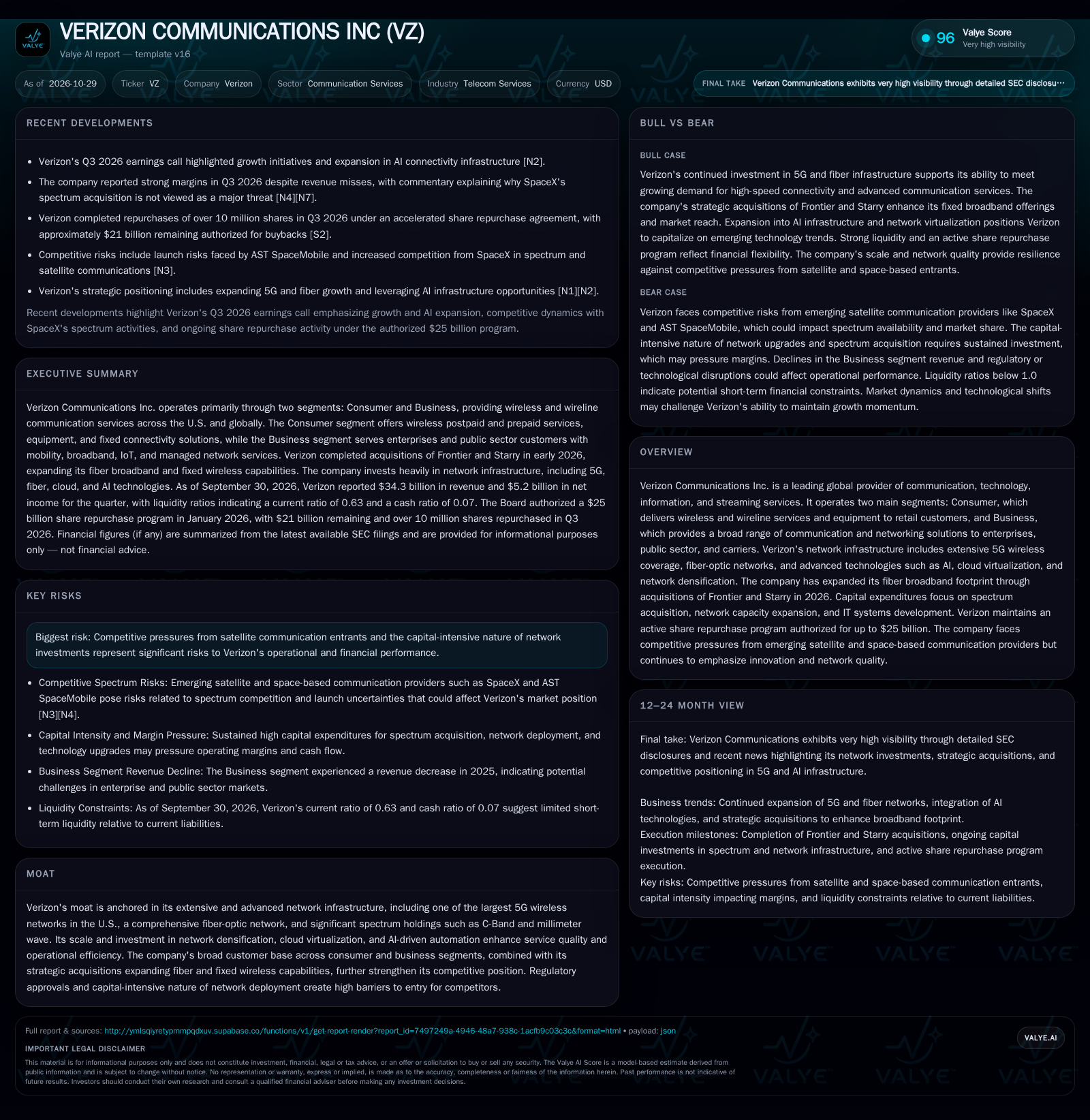
Verizon has expanded its fiber and fixed wireless footprint through the acquisitions of Frontier and Starry, backed by substantial capital investment and a continued focus on 5G and AI-driven infrastructure. Execution on integration, network monetization, and adaptability to new connectivity models will determine whether Verizon’s infrastructure moat holds firm or narrows in the coming cycle. [S1] [S2] [N2]
Verizon’s operating model is in the midst of a strategic transition, marked by aggressive fiber and 5G investment, the integration of new broadband assets, and a push to harness emerging AI-driven connectivity. While the Consumer segment continues to deliver growth, the Business unit’s recent revenue contraction and ongoing capital demands expose the tension between scale-driven network advantages and disruptive forces like satellite communications. The next phase for Verizon will turn on its ability to monetize infrastructure, adapt to new enterprise needs, and manage capital intensity without eroding potential financial flexibility.
Recent Acquisitions, Segment Divergence, and Capital Allocation: What’s Shaping Verizon’s 2026 Outlook
The most significant recent facts shaping Verizon’s outlook are its January 2026 acquisitions of Frontier and Starry, which have broadened its fiber broadband and fixed wireless access footprint. This expansion directly supports the company’s ambition to anchor both consumer and business connectivity on high-capacity, low-latency infrastructure. In 2025, Consumer segment revenues increased by 3.8% to $106.8 billion, while Business segment revenues declined 1.6% to $29.1 billion, signaling divergent trends across end markets. [S1]
Verizon’s Q3 2026 liquidity snapshot shows $4.495 billion in cash and equivalents against $66.271 billion in current liabilities, resulting in a current ratio of 0.63 and a cash ratio of 0.07. This metric reflects the company’s capital-intensive model and the short-term funding pressure inherent in large-scale infrastructure operators. [S2]
The company’s active $25 billion share repurchase program—with $21 billion remaining after buying back over 10 million shares in Q3—suggests management’s commitment to capital return, even as it juggles major infrastructure investment. [S2]
Verizon’s network investment priorities remain centered on 5G, fiber buildout, and AI-driven infrastructure, with recent earnings calls explicitly highlighting these as growth engines. [N2]
Balancing Fixed Cost Leverage and Pricing Power in Infrastructure Economics
Verizon’s business model is fundamentally shaped by high fixed costs—network buildout, spectrum acquisition, and ongoing densification—offset by the potential for substantial operating leverage if network utilization remains high. Revenue is generated from a mix of recurring wireless and wireline service fees, equipment sales, and, increasingly, value-added network solutions for enterprises. The Consumer segment’s growth, driven by wireless data and broadband, indicates that volume and mix shifts toward higher-value services can support top-line expansion, provided churn remains low and ARPU (average revenue per user) is stable or rising.
The company’s recent capital expenditures, totaling $17 billion in 2025, are directed at both maintaining competitive parity (network speed, coverage) and enabling new revenue streams (private networks, IoT, AI-powered solutions). However, the flip side of this investment is persistent margin pressure: as new technologies become table stakes, incremental returns on capital may diminish unless Verizon can differentiate through service quality, pricing, or ecosystem integration.
Verizon’s scale allows for some procurement and operating efficiency, but the company’s ability to pass through cost increases or monetize new capabilities—such as low-latency AI infrastructure—will be tested by both traditional rivals and new entrants. Capital needs remain substantial, and the balance between funding growth, servicing debt, and returning capital to shareholders is delicate in a rising rate or competitive environment.
Fiber, 5G, and Satellite Alternatives: Challenges to Verizon’s Network Moat
Verizon’s historical moat is built on a dense, high-quality wireless and fiber network, deep spectrum holdings (including C-Band and millimeter wave), and regulatory barriers that protect incumbents from easy displacement. The recent acquisitions of Frontier and Starry further reinforce the company’s fixed broadband presence, expanding its reach and service breadth. [S1]
However, the competitive landscape is evolving rapidly. Traditional telecom peers continue to invest in 5G and fiber, but the most significant emerging threat is from satellite and space-based communication providers, which are targeting underserved geographies and, in time, may encroach on urban and enterprise markets. While Verizon’s current network quality and customer base provide resilience, the question is whether these advantages will be eroded by technological substitution or regulatory shifts that lower entry barriers.
Switching costs for consumers and businesses remain moderate: while bundled services and enterprise contracts provide some stickiness, price competition and the growing availability of alternative access technologies (fixed wireless, satellite) could compress margins and raise churn over time. The capital intensity of network upgrades may also limit Verizon’s ability to pivot quickly if industry economics shift.
Durable Growth and Margin Expansion Potential from Fiber and 5G Monetization
The most favorable scenario for Verizon is one in which the integration of Frontier and Starry accelerates fiber broadband adoption, driving both ARPU growth and lower churn in the Consumer segment. If 5G densification and AI infrastructure investments enable Verizon to deliver differentiated, high-value services—such as advanced enterprise networking, edge computing, and private wireless networks—the company could capture a premium from business customers and monetize new use cases before satellite competition gains scale.
Confirmation of this scenario would be visible in sustained Consumer revenue growth above industry averages, stabilization or recovery in Business segment revenues, and improving service margins despite ongoing capex. Evidence would include higher net additions in fiber broadband, rising ARPU, expanded enterprise contracts for managed and AI-powered network services, and a stable or rising free cash flow profile even as investment continues.
Falsification would arise if, despite asset integration and technology deployment, revenue growth stalls, margins compress, or churn accelerates—particularly if satellite or fixed wireless alternatives begin to erode Verizon’s core customer base.
Mixed End-Market Trends Amid Ongoing Capital Requirements
The most plausible path for Verizon is a continuation of current trends: steady but modest growth in Consumer driven by fiber and 5G adoption, offset by ongoing softness in Business segment revenues as enterprise customers reassess network spending or shift to alternative providers. Capital expenditures remain high, supporting network quality but limiting near-term margin expansion and potential financial flexibility.
In this scenario, Verizon maintains its infrastructure moat but faces incremental margin pressure as competitive intensity rises and price-sensitive customers explore alternatives. The company’s scale and asset base insulate it from immediate disruption, but revenue growth is largely tied to execution on integration, service innovation, and retention.
Confirmation would include Consumer segment outperformance relative to Business, continued high capex, stable (but not expanding) margins, and measured share repurchases. Falsification would be signaled by accelerating Business revenue declines, unexpected capex overruns, or a failure to integrate new assets efficiently.
Capital Intensity and Disruptive Competition Driving Margin Pressure
The adverse scenario centers on the convergence of three forces: intensifying competition from satellite and non-traditional connectivity providers, persistent Business segment contraction, and an inability to realize sufficient returns on infrastructure investment. If satellite providers or fixed wireless alternatives accelerate their incursion into Verizon’s core markets, price competition could force ARPU and margin compression even as network costs remain fixed or rise.
If integration of Frontier and Starry assets proves operationally challenging, or if network upgrades fail to generate incremental revenue, Verizon could see profitability erode and balance sheet pressure mount. [S2]
Confirmation of the downside would be visible in sequential margin declines, accelerating churn, negative operating cash flow, or the need to curtail share buybacks or dividend payments. Falsification would require evidence of rapid, profitable adoption of new services and demonstrable resilience to emerging competition.
Key Developments Affecting Verizon’s Infrastructure Revenue and Market Position
Consumer segment revenue growth rate, especially fiber net additions and ARPU trends, as indicators of successful integration and monetization of acquired broadband assets.
Business segment revenue trajectory and composition—particularly changes in enterprise networking, managed services, and AI-powered offerings.
Churn rates (if disclosed) in both Consumer and Business segments, which would signal customer stickiness or vulnerability to new entrants.
Capex intensity as a percentage of revenue and evidence of incremental returns on investment (e.g., margin expansion or improved free cash flow).
Share repurchase pace and any changes to authorization or execution, which may reflect evolving management confidence or capital flexibility.
Competitive developments in satellite and space-based connectivity—new launches, regulatory changes, or major customer wins that could alter the industry structure.
Integration milestones and operational KPIs for the Frontier and Starry acquisitions, such as cost synergies, network expansion metrics, and customer migration progress.
Liquidity management actions, including debt issuance, refinancing, or changes in working capital, as early warnings of capital stress or shifting financial priorities.
Disclaimer: This is research-only, informational analysis and not investment advice. It may include AI-generated interpretation and general industry context. Always verify important details using primary sources.

Comments