
InterDigital’s Patent Licensing Model: Expanding Beyond Mobile to Power New Growth Levers
The central question: Can expansion into new technology verticals offset smartphone market maturity and litigation headwinds?
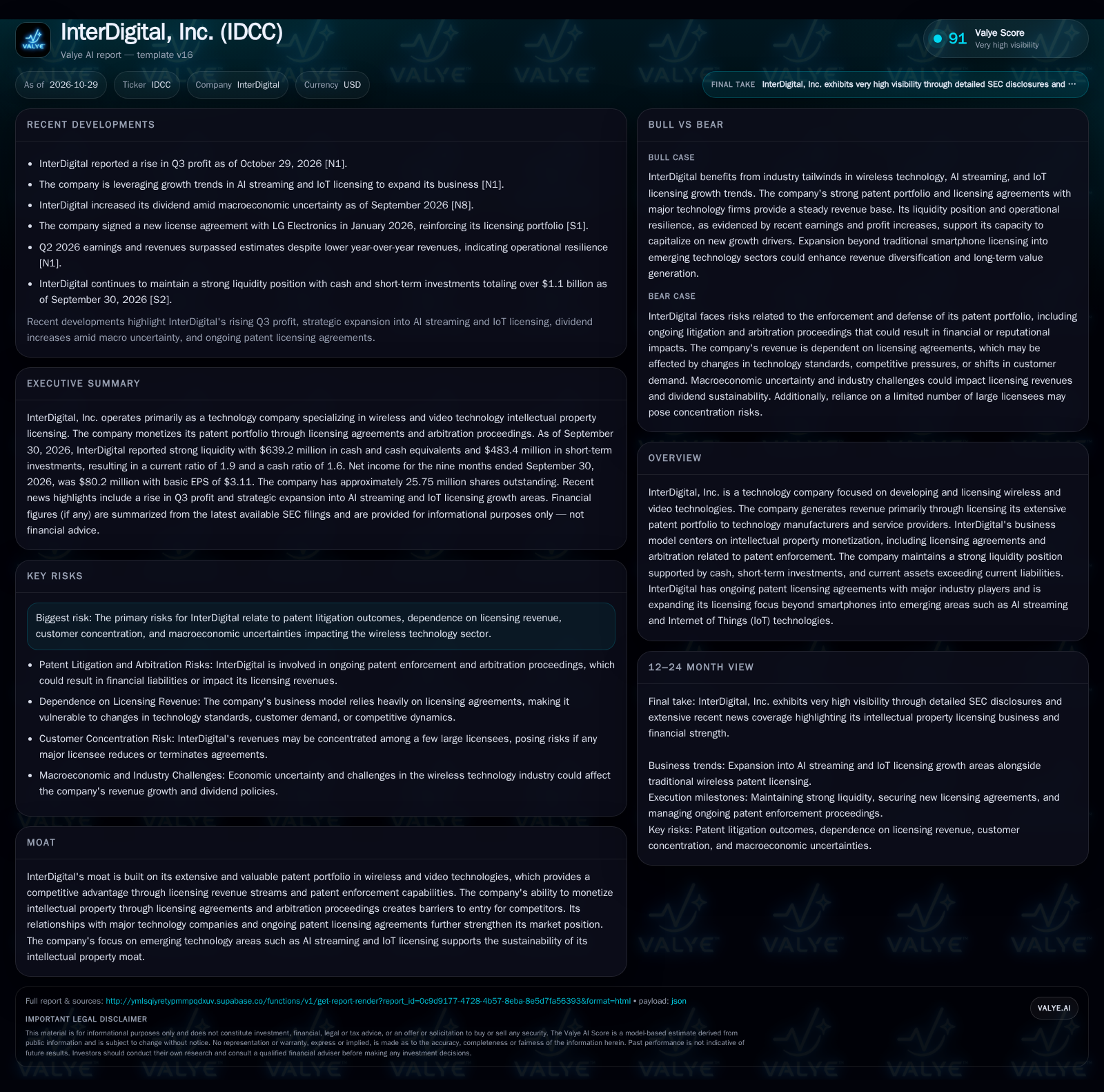
InterDigital, Inc. reported $1.1 billion in liquid assets as of Q3 2026 and a rise in Q3 profit, bolstered by a new LG Electronics license and expansion into AI streaming and IoT licensing. While its patent-driven model provides recurring revenue and financial resilience, ongoing litigation, customer concentration, and the challenge of sustaining growth outside core mobile markets remain critical watchpoints. The company’s ability to translate its IP portfolio into new verticals will determine whether it can maintain and grow its earnings base as traditional smartphone licensing matures. [S2] [N1] [S1]
InterDigital, Inc. sits at a strategic crossroads: its core patent licensing business, rooted in wireless and video technologies, continues to generate stable revenue and profit, as evidenced by recent financial results and a new license agreement with LG Electronics. With over $1.1 billion in liquid assets and a rising dividend, the company possesses clear financial strength. Yet as the smartphone market matures and litigation remains a perennial risk, InterDigital’s push into AI streaming and IoT licensing represents both a diversification imperative and a test of its business model’s adaptability. The durability of its high-margin intellectual property economics—and the ability to replicate licensing success in emerging verticals—will define its next phase of value creation.
Recent Financials, Patent Wins, and Strategic Expansion Set the Stage
As of September 30, 2026, InterDigital reported $639.2 million in cash and $483.4 million in short-term investments, totaling over $1.1 billion in liquid assets. The company’s current ratio stands at 1.9, with a cash ratio of 1.6, signaling a reported liquidity position. Net income for the first nine months of 2026 reached $80.2 million, translating to basic EPS of $3.11. In January 2026, InterDigital secured a new patent license agreement with LG Electronics, reinforcing its core licensing model. The company’s Q3 profit rose, and Q2 2026 results outperformed estimates even as year-over-year revenue declined, suggesting operational resilience amid market shifts. InterDigital has also raised its dividend in the face of macroeconomic uncertainty, and is actively expanding into AI streaming and IoT licensing to diversify its revenue streams. [S2] [N1] [S1] [N8]
How Patent Licensing Drives Cash Flow and Margin Structure
InterDigital’s business model is fundamentally built on monetizing intellectual property: its extensive patent portfolio generates revenue through licensing agreements with device manufacturers and technology platforms. Licensing agreements typically involve periodic payments or royalties, often tied to device volumes or market penetration. This model is characterized by high gross margins, as the incremental cost of licensing additional patents is low once the portfolio is developed and maintained. Fixed costs are primarily related to R&D, legal, and patent enforcement expenses, while variable costs are limited. This creates strong operating leverage: successful licensing deals or favorable arbitration outcomes can meaningfully boost profitability.
Capital needs are relatively modest compared to hardware or manufacturing businesses, but legal costs and the need to constantly defend and refresh the patent portfolio are significant ongoing investments. The economics of patent licensing can be lumpy, with revenue recognition tied to contract timing, settlements, and the resolution of disputes. As InterDigital pushes into AI streaming and IoT, the challenge will be structuring commercially viable licenses in less mature, more fragmented technology stacks, where pricing power and enforcement mechanisms may be less established than in the smartphone domain.
Defensible Moat—But Shifting Industry Boundaries and Enforcement Risks Loom
InterDigital’s competitive advantage stems from the breadth and quality of its wireless and video patent portfolio, which underpins recurring licensing revenue and provides leverage in negotiations and enforcement actions. The company’s relationships with major technology manufacturers, evidenced by recent deals with players like LG Electronics, support its market position. However, this moat is not unassailable: ongoing litigation and arbitration are inherent to the business, and adverse rulings or regulatory changes could undermine royalty streams.
Competition comes from other patent licensors, large technology companies with their own IP portfolios, and defensive aggregators. In emerging areas like AI streaming and IoT, InterDigital faces new competitive dynamics—including open-source alternatives, rapid technology cycles, and the need to prove essentiality of patents in new standards. Substitutes for patent licensing could include cross-licensing, in-house R&D, or even regulatory shifts that weaken patent enforcement. The core question is whether InterDigital can translate its established negotiating power and enforcement expertise into newer, less standardized technology arenas.
If AI Streaming and IoT Licensing Gain Traction, Revenue Diversification Accelerates
A favorable scenario sees InterDigital successfully leveraging its patent portfolio into high-growth verticals such as AI streaming and IoT. If the company can secure licensing agreements with major device manufacturers, platform providers, or infrastructure players in these domains, it could establish new recurring revenue streams that offset the maturation of smartphone royalties. Confirmation would come from announcements of new multi-year licensing deals in AI or IoT, evidence of recurring royalty payments, and a growing share of revenue from non-smartphone verticals.
Further upside could emerge if InterDigital’s patents are deemed essential for emerging standards in these fields, granting the company leverage to negotiate with a broader range of counterparties. Sustained high margins, incremental net income growth, and continued cash accumulation would reinforce the thesis that InterDigital’s licensing engine is adaptable to evolving technology markets.
Resilient Core Licensing with Gradual Expansion into New Verticals
The most plausible path is for InterDigital to maintain a stable baseline of licensing revenue from its established wireless and video IP, while gradually expanding into AI streaming and IoT. Smartphone-related royalties may plateau or decline as the market matures, but periodic new licensing agreements—such as the recent LG Electronics deal—provide a degree of revenue visibility. Expansion into new areas is likely to be incremental, with initial deals taking time to close and enforcement remaining challenging in less standardized markets.
Confirmation of this scenario would be continued profitability, sustained dividends, and a slow but measurable increase in non-core licensing revenue. Falsification would emerge if efforts to diversify stall, litigation outcomes materially erode royalty streams, or customer concentration worsens.
Litigation Losses or Standard Shifts Undermine Royalty Streams
A negative outcome would involve significant adverse litigation or arbitration results, leading to loss of key licensing revenue or outsized legal liabilities. If major licensees successfully challenge the validity or essentiality of InterDigital’s patents, or if global regulatory shifts reduce the enforceability of IP rights, royalty streams could contract sharply. The company’s dependence on a relatively small number of large licensees amplifies this risk: termination or renegotiation of major agreements could result in revenue gaps that are difficult to fill quickly.
In this scenario, efforts to expand into AI streaming and IoT may fail to gain traction or could be met with technical or commercial barriers, leaving InterDigital exposed to core market contraction without a clear offset. Evidence would include a material drop in licensing revenue, increased legal reserves, or management guidance revising down future profit expectations. Dividend cuts or increased cash burn would further confirm stress in the business model.
Testing InterDigital’s Diversification and Royalty Stability: What Will Confirm or Refute the Thesis?
The number and value of new licensing agreements announced in AI streaming, IoT, or other non-smartphone verticals—if disclosed—would help gauge diversification progress.
Revenue mix trends: a rising proportion of total revenue from non-traditional verticals would signal success in expansion efforts.
Updates on major litigation or arbitration outcomes, especially those affecting top licensees or core wireless patents, will be critical for assessing future royalty stability.
Customer concentration metrics—such as the percentage of revenue from the top three licensees—if disclosed, would illuminate risk exposure.
Legal expense trends: rising costs without offsetting revenue gains may indicate heightened patent enforcement challenges.
Announcements of patents deemed essential to new technology standards (AI, IoT, etc.) would strengthen the case for future licensing leverage.
Disclaimer: This is research-only, informational analysis and not investment advice. It may include AI-generated interpretation and general industry context. Always verify important details using primary sources.

Comments