
Teladoc Health: Insurance Evolution and AI Innovations Reshape Virtual Care Landscape
Teladoc Health’s business model is under pressure as its BetterHelp segment transitions from cash-paying to insurance-covered users, straining provider capacity and dampening near-term revenue. Meanwhile, investments in AI-powered platforms for hospitals and integrated care could unlock new efficiencies and market opportunities, but execution risks and competitive dynamics remain central to the investment debate.
Teladoc Health’s Q3 2026 results highlight a business at an inflection point: while its Integrated Care segment shows resilience, the BetterHelp mental health platform faces a challenging revenue mix shift and provider bottlenecks. Monitoring adoption curves for new technology, provider network growth, and insurance reimbursement trends will be critical.
Teladoc Health stands at a strategic crossroads. Its flagship virtual care offerings and global reach have established it as a leader in telehealth, with a recurring revenue engine rooted in B2B contracts. However, the rapid shift in BetterHelp’s user base from cash payments to insurance coverage is straining provider capacity and disrupting growth trajectories. As Teladoc invests in AI-enabled platforms to capture new hospital and health system opportunities, the company must also grapple with short-term financial pressures and intensifying competitive forces. The next phase will test Teladoc’s ability to balance operational discipline with innovation, and the stakes for both margins and growth are high.
Revenue Mix Shifts and Enhanced Potential Financial Flexibility Mark Recent Developments
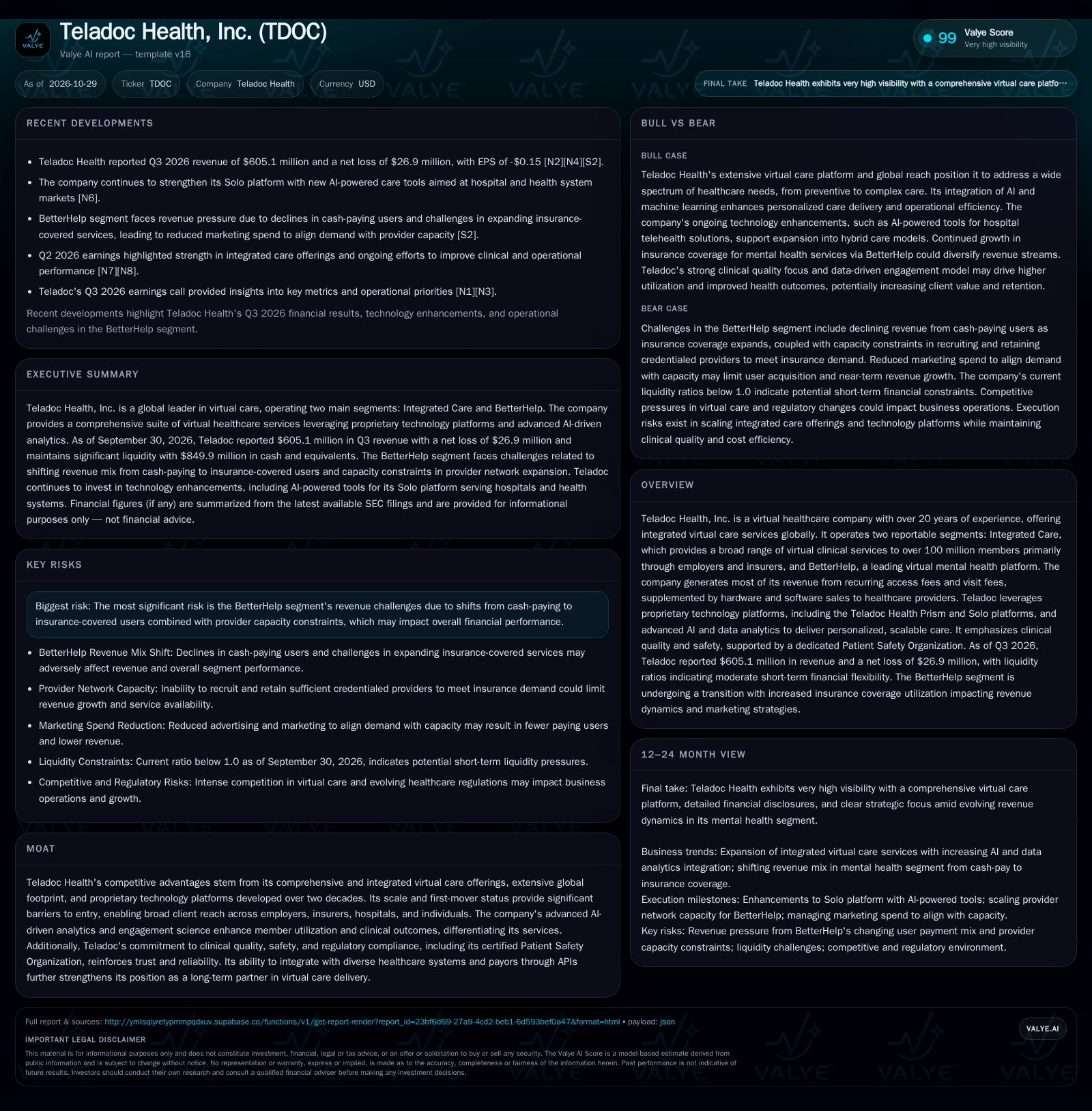
In Q3 2026, Teladoc Health reported revenue of $605.1 million and a net loss of $26.9 million, reflecting ongoing pressure in its business model [S2] [N2] [N4]. [S2] [S2] In response, Teladoc has cut marketing spend for BetterHelp to better align demand with available clinical capacity, further dampening near-term growth [S2]. At the same time, the company is investing in new AI-powered capabilities for its Solo platform, targeting the hospital and health system market [N6]. These simultaneous pressures and investments are reshaping Teladoc’s risk/reward profile in the near and medium term.
Recurring Revenue Challenges Amid Evolving Payer Composition and Margin Pressures
Teladoc’s business model is anchored by recurring access fees—accounting for 83% of consolidated revenue in 2025—primarily through per-member-per-month (PMPM) contracts with employers, health plans, and hospital systems [S1]. This B2B structure historically provided predictability and scale, leveraging the company’s broad member base of over 100 million. BetterHelp, by contrast, has been more consumer-facing, with a mix of cash-pay and insurance-covered users. The current shift toward insurance reimbursement introduces lower average revenue per user, longer payment cycles, and greater administrative complexity, likely compressing segment margins and creating working capital friction if not tightly managed.
Teladoc’s cost base features substantial fixed investments in technology, clinical operations, and regulatory compliance, but variable costs—particularly provider compensation—are sensitive to care volume and mix. The company’s push to enhance AI-driven care delivery (notably through the Solo and Prism platforms) could, if successful, automate triage, improve provider productivity, and support operating leverage. However, the capital intensity of scaling provider networks and investing in new technology may stretch resources, especially with a current ratio below 1.0, unless revenue momentum recovers or cost discipline intensifies [S2].
Competitive Edge Built on Technology, Scale, and Seamless Integration in Virtual Care
Teladoc’s competitive position is built on its comprehensive virtual care suite, proprietary technology platforms, and established relationships with large employers, payors, and health systems [S1]. Its two-decade track record and global reach create switching frictions for institutional clients, while its AI and data analytics capabilities (e.g., Pulse intelligence engine) aim to drive personalization and improved outcomes. However, the virtual care market remains crowded, with incumbent payors, pure-play telehealth startups, and horizontal technology entrants all vying for share.
Integrated Care’s B2B contracts offer relative stability, but are increasingly exposed to price pressures as payors and employers scrutinize healthcare spend and seek multi-vendor solutions. Meanwhile, in virtual mental health, BetterHelp faces intensifying competition from both digital-first mental health providers and traditional brick-and-mortar networks expanding their virtual offerings. The shift to insurance reimbursement may dilute differentiation, as payors commoditize mental health service networks. Teladoc’s scale and clinical quality infrastructure provide some moat, but sustainable advantage will depend on technology integration, outcomes data, and the ability to navigate regulatory and reimbursement complexities.
Growth Opportunities Emerging from AI Platforms and Expanding Insurance Coverage
A favorable outcome for Teladoc would see rapid adoption of its AI-powered Solo and Prism platforms by hospitals and health systems, driving both higher-margin software revenue and deeper integration into clinical workflows. If insurance reimbursement for virtual mental health accelerates and Teladoc can efficiently scale its provider network, BetterHelp could stabilize and eventually return to growth by capturing a larger share of covered lives.
Confirmation of this scenario would come from evidence of accelerating hospital and health system client wins, increased utilization of AI-driven care tools, and a rebound in BetterHelp user growth without a proportional increase in marketing spend. Improving provider productivity and lower churn, along with demonstration of margin expansion in both segments, would further validate the upside. A reversal of the current liquidity drag—through improved working capital or cost discipline—would also support a bullish thesis.
Teladoc’s Adaptation to Payer Shifts and Provider Limitations Yields Varied Results
The most plausible near-term scenario is one of gradual adaptation: Integrated Care remains relatively resilient, supported by recurring B2B contracts and incremental technology enhancements, while BetterHelp faces a period of slower growth and margin compression as the insurance mix shift and provider bottlenecks play out. Teladoc manages to align capacity and demand in BetterHelp, but revenue per user remains below prior cash-pay levels, and marketing efficiency gains are offset by greater administrative burden.
This scenario would be confirmed by modest revenue growth in Integrated Care, stabilization (but not rapid acceleration) of BetterHelp user counts, and persistent—though potentially narrowing—operating losses. Progress in AI tool adoption and hospital platform wins would be incremental rather than transformative. If disclosed, steady or improving provider recruitment metrics and insurance reimbursement rates would be supportive; ongoing liquidity constraints would keep the company focused on operational discipline.
Financial Pressures Intensify Due to Provider Shortages and Margin Erosion
In a negative scenario, Teladoc fails to scale its provider network fast enough to meet insurance-driven demand in BetterHelp, resulting in user churn and further revenue declines. Administrative complexity and reimbursement delays exacerbate working capital stress, while cost-cutting in marketing and operations undermines user acquisition and engagement. Integrated Care faces increasing pricing pressure from large payors or loses share to tech-savvy competitors.
Evidence would include continued declines in BetterHelp revenue and user counts, mounting operating losses, worsening liquidity ratios, and limited traction for new AI-enabled platforms. If disclosed, high provider churn, negative customer satisfaction trends, or deteriorating contract renewal rates would confirm structural challenges. In this scenario, Teladoc could be forced to seek external financing or restructure operations.
Key Developments Influencing Teladoc’s Future Trajectory in Virtual Healthcare
Trends in BetterHelp’s user mix by payment source (cash vs. insurance) and corresponding revenue per user, if disclosed, would help test the impact of the insurance transition.
Provider recruitment, retention, and utilization rates within BetterHelp—especially as insurance adoption rises—will be critical for assessing service capacity and growth potential.
Recurring access fee growth and contract renewal rates in Integrated Care would indicate the durability of the B2B revenue base.
Adoption metrics and revenue contribution from AI-powered Solo and Prism platforms in the hospital/health system channel, if disclosed, would clarify the return on technology investments.
Operating margin trends for both segments, particularly in the context of shifting payer dynamics and technology spend, will signal the company’s ability to manage costs and drive profitability.
Insurance reimbursement rates and administrative costs for virtual mental health services, if disclosed, would shed light on the evolving economics of the BetterHelp segment.
Client satisfaction, retention, and clinical outcomes data—especially in large employer and payor relationships—will be important for defending market share and pricing power.
Disclaimer: This is research-only, informational analysis and not investment advice. It may include AI-generated interpretation and general industry context. Always verify important details using primary sources.

Comments