
Rafael Holdings at an Inflection: Subgroup Efficacy, Portfolio Restructuring, and the Uncertain Road to Rare Disease Commercialization
Rafael Holdings has reached a pivotal moment with the FDA submission for Trappsol® Cyclo™ following mixed Phase 3 results in Niemann-Pick Disease Type C. The company’s future now hinges on regulatory interpretation of subgroup efficacy, disciplined resource allocation, and the ability to extract value from a diversified but uneven portfolio of pharmaceutical and device assets.
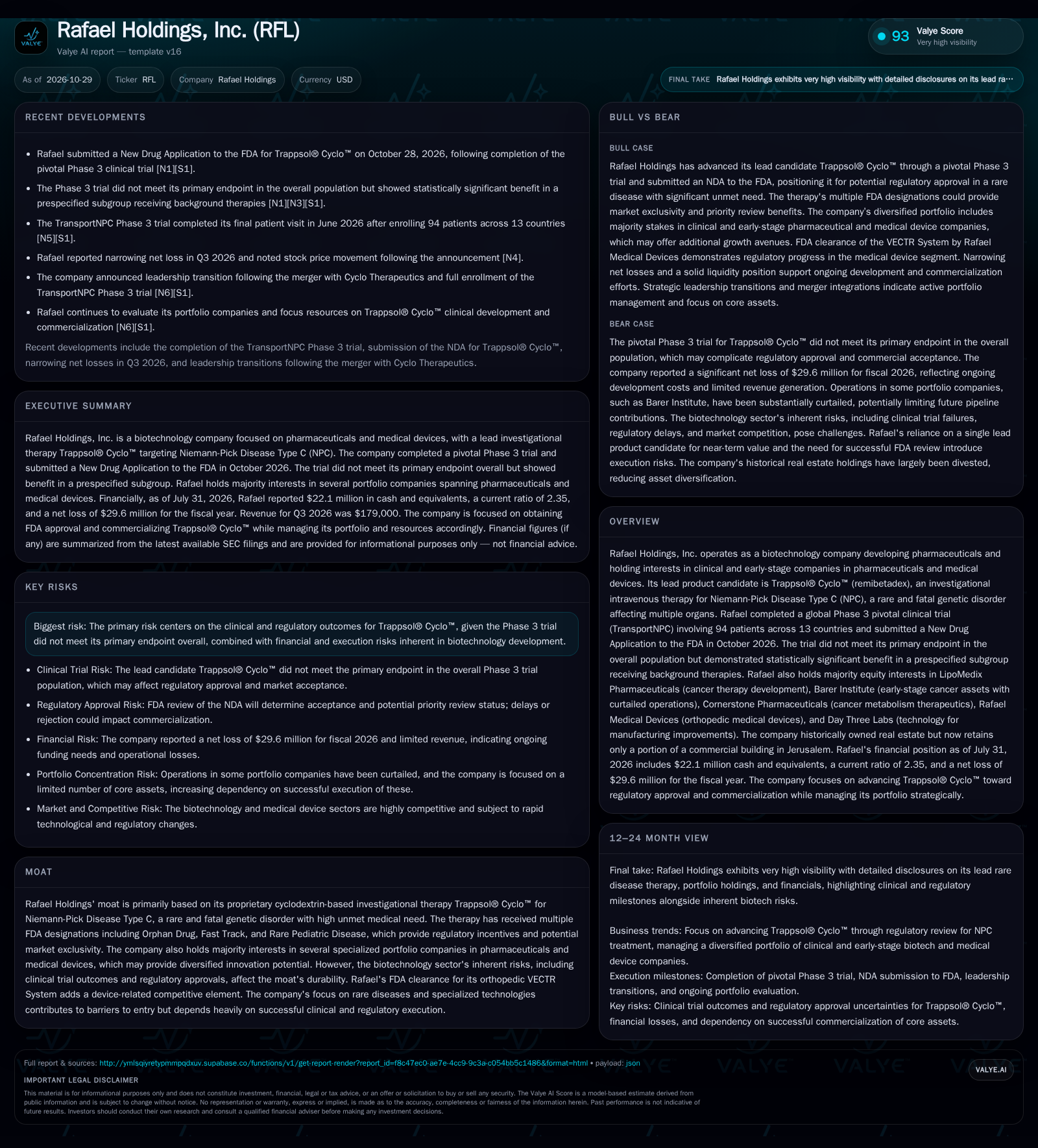
Rafael Holdings has submitted its lead rare disease therapy, Trappsol® Cyclo™, for FDA review after a global Phase 3 trial showed no overall efficacy but did reveal a significant benefit in a subgroup on background therapies. With $22.1 million in cash but ongoing losses and limited revenue, the company is concentrating resources on Cyclo™ while evaluating its broader portfolio. The outcome of the FDA review, especially regarding the prespecified subgroup, will be critical for value creation and future funding needs. [S1] [N1] [N3]
Rafael Holdings stands at a strategic crossroads, having recently completed and submitted an FDA application for Trappsol® Cyclo™, its investigational treatment for Niemann-Pick Disease Type C. The pivotal Phase 3 trial failed to meet its primary endpoint in the overall population, but a prespecified subgroup analysis indicated statistically significant benefit for patients receiving background miglustat and/or leucine therapy. With $22.1 million in cash and a sharpened focus on rare disease development, Rafael’s immediate future is tightly linked to the FDA’s interpretation of these data, the operational discipline around its broader portfolio, and its ability to navigate the high-risk, high-reward dynamics of orphan drug commercialization. [S1] [N1] [N3]
Subgroup Efficacy and Regulatory Review Define the Moment
Rafael Holdings has submitted a New Drug Application (NDA) for Trappsol® Cyclo™ to the FDA following the completion of its pivotal Phase 3 TransportNPC trial in Niemann-Pick Disease Type C (NPC) [N1] [S1]. The trial, which enrolled 94 patients across 13 countries, did not meet its primary endpoint in the overall population; however, a prespecified analysis found statistically significant benefit in patients on background miglustat and/or leucine therapy [N1] [N3] [S1]. This nuanced outcome places the regulatory focus squarely on whether the FDA will accept subgroup efficacy as sufficient for approval in this ultra-rare indication. Rafael reported $22.1 million in cash and equivalents at July 31, 2026, and a net loss of $29.6 million for fiscal 2026, reflecting the cost-intensive nature of late-stage clinical development and limited near-term revenue ($179,000 for the April 2026 quarter) [S1]. The company is channeling its resources toward Cyclo™ while reevaluating other portfolio assets and has recently undergone leadership changes following its merger with Cyclo Therapeutics [N6] [S1].
Commercial Pathways, Cost Structure, and the Dynamics of Orphan Drug Development
Rafael’s economic model is shaped by the high-risk, high-reward structure of orphan drug development. Trappsol® Cyclo™ targets NPC, a disease with minimal existing treatment options, which—if approved—could qualify for premium pricing, limited marketing costs, and potentially rapid adoption among the small eligible patient base. The economics of orphan drugs often rely on a concentrated payer mix, with high per-patient annual costs justified by unmet need and clinical benefit. However, the addressable market for NPC is inherently small, and even optimistic scenarios are capped by limited prevalence.
The company's cost structure is dominated by research and development and general administrative expenses, typical for a late-stage biotech without approved products. As of July 2026, losses remain substantial, and product revenue is minimal, primarily from Cyclo’s legacy specialty chemicals business [S1]. If Cyclo™ is approved, Rafael could benefit from Orphan Drug, Fast Track, and Rare Pediatric Disease designations, potentially securing market exclusivity, accelerated review, and a valuable priority review voucher. Commercialization would likely require either a small, targeted sales force or a partnership/licensing model, particularly given the concentrated pool of rare disease treatment centers. The capital needs for launch, post-approval studies, and market access initiatives could outstrip current cash, implying a likely need for additional financing or strategic collaboration if approval is granted.
Assessing Barriers and Differentiation in Rare Disease and Device Markets
Rafael’s competitive position is anchored in its proprietary cyclodextrin-based therapy for NPC, a field with high barriers to entry due to the rarity of the disease, regulatory exclusivities, and the complexity of clinical development. With multiple FDA designations, Cyclo™ stands to benefit from up to seven years of exclusivity in the US and ten in Europe if approved. The main competitive threat is from alternative therapies, off-label use of existing drugs, or gene therapy approaches under development elsewhere. The clinical differentiation for Cyclo™ rests on the observed subgroup benefit, which could be compelling in the context of limited alternatives for patients on background therapies.
Beyond Cyclo™, Rafael’s majority interests in LipoMedix, Cornerstone, and Rafael Medical Devices offer a measure of diversification, but these assets are at earlier stages or—like Barer Institute—have curtailed operations, limiting their near-term impact. The device business (VECTR System) has achieved FDA clearance, but its commercial scale and margin profile are not established, making it less likely to drive material value in the short term. In the broader biotech landscape, Rafael faces the typical counterforces of capital intensity, regulatory unpredictability, and the need for specialized commercial execution.
Pathways to Value Creation: Subgroup Approval and Portfolio Monetization
The most favorable scenario for Rafael involves the FDA accepting the statistically significant subgroup data as sufficient for approval of Trappsol® Cyclo™ in NPC patients on background therapy. Such an outcome could unlock Orphan Drug exclusivity, a potential Rare Pediatric Disease priority review voucher (which is monetizable), and rapid uptake in specialized treatment centers. Under this scenario, Rafael could either commercialize Cyclo™ directly—leveraging targeted engagement with key opinion leaders—or license the asset to a larger rare disease-focused pharmaceutical company, generating upfront and milestone payments.
Portfolio monetization of other holdings, such as Rafael Medical Devices (if the VECTR System gains commercial traction) or LipoMedix (upon positive clinical progress), could provide additional, though less certain, sources of value. Upside confirmation would come from FDA acceptance of the NDA (especially if the label includes the subgroup), issuance and sale of a priority review voucher, early revenue traction in the US and EU, and evidence of non-dilutive funding or strategic collaborations post-approval.
Regulatory Hurdles, Focused Execution, and Portfolio Triage Shape the Next Phase
The most plausible trajectory is that the FDA conducts a thorough review of the subgroup efficacy data, potentially requesting additional analyses or post-marketing commitments. Approval may be limited to the subgroup on background therapy, narrowing the initial addressable market. In this base case, Rafael would need to execute a disciplined launch, focusing commercial resources on top NPC centers and patient advocacy networks while seeking to extend the label through additional studies.
Simultaneously, the company continues to manage its burn rate, selectively investing in only the most promising portfolio assets and potentially winding down less productive operations (as already seen with Barer Institute). Additional funding—through equity, partnerships, or sale of the priority review voucher—is likely required to support both commercialization and ongoing obligations. Confirmation would include a regulatory decision (approval with a restricted label or request for more data), modest early revenue, and evidence of cost containment and portfolio rationalization.
Non-Approval, Funding Pressure, and Portfolio Asset Impairment
The adverse scenario involves the FDA rejecting the NDA due to failure to meet the primary endpoint in the overall trial population, or requiring new trials before any approval. In this event, Rafael’s lead asset would be delayed or derisked, forcing the company to rely on a portfolio of earlier-stage, less validated assets with limited near-term revenue potential. The lack of a commercial product would intensify cash burn, potentially triggering asset sales, licensing on unfavorable terms, or dilutive financings.
If the company cannot secure additional funding or monetize portfolio assets, it may be compelled to further curtail operations, as has already occurred with Barer Institute. Downside confirmation would include an FDA complete response letter, substantial reductions in R&D and headcount, forced asset divestitures, or unfavorable financing terms.
Milestones That Will Clarify Rafael’s Rare Disease Value Proposition
FDA acceptance and review outcome for the Trappsol® Cyclo™ NDA, especially regarding the weight given to subgroup efficacy.
Label scope and any post-marketing commitments or requirements for additional trials imposed by regulators.
Receipt and potential monetization of a Rare Pediatric Disease priority review voucher, if granted by the FDA.
Early revenue generation from Cyclo™ post-approval, if applicable, and the pace of adoption among US and EU NPC treatment centers.
Evidence of commercial partnerships, licensing deals, or non-dilutive funding to support launch and further development.
Progress or commercial traction for portfolio assets such as the VECTR System or LipoMedix, if disclosed.
Cash runway updates and any new financing or asset sale announcements in response to regulatory or commercial developments.
Operational cost containment and resource allocation—especially R&D and SG&A trends—as the company aligns with its core rare disease strategy.
Disclaimer: This is research-only, informational analysis and not investment advice. It may include AI-generated interpretation and general industry context. Always verify important details using primary sources.

Comments