
PHINIA INC.: Cost Pressures, Acquisition Integration, and the Search for Margin Stability
PHINIA INC. reported solid quarterly profitability and maintains a reported liquidity position, but is contending with higher employee costs and integration of recent acquisitions. The company’s ability to manage rising costs and realize synergies from its strategic moves will shape its near-term trajectory.
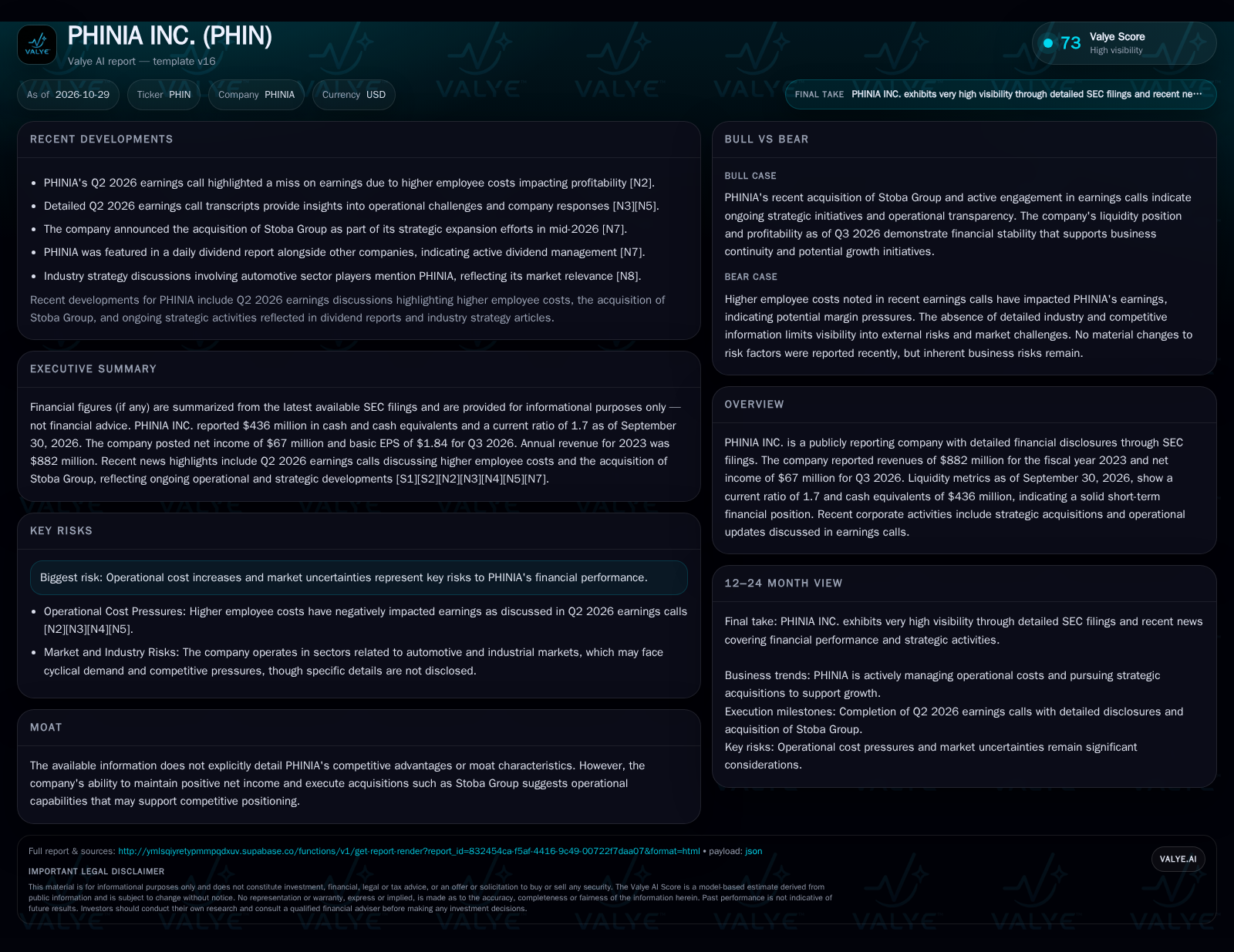
PHINIA INC. posted $67 million in net income for Q3 2026 and holds $436 million in cash, with a robust current ratio of 1.7. However, increasing employee expenses are weighing on earnings, and the company is navigating the integration of recent acquisitions. The critical questions are whether PHINIA can contain margin pressures and capitalize on its expanded operational footprint to drive sustainable growth. [S2] [N2] [N3] [N4] [N5]
PHINIA INC. enters late 2026 with a mix of financial strength and operational complexity. The company’s latest results show continued profitability and a reported liquidity position, but rising employee costs are eroding margins. With recent acquisitions such as Stoba Group adding new scale and integration challenges, PHINIA’s near-term performance hinges on its ability to control costs and extract value from its expanding portfolio. Investors must weigh the company’s demonstrated financial stability against persistent margin pressures and integration risks as the next phase of growth unfolds. [S2] [N2] [N3] [N4] [N5]
Latest Financials Highlight Margin Pressure Amid Growth Moves
PHINIA INC. reported net income of $67 million and basic earnings per share of $1.84 for the quarter ended September 30, 2026, reflecting a period of continued profitability. The company reported cash and liquidity metrics for the period; these figures do not by themselves establish operating runway, investment capacity, financial flexibility, or financing capacity. However, recent earnings call coverage and financial releases point to increased employee costs as a key factor contributing to a miss on earnings estimates for Q2 and ongoing margin pressure. These higher costs have emerged as a notable headwind, even as PHINIA pursues growth through strategic acquisitions such as the Stoba Group. The integration of new assets and management of cost inflation remain the central operational challenges shaping the company’s outlook. [S2] [N2] [N3] [N4] [N5]
Operational Leverage and the Challenge of Cost Containment
PHINIA’s business model appears to be rooted in supplying engineered products—likely for automotive and industrial applications—where scale, capital intensity, and fixed-cost leverage play significant roles. Revenue for the fiscal year 2023 was $882 million, suggesting a mid-market industrial profile. The recent uptick in employee costs, which have materially impacted earnings, highlights the company’s exposure to labor inflation and possibly unionized or specialized technical workforces. In such businesses, gross margins can be sensitive to shifts in wage structures and benefits, especially if pricing power is limited or if customers resist cost pass-throughs.
The acquisition of new entities such as Stoba Group introduces both potential synergies and additional complexity. Ultimately, sustained profitability will depend on PHINIA’s ability to grow volume, maintain pricing discipline, and extract operating leverage from its expanded asset base.
In capital-intensive engineered product sectors, the balance between fixed and variable costs critically influences operating leverage. PHINIA’s ability to scale production without proportional increases in labor or overhead costs will determine its margin resilience. If the company can optimize capacity utilization and streamline manufacturing processes, it may partially offset wage inflation through improved productivity. However, this requires disciplined operational execution and potentially significant upfront investment in automation or process innovation, which could pressure short-term cash flows. Furthermore, the nature of the workforce—whether highly specialized or broadly skilled—affects flexibility in adjusting labor costs in response to demand fluctuations.
Where PHINIA Stands: Industry Cyclicality and Competitive Dynamics
PHINIA operates in markets likely characterized by cyclical demand, technical requirements, and a mix of established OEM and industrial customers. The competitive environment for engineered industrial and automotive components is typically intense, with global players, emerging new entrants, and technological substitution (such as electrification in automotive) exerting downward pressure on prices and margins. While the company’s ability to report consistent profitability and pursue acquisitions demonstrates operational competence, there is no explicit evidence of a durable moat such as proprietary technology, long-term customer lock-in, or significant switching costs.
Industry peers may include component manufacturers, systems integrators, and diversified industrials. The key competitive levers are likely to be scale, cost structure, engineering know-how, and customer intimacy. The risk of substitution—especially from electrification trends or shifts in regulatory requirements—remains a latent threat. PHINIA’s challenge will be to defend or expand its position by either moving up the value chain, investing in differentiated technology, or building sticky customer relationships.
The interplay between technological evolution and customer requirements shapes competitive dynamics in PHINIA’s markets. As electrification and digitalization advance, suppliers must adapt their product offerings and service models to remain relevant. Companies that anticipate these shifts and invest in modular, adaptable technologies may secure stronger customer relationships and pricing power. Conversely, firms reliant on legacy products risk commoditization and margin erosion. PHINIA’s strategic decisions around innovation investment and partnership development will be pivotal in navigating these transitions. Additionally, regulatory environments that incentivize sustainability or emissions reductions could create both challenges and opportunities, depending on the company’s agility and product portfolio alignment.
Synergy Realization and Cost Control Could Drive Margin Expansion
If PHINIA successfully integrates its recent acquisitions—most notably Stoba Group—and realizes anticipated synergies, the company could achieve material operating leverage. Effective cost management, particularly in labor and procurement, would allow PHINIA to stabilize or expand margins even amid inflationary pressures. Additional upside could come from cross-selling new products to acquired customer bases, streamlining back-office functions, and leveraging shared R&D or manufacturing assets.
Confirmation of this scenario would come from sequential improvement in gross and operating margins, explicit management guidance on synergy capture, and sustained or accelerating earnings growth despite industry cost headwinds. A reduction in employee cost growth rates, successful new product launches, or evidence of pricing power in select segments would further validate the upside pathway.
The realization of synergies from acquisitions often hinges on effective integration of corporate cultures, systems, and processes. PHINIA’s success in this area would not only reduce redundant costs but also enhance knowledge sharing and innovation across the combined entity. Cross-functional teams focused on aligning sales strategies and operational best practices could unlock incremental revenue streams and improve customer satisfaction. Moreover, leveraging scale in procurement and supply chain management may yield cost savings beyond initial estimates. Such improvements, if sustained, can create a virtuous cycle of reinvestment in R&D and talent development, further strengthening competitive positioning and margin expansion potential.
Cost Pressures Offset Growth as PHINIA Seeks Operational Balance
The most plausible near-term outcome is that PHINIA maintains profitability and liquidity, but faces continued margin pressure from elevated employee and input costs. Integration of recent acquisitions may proceed without major disruption, but synergy realization could be gradual and partially offset by ongoing cost inflation or unforeseen integration expenses. Revenue may grow modestly as a result of the expanded portfolio, but earnings growth could lag as margin headwinds persist.
Evidence supporting this scenario would include stable or slightly declining margins, continued positive net income, and incremental rather than transformative improvements in efficiency. Disclosures of one-time integration costs, modest restructuring charges, or cautious management commentary on cost trends would reinforce the expectation of a balanced but challenged operating environment.
Rising Costs and Integration Risks Threaten Earnings Trajectory
If employee costs continue to escalate and PHINIA struggles to integrate recent acquisitions effectively, the company could see a material erosion of operating margins and net income. Delays in achieving synergies, cultural or operational friction from integration, or customer attrition could compound cost pressures.
This scenario would be confirmed by sequential declines in gross and operating margins, negative earnings surprises, or the emergence of restructuring, impairment, or severance charges in future filings.
Signals That Will Shape PHINIA’s Margin and Growth Outlook
Quarterly trends in gross and operating margin, especially in relation to disclosed employee and integration costs, would help test the company’s ability to manage inflationary pressures.
Updates on the pace and success of Stoba Group and other acquisition integrations, including any quantified synergy realization, would clarify the impact of recent deals.
Disclosure of customer concentration, order backlog (if any), or contract renewal rates would illuminate demand stability and revenue visibility.
R&D and capex trends, especially as a percentage of revenue, would indicate PHINIA’s commitment to innovation and operational renewal.
Labor cost growth rates and workforce rationalization efforts—if disclosed—would help assess the company’s control over its largest cost driver.
Management commentary on competitive threats, pricing power, or regulatory changes (such as emissions or electrification) would help gauge future margin risk.
Disclaimer: This is research-only, informational analysis and not investment advice. It may include AI-generated interpretation and general industry context. Always verify important details using primary sources.

Comments