
Vulcan Materials: Aggregates Scale, Regulatory Barriers, and the Next Leadership Chapter
Vulcan Materials leverages deep reserves and a metro-focused footprint to anchor its aggregates-led model, but faces economic cyclicality, regulatory hurdles, and a pending CEO transition. The interplay among infrastructure demand, cost discipline, and execution continuity will shape the company's next phase.
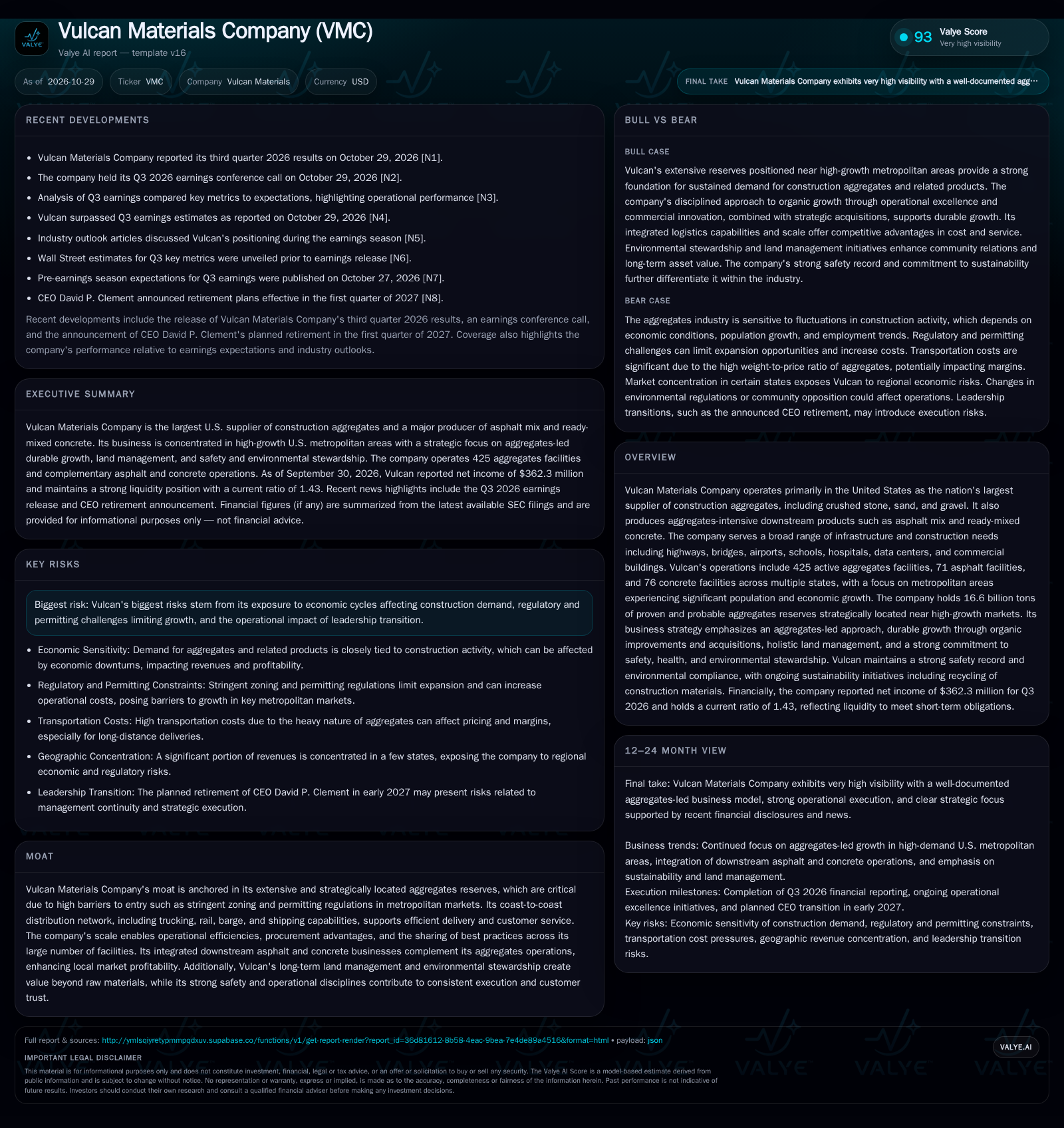
Vulcan Materials remains the largest U.S. supplier of construction aggregates, operating 425 active sites and holding 16.6 billion tons of reserves primarily near high-growth metros. Its Q3 2026 results exceeded expectations, but revenue concentration in a handful of states and the early 2027 CEO retirement introduce new execution variables. Regulatory and transportation cost barriers protect the moat but also pose expansion and margin risks. The company’s ability to sustain organic and inorganic growth, optimize logistics, and manage leadership transition will be central to its outlook. [S1] [S2] [N1] [N2] [N4] [N8]
Vulcan Materials stands at a pivotal juncture in 2026, cementing its position as the nation’s dominant aggregates supplier while preparing for a leadership handoff. With a vast portfolio of strategically located reserves and a footprint tuned to the pulse of U.S. infrastructure and construction cycles, Vulcan’s economic engine is well fortified by regulatory and logistical moats. Yet, the company’s heavy exposure to a handful of high-growth states, combined with industry-wide cyclicality and a CEO transition, introduces a mix of opportunity and risk. How Vulcan navigates these competing dynamics will define its next chapter.
Recent Performance and Strategic Positioning Define Vulcan’s 2026 Landscape
Vulcan Materials reported net income of $362.3 million for the quarter ended September 30, 2026, with diluted EPS of $2.80, surpassing Wall Street expectations and reflecting operational discipline. The company’s footprint includes 425 aggregates facilities, 71 asphalt plants, and 76 concrete plants, with the vast majority of revenue sourced from California, Texas, Georgia, Tennessee, and Virginia. This concentration provides scale and local market leverage but creates exposure to regional economic swings. Vulcan continues to emphasize an aggregates-led strategy backed by 16.6 billion tons of reserves located near high-growth urban centers. The planned retirement of CEO David P. Clement in Q1 2027 introduces a potential inflection point in leadership and execution continuity. [S1] [S2] [N1] [N2] [N4] [N8]
How Aggregates Economics and Scale Shape Vulcan’s Profit Model
Vulcan’s core business—supplying crushed stone, sand, and gravel—relies on local scale and proximity to end markets, given the prohibitive transportation costs of aggregates. Pricing power is typically strongest in metro areas with high barriers to new quarry development, enabling stable or rising margins during periods of robust construction activity. The company’s integrated model extends to asphalt and ready-mix concrete, allowing for some vertical margin capture and operational synergies, though these downstream businesses may carry lower margins and more exposure to competitive bidding.
Fixed costs are significant, particularly in land management, equipment, and regulatory compliance, while variable costs are driven by labor, fuel, and logistics. As a result, Vulcan’s model benefits from high operating leverage: incremental volumes during demand upswings can drive outsized profit gains. Capital intensity is high, both to maintain reserves and to comply with evolving safety and environmental standards. The company’s long-term land management approach—spanning conservation, reclamation, and mitigation credits—can unlock non-core revenue streams and enhance asset value, but also requires upfront investment and patient capital.
Acquisitions have played a material role in expanding the footprint and locking in reserves, with over 30 deals in the past decade. This inorganic growth strategy depends on disciplined integration and the ability to extract synergies from newly acquired assets.
Regulatory Barriers, Logistics, and Metro Focus: Vulcan’s Defensive Moat
Vulcan’s competitive edge is anchored in its control of large, strategically located reserves near high-growth metros—a position reinforced by regulatory barriers that make new quarry permitting a multi-year, high-cost process. This creates a formidable moat against new entrants and limits the risk of local oversupply. The company’s coast-to-coast logistics network, spanning trucking, rail, barge, and shipping, enables flexible supply and cost optimization, particularly in markets where local supply is tight or demand is peaking.
However, these same barriers also create inflexibility and may slow response to shifting demand or regulatory changes. Competitors include other national and regional aggregates suppliers, vertically integrated construction materials firms, and, to a lesser extent, recycled materials providers. Substitution risk from recycled aggregates is rising but remains limited by technical and regulatory specifications for critical infrastructure projects.
Vulcan’s scale supports procurement advantages, best-practice sharing, and resilience to input price shocks. Its strong safety and environmental record builds community trust—a critical soft asset in an industry subject to local opposition and permitting risk. Yet, the company is not immune to price competition in less concentrated markets or to the margin squeeze from rising transportation and energy costs.
Infrastructure Stimulus and Execution Could Unlock Margin Expansion
A favorable outcome for Vulcan hinges on a sustained surge in infrastructure investment at the federal, state, and municipal levels—potentially triggered by new stimulus bills or accelerated urbanization. If public construction outpaces private sector cyclicality, Vulcan could see multi-year volume growth, particularly in its largest markets. This would support not only higher aggregate shipments but also improved pricing discipline, as local supply remains constrained by regulatory bottlenecks.
Operational initiatives around logistics, commercial excellence, and recycling could further expand margins by lowering delivered costs and capturing premium pricing for sustainable materials. Successful integration of recent acquisitions and effective land management could unlock synergies and new revenue streams. Confirmation of this scenario would require evidence of sustained volume and pricing growth in core metros, margin expansion above historical averages, and continued discipline in capital allocation and integration.
Metro Concentration and Cyclical Demand Drive a Mixed Near-Term Outlook
The most plausible trajectory is moderate growth, characterized by stable to slightly rising demand in key metro areas, offset by pockets of softness if private construction or regional economies slow. Vulcan is likely to maintain or gradually improve margins through cost control, incremental pricing, and operational improvements, but will remain exposed to fluctuations in infrastructure funding and broader economic cycles.
The planned CEO transition in early 2027 is unlikely to disrupt day-to-day operations if internal succession and strategy continuity are preserved, but any sign of strategic drift or execution missteps could weigh on investor confidence. Confirmation would come from steady revenue growth, stable or improving operating margins, and smooth leadership succession, while evidence of margin compression, integration setbacks, or regulatory-driven delays would challenge the base case.
Economic Downturn and Execution Risks Could Erode Vulcan’s Margin Buffer
In a negative scenario, a broad construction downturn—driven by recession, rising interest rates, or a collapse in public infrastructure spending—would cut volumes and pressure pricing, especially in Vulcan’s most concentrated markets. High fixed costs and capital intensity could rapidly compress margins, and the company’s exposure to regional economic shocks would be amplified by its revenue concentration.
Execution risk is heightened during the CEO transition: any loss of operational discipline, failed integrations, or missteps in regulatory compliance could lead to missed targets or reputational damage. Additionally, if recycled materials gain rapid regulatory acceptance, substitution could accelerate faster than Vulcan can adapt. This scenario would be confirmed by declining volumes, shrinking margins, missed integration milestones, or any evidence of strategic reversal during management transition.
Milestones That Will Shape Vulcan’s Aggregates-Led Thesis in 2027
Volume growth and pricing trends in top five revenue states—California, Texas, Georgia, Tennessee, and Virginia—will provide early signals of demand resilience or weakness.
Operating margin progression, especially in aggregates versus downstream asphalt/concrete, would help test the sustainability of margin expansion.
Integration outcomes and realized synergies from recent acquisitions, if disclosed, are critical for validating inorganic growth benefits.
Leadership transition details—succession clarity, executive retention, and post-retirement strategy statements—will be closely scrutinized.
Regulatory developments affecting quarry permitting or recycled aggregate adoption could alter the supply/demand balance.
Capital expenditure discipline and land management outcomes, particularly in reclamation and mitigation credit revenue, would clarify long-term asset value.
Trends in transportation and energy costs, and Vulcan’s ability to offset or pass through these pressures, will impact profitability.
Community relations and environmental compliance, as evidenced by citation-free inspections and new sustainability certifications, would help test soft-moat durability.
Disclaimer: This is research-only, informational analysis and not investment advice. It may include AI-generated interpretation and general industry context. Always verify important details using primary sources.

Comments