
Crocs in 2026: Brand Power, Digital Leverage, and the Realities of Global Footwear Expansion
Crocs’ Q3 2026 results reinforce its reputation for resilient earnings and strong brand resonance as it doubles down on digital channels, product diversification, and global market share. The company faces the dual challenge of sustaining consumer engagement through innovation and managing execution risks as it pushes further into key Tier 1 markets.
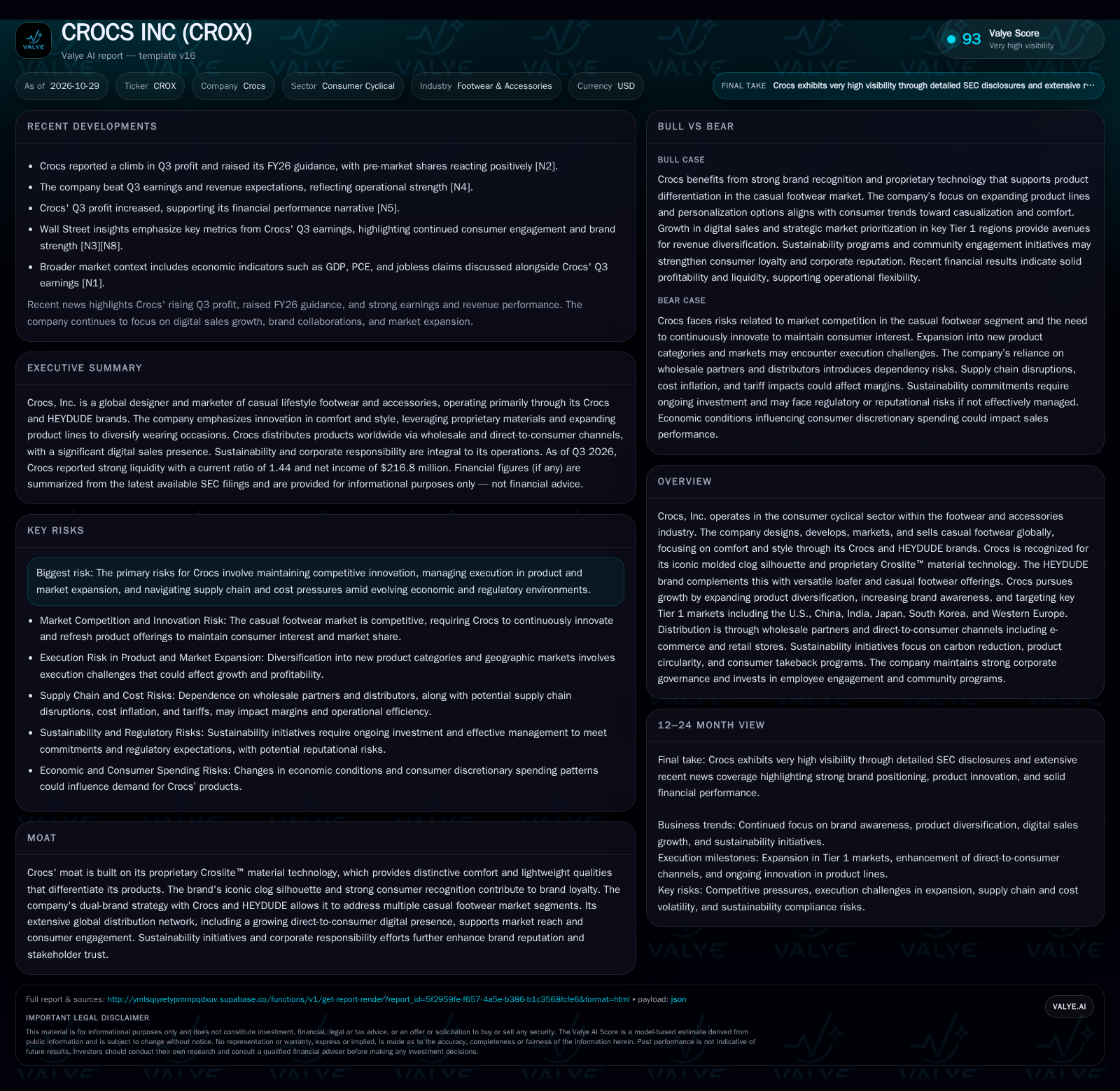
Crocs reported higher Q3 2026 profits and raised its full-year guidance, underpinned by robust digital sales and broadening brand initiatives. As the company expands its Crocs and HEYDUDE brands and increases its digital mix, the challenge will be maintaining momentum in a highly competitive and innovation-driven global footwear market. Key watchpoints include digital revenue share, product refresh cycles, and execution in emerging markets.
Crocs, Inc. enters the final quarter of 2026 with strong financial momentum, reporting a notable increase in Q3 profits and raising its full-year guidance on the back of better-than-expected earnings and revenues. The company continues to leverage its iconic comfort-focused footwear, digital sales channels, and inventive brand collaborations to reach a global consumer base. With over a third of revenues now deriving from digital channels and strategic efforts underway to expand in major international markets, Crocs must balance the opportunities of diversification and geographic growth with the inherent risks of consumer fickleness, operational complexity, and competitive intensity.
Profitability Surges and Digital Sales Reshape Crocs’ 2026 Trajectory
Crocs reported a significant climb in Q3 2026 profit, surpassing both earnings and revenue expectations and prompting management to raise full-year guidance [N2] [N4] [N5]. This performance was driven in part by continued strength in digital sales, which accounted for approximately 37.8% of consolidated revenues in 2025—a figure that underscores the accelerating importance of e-commerce and direct-to-consumer engagement to the overall business model [S1]. As of September 30, 2026, Crocs had a current asset base of $1.03 billion against $714 million in current liabilities (current ratio 1.44), with net income at $216.8 million for the quarter [S2]. These results highlight Crocs’ ability to convert consumer demand and operational leverage into tangible earnings, while also maintaining flexibility for further investment or risk management.
How Crocs Monetizes Comfort: Pricing, Channel Mix, and Scale Dynamics
Crocs’ business model relies on the combination of product differentiation—via its proprietary Croslite™ material and iconic clog design—and a multi-channel distribution strategy spanning wholesale, e-commerce, and owned retail. The company’s profitability is shaped by the interplay between average selling price (ASP), product mix (including higher-margin personalization such as Jibbitz™ charms), and the relative weight of direct-to-consumer versus wholesale sales. Digital and direct-to-consumer channels typically offer higher gross margins but require ongoing investment in fulfillment, marketing, and technology platforms.
The addition of the HEYDUDE brand diversifies Crocs’ portfolio, targeting a broader set of casual footwear occasions and potentially smoothing seasonality and demand cycles. Fixed costs include design, marketing, and supply chain infrastructure, while variable costs are tied to materials, production, and shipping. As the company grows, operating leverage may improve if revenue growth outpaces increases in SG&A and supply chain expenses. However, the push into new geographies and categories can drive up short-term costs, especially if localization or regulatory adaptations are needed.
Capital needs are moderate for a footwear company of Crocs’ scale, with investment typically directed at digital infrastructure, store rollouts in key markets, and sustainability initiatives. The company reported cash and liquidity metrics for the period; these figures do not by themselves establish operating runway, investment capacity, financial flexibility, or financing capacity.
Defending the Clog: Brand, Materials, and the Pressures of Global Footwear Competition
Crocs competes in a global footwear market characterized by intense rivalry, rapid trend cycles, and relatively low switching costs for consumers. Its competitive advantage centers on proprietary Croslite™ material technology, strong brand recognition, and the ability to personalize products through accessories like Jibbitz™ charms. The company’s dual-brand strategy with Crocs and HEYDUDE allows it to address distinct segments within the casual and comfort footwear spectrum.
However, barriers to entry in footwear are generally low, with many competitors capable of replicating basic silhouettes or responding quickly to fashion shifts. Key peer categories include athletic-casual brands, value footwear retailers, and emerging digital-first brands. The battle for shelf space—both physical and digital—is ongoing, and consumer loyalty can be highly contingent on perceived innovation, comfort, and price-value.
Crocs’ extensive global distribution network, including a significant e-commerce footprint, supports reach and engagement, yet exposes the company to execution risks in new markets where local brands or entrenched global players may have an edge. Sustainability and corporate responsibility initiatives, while enhancing brand reputation, are increasingly table stakes rather than unique differentiators.
What Could Drive a Step-Change in Crocs’ Growth: Digital Acceleration and Product Innovation
A favorable scenario for Crocs would see sustained double-digit growth in digital sales, further increasing their share of total revenues and driving higher margin contribution. This could be enabled by successful new product launches that resonate with younger or previously underpenetrated consumer segments, as well as effective brand collaborations that create social media buzz and repeat purchase opportunities.
Execution in Tier 1 international markets—such as China or India—could unlock significant incremental revenue if Crocs adapts styles, marketing, and distribution to local preferences. The HEYDUDE brand could capture additional share in the casual footwear segment, particularly if it develops a cult following similar to the Crocs clog.
Evidence confirming this scenario would include accelerating digital channel growth above the current 37.8% revenue mix, robust same-store sales in new markets, and a steady cadence of successful product collaborations. Margin expansion driven by mix shift to higher-margin direct and personalized products would further validate the upside thesis.
Sustaining Relevance in a Crowded Market: The Most Likely Outcome
The most plausible path for Crocs is a continuation of mid-to-high single-digit revenue growth, with digital sales gradually increasing as a percentage of total revenues but facing tougher comps as e-commerce matures. The core Crocs clog and related silhouettes remain popular, but growth is increasingly dependent on periodic refreshes, seasonal collaborations, and incremental geographic expansion rather than explosive category creation.
HEYDUDE provides some portfolio diversification, but its impact is likely to be evolutionary rather than revolutionary. Operating margins remain healthy if supply chain costs are contained and the channel mix does not swing back toward lower-margin wholesale. Ongoing investment in sustainability and digital infrastructure is necessary to meet consumer and regulatory expectations but may limit margin expansion near term.
This scenario would be confirmed by continued, but decelerating, digital sales growth; stable or slightly improving gross margins; and steady, rather than breakout, performance in new markets. Watch for a balance between SG&A growth and revenue expansion as an indicator of disciplined execution.
When Fashion Turns: Demand Volatility, Margin Compression, and Expansion Risks
A negative scenario could materialize if consumer preferences shift away from Crocs’ core styles, leading to inventory build-up, discounting, and margin compression. The casual footwear market is highly susceptible to trend reversals, and overreliance on a few hero products increases vulnerability to sudden shifts in taste or media backlash.
Execution risks in new markets—such as misjudging local demand, supply chain complexity, or regulatory hurdles—could result in underwhelming returns on investment. Supply chain disruptions, cost inflation, or unfavorable currency swings could further erode margins, especially if the company is forced to absorb higher input costs or engage in price-based competition.
Confirmation of a downside scenario would include negative same-store sales, shrinking digital revenue share, rising inventory levels, or a notable decline in gross and operating margins. Failure to successfully launch new products or maintain innovation cadence would also be red flags.
Milestones and Metrics That Will Reveal Crocs’ Next Chapter
The percentage of consolidated revenue derived from digital channels, particularly e-commerce, as a leading indicator of channel mix evolution and margin potential (if disclosed by quarter).
Trends in same-store sales (comparable sales), especially in new international markets and for HEYDUDE retail locations, to assess organic growth and brand resonance.
Gross and operating margin progression, with a focus on the impact of channel mix, product innovation, and supply chain costs.
Inventory turnover rates and discounting trends, which can reveal the degree of demand volatility or product misalignment.
The frequency, scale, and commercial impact of new product launches and brand collaborations, as these drive both consumer engagement and pricing power.
Progress on sustainability initiatives—such as adoption of bio-circular materials and consumer takeback programs—and their effect on cost structure and brand equity (if disclosed with quantifiable metrics).
Geographic revenue mix, particularly the share and growth rates in targeted Tier 1 markets like China, India, and Western Europe (if provided).
Staff retention and employee engagement metrics, as human capital stability is crucial for innovation and execution in a fast-moving consumer environment (if disclosed).
Disclaimer: This is research-only, informational analysis and not investment advice. It may include AI-generated interpretation and general industry context. Always verify important details using primary sources.

Comments