
Willis Towers Watson: Product Innovation, Margin Leverage, and the Battle for Differentiation in Insurance Advisory
Willis Towers Watson’s Q3 2026 results highlight a company executing on new product launches and operational efficiency, but competitive and structural pressures in insurance brokerage and consulting remain acute. The next phase for WTW will hinge on its ability to translate technology and wealth management initiatives into sustainable margin and revenue gains.
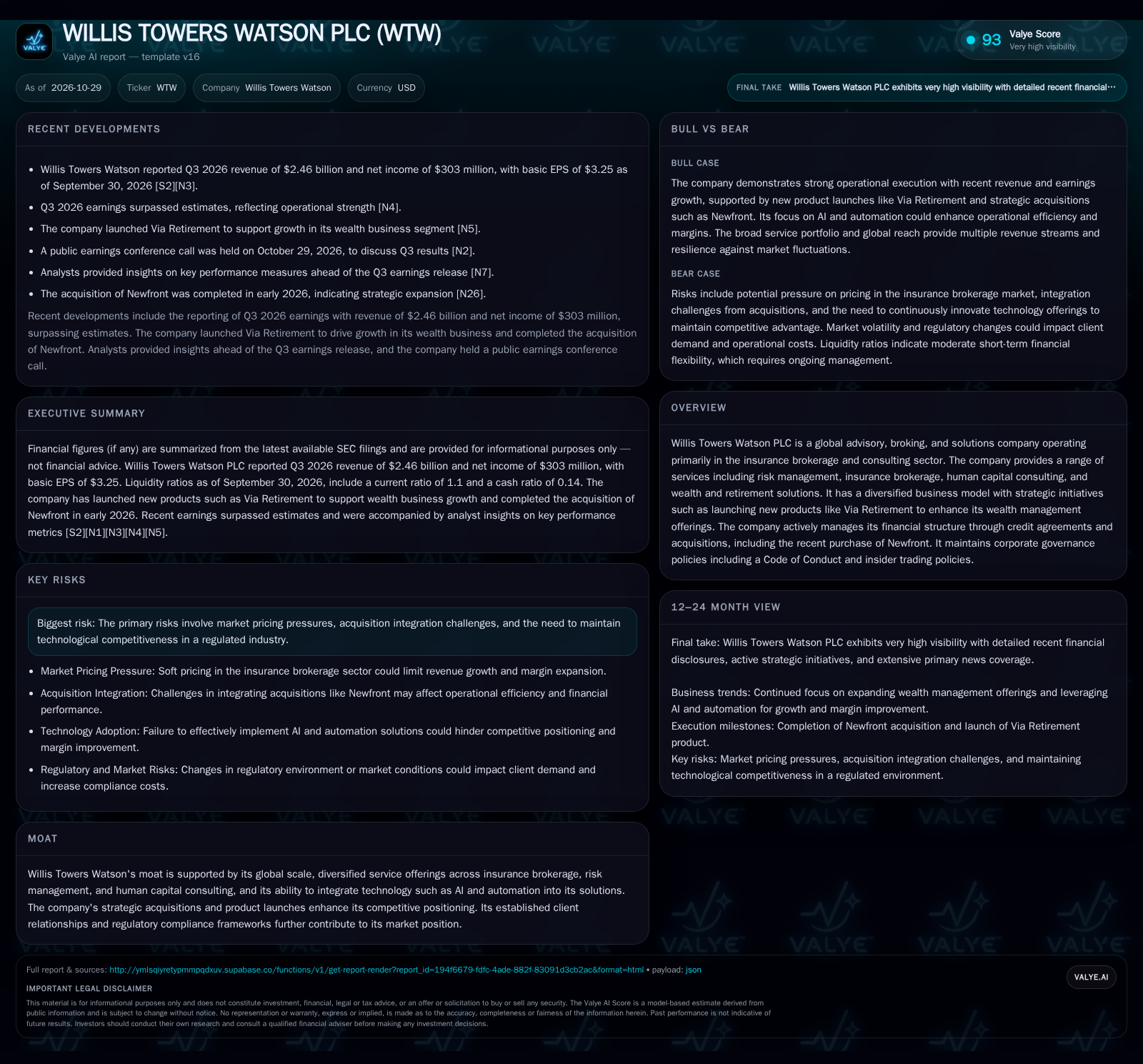
Willis Towers Watson reported Q3 2026 revenue of $2.46B and net income of $303M, beating estimates. Recent launches like Via Retirement and an emphasis on AI and automation are the company’s levers for growth and efficiency. The core question is whether innovation and scale can offset pricing and integration pressures in the coming quarters. [S2] [N3] [N4] [N5]
Willis Towers Watson’s latest quarter underscores the company’s dual focus on innovation and operational rigor. With Q3 2026 revenue and earnings exceeding analyst expectations, WTW is aiming to leverage new product launches—such as Via Retirement—and the rollout of AI-driven solutions to carve out growth in a mature, margin-sensitive industry.
Recent Results and Strategic Initiatives Set the Stage
Willis Towers Watson reported Q3 2026 revenue of $2.46 billion and net income of $303 million, with basic EPS of $3.25, surpassing consensus estimates and highlighting operational strength [S2] [N3] [N4]. The company reported cash and liquidity metrics for the period; these figures do not by themselves establish operating runway, investment capacity, financial flexibility, or financing capacity. [S2] The launch of Via Retirement signals a push to expand WTW's wealth management segment, while ongoing adoption of AI and automation is intended to drive margin improvement and service innovation [N5]. Together, these developments frame a company at an inflection point between proven execution and the need to deliver on its next wave of growth initiatives.
How WTW’s Model Converts Expertise and Scale into Earnings
Willis Towers Watson operates a diversified advisory, broking, and solutions business, primarily deriving revenue from commissions on insurance placements, advisory fees, and consulting services. The company's economics are characterized by a mix of recurring revenue from multi-year advisory relationships and project-based consulting fees. Pricing tends to be competitive, with revenue per client influenced by service breadth, complexity, and retention. Volume growth can come from new client wins, cross-selling additional services, or expanding into adjacent verticals such as wealth management and retirement solutions.
The cost structure is anchored by personnel expenses, technology investments, and regulatory compliance, with a moderate degree of operating leverage due to the scalable nature of advisory and technology-enabled services. Fixed costs in IT and compliance rise with regulatory demands and technology upgrades, while variable costs flex with deal volume and project load. Margin expansion hinges on boosting high-value, technology-enabled services (such as AI-driven risk assessment), improving retention, and leveraging shared platforms across business units.
Capital needs are typically moderate, with working capital requirements tied to receivables cycles and the timing of premium flow. Acquisitions and technology investments can create episodic capital demands, and integration costs may pressure near-term margins if not managed tightly. The company’s reported liquidity position highlight the importance of disciplined cash management, particularly as WTW pursues new product launches and integration of acquired businesses [S2].
The Dynamics of Differentiation in Insurance Broking and Consulting
WTW competes against global insurance brokers and consulting powerhouses, including firms like Marsh and sector-specific platforms such as Neptune Insurance. The competitive landscape is characterized by price competition, service breadth, and technology adoption. Large incumbents benefit from scale, brand reputation, and entrenched client relationships, making client switching less frequent but not impossible—particularly if innovation lags or integration falters.
WTW’s potential edge comes from its diversified service lines, global reach, and increasing emphasis on technology-enabled solutions, including AI and automation. The ability to integrate new offerings, such as Via Retirement, may drive cross-selling and deepen client relationships. However, barriers to entry for technology-driven platforms have been falling, and new digital-first competitors can erode legacy advantages, especially in standardized insurance products.
Switching costs for large clients can be moderate due to integration with HR, risk, and benefits systems, but price-sensitive segments and smaller accounts may be more willing to shop around. Regulatory complexity and the need for tailored advice still favor established players, but the question is whether those advantages are durable as technology commoditizes more aspects of the business.
Unlocking Margin Expansion Through Technology and Wealth Products
The bull case for WTW rests on its ability to scale new high-margin products—like Via Retirement—and embed AI-driven automation across its advisory and broking services. If the company successfully integrates recent acquisitions and executes on technology upgrades, it could see a step-change in productivity and client retention, driving both top-line growth and margin expansion.
Confirmation would come from sustained above-peer revenue growth in wealth and retirement, disclosure of improved segment margins, and evidence that AI adoption is reducing service delivery costs or enabling new premium services. Accelerating client wins in digital offerings, higher revenue per client, and positive operating leverage as fixed tech investments are absorbed would further validate the scenario. External validation might include public reference deals, industry awards for innovation, or analyst upgrades citing margin and growth inflection points.
The scenario may be falsified if new offerings underperform, integration costs persistently weigh on margins, or if technology investments fail to yield tangible efficiency gains relative to peers.
Incremental Gains Amid Competitive and Integration Pressures
The most plausible path for WTW is one of steady, incremental gains: modest revenue growth from wealth and consulting, with AI and automation delivering gradual efficiency improvements rather than dramatic step-changes. Integration of acquisitions like Newfront may create near-term cost headwinds, offset by cross-selling opportunities and operational synergies over time.
In this scenario, WTW maintains its market position through service breadth and client stickiness in complex risk and benefits consulting, but faces ongoing price competition in more commoditized segments. Margins may expand slightly as technology adoption matures, but regulatory and compliance costs remain a drag.
Evidence for this scenario would include stable or slightly improving operating margins, modest top-line growth in core and adjacent verticals, and continued analyst commentary on execution and integration. Falsification would come if margin compression accelerates, client churn rises, or integration setbacks become visible in segment reporting.
Pricing Erosion and Integration Missteps Threaten Profitability
The bear case centers on margin compression driven by persistent pricing pressure, failure to realize synergies from acquisitions, and an inability to keep pace with technology-driven competitors. If clients increasingly view insurance broking and basic advisory as commoditized, WTW could face downward pressure on fees and increased churn, particularly in its lower-complexity client base.
Integration missteps—such as delayed realization of synergies or cultural clashes—could drive up costs and distract management, while technology investments that fail to deliver operational savings would exacerbate the squeeze on profitability.
This scenario would be confirmed by declining operating margins, missed revenue targets, analyst downgrades citing execution risk, or disclosures of integration costs exceeding initial forecasts. A spike in client attrition or the loss of large accounts would also be red flags.
Benchmarks for Assessing WTW’s Execution on Innovation and Integration
Sustained revenue growth and margin improvement in the wealth and retirement segment, particularly attributable to new offerings like Via Retirement, if disclosed.
Traction and client adoption metrics for AI-driven or automated service offerings—such as number of clients using new digital platforms, or technology-enabled revenue mix, if disclosed.
Progress on acquisition integration, including realization of targeted cost synergies and retention of key personnel from acquired firms.
Operating margin trends at both the consolidated and segment level, with particular attention to the impact of technology investments and acquisition costs.
Client retention and churn rates across major business lines—a useful metric would be disclosed annual retention rates or net client wins/losses.
Commentary or disclosures on pricing trends and competitive win/loss rates relative to peer benchmarks.
Disclaimer: This is research-only, informational analysis and not investment advice. It may include AI-generated interpretation and general industry context. Always verify important details using primary sources.

Comments