
Agomab Therapeutics Advances With Organ-Targeted Fibrosis Therapies and Nasdaq Debut
Agomab's recent Nasdaq IPO and localized ALK5 inhibitor pipeline highlight strategic progress against fibro-inflammatory diseases.
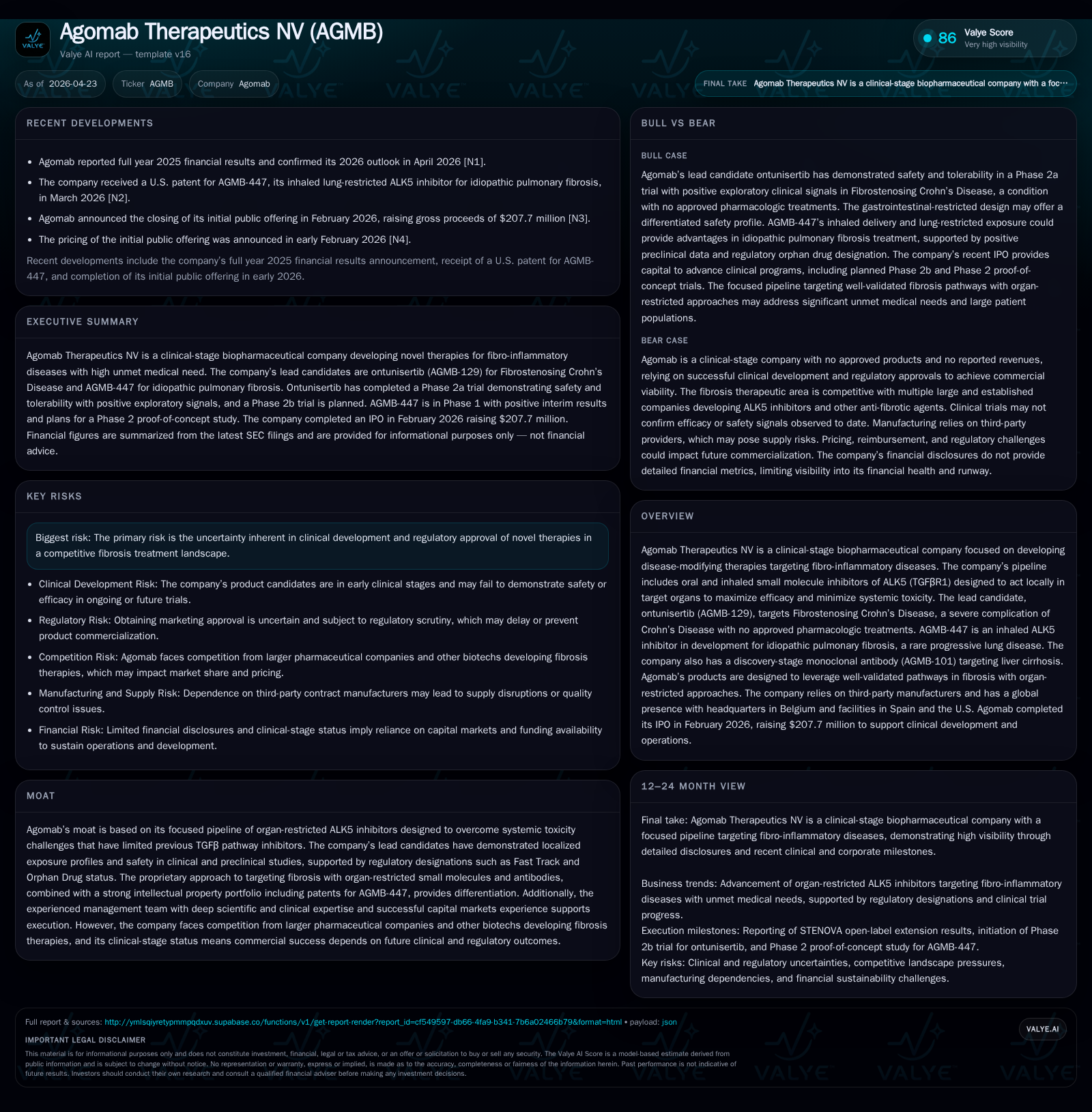
Agomab Therapeutics became public via a Nasdaq IPO in February 2026, raising over $200 million to support its clinical-stage programs. The company specializes in organ-restricted ALK5 inhibitors aimed at fibrosis disorders with high unmet needs, including Fibrostenosing Crohn’s Disease and idiopathic pulmonary fibrosis. Agomab’s focused strategy emphasizes safety differentiation through localized drug targeting and robust intellectual property, but clinical development risks and complex market access remain key challenges. Upcoming pipeline milestones, particularly Phase 2 trials, will be critical near-term indicators for the company’s execution trajectory.
Recent Quarterly Update: IPO Impact and Operational Developments
Agomab Therapeutics NV transitioned to a public company in early 2026 through its Nasdaq Global Select Market listing under ticker "AGMB," closing its initial public offering on February 9, 2026 [S3]. The offering comprised 12.5 million American Depositary Shares, delivering gross proceeds totaling $207.7 million [N1]. This capital infusion forms the financial underpinning for advancing Agomab’s clinical programs targeting fibro-inflammatory diseases. As part of the IPO process, the company adopted amended Articles of Association effective immediately post-offering [S3], formalizing governance changes appropriate to a publicly traded entity.
Subsequent interim disclosures filed on March 5, 2026 reaffirmed Agomab's ongoing compliance with U.S. Securities Exchange Act reporting requirements, signaling institutional readiness for public-market scrutiny [S2]. The company continues quarterly reporting under Form 20-F, aligning financial transparency with Nasdaq standards.
From an operational perspective, the IPO proceeds enhance Agomab's ability to fund pivotal drug development milestones and scale organizational capabilities across research hubs in Belgium, Spain, and the United States. Management commentary accompanying the April investor update reiterated guidance consistent with advancement plans for lead assets [N1]. There is heightened visibility into clinical trial progression timelines backed by strengthened financial resources.
Business Model Centered on Organ-Restricted ALK5 Inhibition
Agomab’s business model revolves around discovery and clinical-stage development of novel therapeutics that modulate fibrotic pathology by inhibiting transforming growth factor-beta receptor type I (TGFβR1 or ALK5) via organ-specific delivery platforms [S1]. This approach is designed to harness well-characterized fibrosis signaling pathways while circumventing systemic toxicity challenges that have historically hampered broad TGFβ pathway drug utility.
The company deploys oral small molecules tailored for gastrointestinal restriction alongside inhaled formulations optimized for pulmonary delivery — further complemented by monoclonal antibody candidates targeting affected organs such as the liver , [S17]. These differentiated delivery mechanisms aim to localize drug action at the site of fibro-inflammatory injury thereby improving therapeutic index.
Currently without revenue-generating marketed products due to its clinical-stage status, Agomab relies on equity financing from capital markets supplemented by government grants primarily from Flemish and Belgian innovation programs [S1]. It outsources active pharmaceutical ingredient manufacturing to third-party contract organizations compliant with current Good Manufacturing Practices (cGMP) [S17]. This asset-light strategy offers operational flexibility but necessitates careful supply chain oversight as pipeline progression intensifies.
Pipeline Overview: Lead and Emerging Candidates
Agomab’s leading asset ontunisertib (AGMB-129) is a gastrointestinal-restricted oral inhibitor of ALK5 developed specifically to treat Fibrostenosing Crohn’s Disease (FSCD), a debilitating stricture-forming complication of Crohn's Disease with no approved medical treatment options [S1], . FSCD affects a significant patient base estimated at approximately 1.4 million across seven major markets including the U.S., major European countries, Japan, and the UK.
AGMB-447 constitutes the company’s second clinical-stage product – a nebulized inhaled ALK5 inhibitor designed for idiopathic pulmonary fibrosis (IPF), a lethal fibrotic lung disorder with median survival under five years post-diagnosis [S1]. The inhalation route aims to act locally within lung tissue reducing off-target effects. Notably, Agomab received a U.S. patent grant covering AGMB-447 in late March 2026 consolidating intellectual property protection over this novel molecule-device combination [N2].
An emerging discovery-stage monoclonal antibody candidate AGMB-101 targets liver cirrhosis by mimicking hepatocyte growth factor activity through MET receptor agonism, demonstrating antifibrotic effects alongside regenerative potential in preclinical hepatic injury models , [S24]. Regulatory clearance has been obtained to proceed with Phase 1 trials in liver disease patients shortly.
Together these programs reflect modality diversification across oral small molecules, inhaled therapies, and biologics focused on chronic fibro-inflammatory diseases impacting disparate organ systems.
Industry Context: Competing in Fibrosis Therapeutics
The biopharmaceutical landscape addressing fibrosis is crowded with both large pharmaceutical firms and specialized biotech companies exploring multiple molecular targets beyond TGFβ signaling. TGFβ pathway inhibition presents inherent challenges due to ubiquitous receptor expression pivotal for homeostasis; this has constrained prior attempts largely because of systemic adverse effects limiting therapeutic windows leading to discontinuations , [S1].
Agomab’s organ-restricted targeting addresses these foundational safety issues potentially broadening clinical applicability. However, reimbursement realities remain complex particularly within the EU where pricing negotiations are fragmented nationally rather than harmonized at bloc level—adding layers of market access uncertainty despite ongoing legislative efforts toward alignment expected from reforms projected for implementation circa 2028 [S1], [S12], [S22]-[S23]. Such heterogeneity affects commercial launch timing as well as price positioning strategies in European key markets compared to more centralized U.S. payor frameworks.
Furthermore, aggressive healthcare cost-containment trends worldwide impose downward pressure on drug pricing which could compress margins or restrict adoption depending on demonstration of clinically meaningful benefits versus existing therapies or standard care [S12], [S18]. These external demand-side constraints underscore the importance of differentiated efficacy/safety profiles coupled with favorable regulatory designations.
Competitive Moat: Intellectual Property and Safety Differentiation
Agomab leverages a protected portfolio of issued patents including those recently awarded for AGMB-447 covering inhaled formulation chemistry and dosing devices that collectively secure market exclusivity horizons providing barriers against generic or biosimilar entrants during critical commercialization phases [N2]. The organ-localized exposure profile documented in early-phase clinical studies contributes further competitive advantage by addressing toxicity liabilities which have undermined other global TGFβ inhibitors.
Management depth anchored by seasoned executives with prior successes in corporate development (e.g., AM-Pharma Pfizer deal experience), drug approval facilitation (ex-Genkyotex CMO expertise), and capital markets navigations bolsters confidence in technical strategy execution as well as financing acumen essential during this capital-intensive discovery-to-market continuum [S1]. Additionally, partnerships cultivating relationships with third-party manufacturers maintain scalable supply without investing prematurely in costly infrastructure enabling capital efficiency during pre-commercial stages.
These moats are substantial differentiators within the fibrosis domain though tempered by intensive competition from established pharma portfolios pursuing nuanced anti-fibrotic strategies encompassing novel molecular targets or broader immunomodulation paradigms that may offer superior long-term efficacy or multi-organ applicability.
Growth Drivers: Organ-Specific Targeting and Regulatory Incentives
Structural growth drivers stem primarily from acute unmet medical needs exemplified by FSCD where no approved pharmacologic therapy exists creating opportunity for disease-modifying intervention rather than surgery-driven symptomatic management. Similarly, IPF represents a well-recognized orphan indication benefiting from increased diagnosis rates due to aging populations coupled with limited treatment options yielding high mortality rates ensuring persistent demand for innovative therapeutics [S1], .
Regulatory Fast Track designations expedite clinical development timelines enhancing probability-weighted valuation profiles relative to conventional approval pathways alongside orphan drug status conferring seven years market exclusivity post U.S. approval plus potential tax incentives significantly enhancing investment attractiveness combined with supportive health technology assessment ecosystems if cost-effectiveness thresholds are met promptly following launch [S16], [S17].
Additional growth levers may emerge from label expansions into related fibrotic conditions contingent upon successful proof-of-concept readouts extending lifecycle value propositions. Ongoing pilot studies assessing AGMB-101 also offer optionality into hepatology therapeutics broadening patient populations addressed while reinforcing platform modality credibility across biologic categories.
Constraints: Clinical Development Risks and Market Access Challenges
The dominant risk vector remains clinical execution uncertainty inherent in novel fibrosis drug candidates representing highly complex pathologies involving multifactorial immune dysregulation alongside tissue remodeling processes not entirely understood mechanistically. Despite promising localized safety profiles observed thus far, translating these signals into tangible efficacy improvements sufficient for regulatory approval remains unproven requiring extensive pivotal data sets collected over prolonged timelines increasing capital requirements and downside exposure substantially ,[S4]-[S8].
Market access barriers are accentuated by heterogeneous reimbursement structures across jurisdictions especially outside the U.S., where variable formulary placement decisions directly impact prescriber uptake affecting peak sales potential substantially. Growing demands from payors for pharmacoeconomic evidence could introduce additional delays or restrictive coverage policies jeopardizing commercial returns even if approvals are attained swiftly.
Competition from better-resourced pharmaceutical companies deploying broader pipelines combining fibrosis-targeting agents with complementary modalities introduces risk around obscuring smaller players’ differentiation unless clear superiority can be demonstrated clinically or economically compelling payors toward premium reimbursement status.
Notably, latest SEC filings do not indicate any material balance sheet concerns such as debt covenants or liquidity constraints providing operational runway backed by recent capital raise proceeds sufficient for near-to-medium term R&D spend levels aligning with stated pipeline development priorities [S2],[S3],[N1].
Key Milestones and What to Watch Next
The upcoming second half of 2026 is pivotal as Agomab plans initiation of a Phase 2 proof-of-concept study evaluating AGMB-447 efficacy in IPF patients following positive scientific advice secured from MHRA earlier this year confirming regulatory alignment on study design parameters [S24]. Concurrently, results from the Phase 1b study assessing safety and pharmacodynamics in IPF cohorts are expected within this time frame marking early clinical validation benchmarks important for investor confidence.
For ontunisertib (AGMB-129), continued enrollment progress in ongoing trials will be closely monitored alongside any disclosure regarding interim efficacy or safety outcomes that could accelerate subsequent registration-enabling efforts given FSCD’s unmet need profile enhancing potential priority review consideration.
Intellectual property developments such as further patent grants or strengthening claims around AGMB-101 may materially influence strategic options regarding partnerships or licensing deals targeting liver-related fibrotic diseases adding additional optionality outside core small molecule franchises.
Lastly, capitalization strategy following IPO deployment will be under scrutiny ensuring efficient use of raised funds sustaining pipeline advancement without dilution while exploring potential collaborations to mitigate later-stage development risk exposure remains an execution focus point highlighted in public disclosures moving forward [N1],[S2],[S3].
This analysis does not provide investment advice but aims to present an informed evaluation based on the latest publicly available operating disclosures filed by Agomab Therapeutics NV through March-April 2026 SEC documentation along with associated public news releases. It highlights operational transitions as a newly listed entity amidst dynamic clinical developments within the challenging but potentially transformative fibro-inflammatory disease therapeutic sector.
Disclaimer: This is research-only, informational analysis and not investment advice. It may include AI-generated interpretation and general industry context. Always verify important details using primary sources.

Comments