
American Healthcare REIT’s Accelerated Revenue Surge Challenges Sustainable Profitability Amid Operational Complexity
American Healthcare REIT, Inc. has achieved rapid revenue growth driven by portfolio expansion and RIDEA-structured operations but faces execution and regulatory risks.
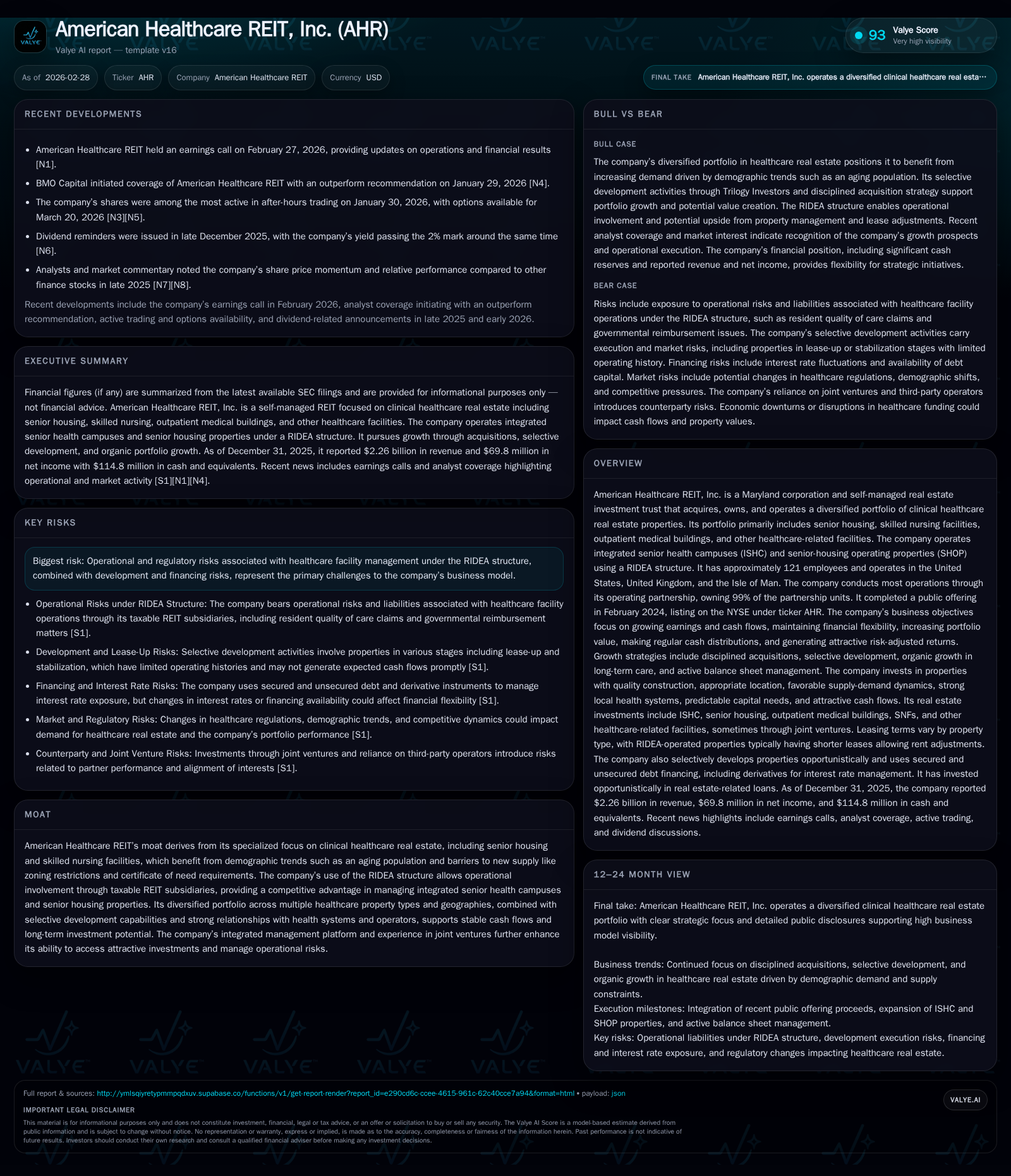
American Healthcare REIT, Inc. (AHR) has transformed from a niche clinical healthcare real estate owner to a diversified operator with $2.26 billion in revenue by 2025, expanding primarily through integrated senior health campuses and senior housing operating properties under a RIDEA structure. While this rapid expansion drove a 1771% increase in top-line from 2024 to 2025, profit margins remain challenged, reflected in modest net income and comparatively low ROE of around 2%. Looking forward, growth is supported by demographic tailwinds and selective development but moderated by regulatory complexity and concentrated geographic exposure. Capital allocation focuses on dividend distributions with no recent share repurchases, financed through debt and equity issuance, warranting close monitoring of leverage and operational cash flows.
Introduction
American Healthcare REIT, Inc. (NYSE: AHR), incorporated in Maryland, is a self-managed REIT focused on clinical healthcare real estate including senior housing, skilled nursing facilities (SNFs), outpatient medical buildings (OM), and other healthcare-related properties [S1]. The company operates uniquely through integrated senior health campuses (ISHC) and senior housing operating properties (SHOP) utilizing the REIT Investment Diversification and Empowerment Act (RIDEA) structure which facilitates operational involvement via taxable REIT subsidiaries [S1]. Since its public listing on the NYSE in February 2024 following an offering that raised approximately $773 million gross proceeds [S7], AHR has aggressively expanded its portfolio and operational footprint across the United States as well as the United Kingdom and Isle of Man [S1].
Historical Performance
AHR's historical financial trajectory reveals dramatic revenue growth powered by acquisitions, development activity via Trilogy Management Services LLC managing all ISHCs, and strategic RIDEA-enabled operations.
Historical performance (annual)
| FY | Net ($mm) | CFO ($mm) | OpInc ($mm) | Capex | Net YoY |
|---|---|---|---|---|---|
| 2025 | 70 | 294 | 415 | +284.6% | |
| 2024 | -38 | 176 | 364 | +47.1% | |
| 2023 | -71 | 99 | 307 | 0 | +12.1% |
| 2022 | -81 | 148 | 302 | 0 |
Source: SEC companyfacts cache [F1].
Capital returns and efficiency (annual)
| FY | Div ($mm) | Buybacks ($mm) | FCF ($mm) |
|---|---|---|---|
| 2025 | 164 | 0 | |
| 2024 | 121 | 0 | |
| 2023 | 76 | 0 | 99 |
| 2022 | 51 | 21 | 148 |
Source: SEC companyfacts cache [F1].
The figures indicate that until the recent two years leading up to their IPO event horizon circa early-2024,[F1] revenue was comparatively modest — under $130 million annually — reflecting early-stage operations or limited portfolio scale. Post-IPO capital inflows fueled a sharp expansion reflected in nearly twentyfold revenue increase by end-2025 [F1]. Operating income showed healthier upward momentum through consistent expansion of property earnings but lagged behind revenue growth rates suggestive of startup operational scaling or integration costs.
Net income remained negative through calendar years ending December 31 of 2022-24 but swung positive in FY25 driven by improved operational leverage and possibly one-off gains or cost control measures [F1]. Operating cash flows also scaled strongly with near tripling from about $98M in FY23 to nearly $295M by FY25 indicating robust underlying cash generation capacity essential for financing distributions.
Dividend payouts have expanded commensurately albeit still representing payout pressuring net income margins — reflective of typical REIT distribution obligations — yet highlighting a shareholder value focus amid growing cash flows [F1]. Share repurchases are negligible relative to the overall equity base indicating capital deployment preferences lie heavily on growth activities or conservation for balance sheet strength [F1].
Growth Drivers and Future Prospects
AHR's growth prospects hinge on several key pillars:
- Demographic tailwinds: The aging US population boosts demand for senior housing and skilled nursing services integrated into the company’s portfolio platforms like ISHCs and SHOPs [S1].
- RIDEA Structure Operational Leverage: The company’s use of RIDEA enables it to operate and manage healthcare facilities directly through TRSs potentially boosting returns versus pure triple-net lease REIT models where landlords lack operational control [S1][S25]. This structure allows higher margin capture but raises operational risk complexity.
- Portfolio diversification across healthcare property types: Apart from larger concentrations in senior housing (
49%) and SNFs (27%), outpatient medical buildings (~20%) provide some counterbalance while expanding into specialty care areas remains an option [S20]. - Geographic focus aligned with regional healthcare need profiles: Concentrations notably Indiana (33.4%) and Ohio (11.5%) expose AHR to specific economic cycles but also cluster advantages in healthcare network relationships [S20].
- Selective development projects managed via Trilogy: Opportunistic development mitigates reliance on acquisitions alone though capex history suggests restrained developmental spending recently [S25][S26].
- Capital Market Access: Convertible equity issuance capability—established ATM equity program for opportunistic financing—and available secured/unsecured debt enhance purchasable asset capacity subject to credit market conditions [S3][S4][S25].
Constraints & Risks
The business model faces notable headwinds:
- Regulatory complexity inherent to managing licensed skilled nursing/senior living facilities involves licensing risks including potential certificate-of-need revocation impacting revenue streams [S13][S29].
- Tenant/operator credit deterioration directly impairs rental receipts especially with financially sensitive SNFs or senior housing operators historically vulnerable to Medicare/Medicaid reimbursement fluctuations [S10][S15].
- Geographic concentration may amplify local economic downturn effects or regulatory changes causing volatility disproportionate compared with more diversified peers [S20][S22].
- Interest rate environment heightens borrowing costs limiting distribution sustainability or acquisition pace unless offset by operating efficiencies or capital mix optimization [S4][S5][S16].
- Litigation exposure tied to resident care standards or regulatory compliance can result in financial penalties impacting borrower strength plus reputational outcomes [S10][S15].
Financial Forecasting & Key Milestones
Explicit forward guidance is not detailed within disclosures; however investors should track:
- Quarterly reports for same-store NOI growth metrics; recent commentary cited notable NOI growth accelerations at ~16% indicating ongoing portfolio health improvements post FY25 [N2][N1].
- Operational performance of Trilogy as operating partner intensely influences outcomes given majority revenue share from ISHC managed properties; executive leadership transitions pose execution variance risks [S10][N1].
- Refinancing activity terms on mortgage loans closely watched amid rising interest rates influencing interest expense trajectory affecting free cash flow coverage ratios [S4][S9].
- Distributions are board discretionary though they increased materially post IPO; cash flow trends will dictate maintenance or adjustments especially if tenant stresses emerge affecting rental collections [S8][S24][N1].
Returns & Capital Allocation
ROE approximated at around a modest 2.1% based on latest annual net income over equity position signals infancy stage profitability relative to invested capital intensity though improving steadily post listing events [F1]. Operating cash flow growth substantially outpaces net income recovery suggesting non-cash charges or initial startup impairments previously burdened earnings.
Capital returns focus heavily on dividends which have escalated annually aligned with cash flow uptrends establishing shareholder yield credibility provided stable earnings sustain support; no material buybacks have been undertaken likely conserving capital for reinvestment or debt management needs given elevated leverage levels near but below internal policy limits (<30%) [F1][S4][S7][N1].
Leverage strategy balanced between unsecured lines ($550M) plus secured mortgages nearing $986M supports acquisition pipeline while necessitating careful liquidity management particularly if credit conditions tighten or macroeconomic stress persists [F1]. Credit agreements impose covenants restricting distribution ability under default scenarios adding cautionary layers for dividend sustainability as core operational performance evolves.
Industry Context & Competitive Positioning Analysis
Healthcare real estate remains an attractive niche due to aging demographics combined with barriers such as zoning regulations and certificate-of-need laws that limit new supply entry supporting occupancy stability and rent renewal power . The RIDEA model champions a hybrid landlord/operator approach uncommon among REIT peers which typically rely on triple-net leases reducing direct operating risk but missing margin upside from facility management.
However this advantage comes with specialized compliance burdens unique to healthcare operations including heightened risk scopes compared with ordinary commercial real estate REITs. Selective vertical integration via Trilogy differentiates AHR yet requires robust governance capabilities amidst regulatory scrutiny tightening worldwide including USA/UK jurisdictional overlays given international portfolio segments.
Geographically concentrated portfolios may benefit from economies of scale within local healthcare ecosystems yet introduce location-specific systemic risks contrasting diversified multi-regional operators. Balance sheet utilization with prudent hedging instruments mitigates interest rate risks critical for financial stability within current volatile capital markets.
Conclusion
American Healthcare REIT exhibits a compelling growth narrative transitioning rapidly from a smaller niche operator into a substantial clinical healthcare property platform capturing scale benefits through integrated management enabled by RIDEA structures. Nevertheless substantial execution risks remain given the complexity inherent to operating licensed senior care facilities entwined with volatile reimbursement environments plus geographic concentration hazards.
Financially the company has demonstrated remarkable revenue acceleration coupled with improving earnings patterns yet must sustain strong operational discipline alongside capital structure prudence amid tightening borrowing costs and evolving regulatory landscapes. Dividend commitments reflect confidence in underlying free cash generation although mandates linked to indebtedness covenants necessitate vigilant liquidity monitoring.
Key indicators for ongoing assessment include NOI trends reported quarterly; performance metrics of ISHC/TRIOGLY-operated assets; refinancing outcomes amidst interest rate fluctuations; tenant financial health amid reimbursement pressure; regulatory adherence status especially licensing/construction permits; plus corporate governance continuity given recent executive absenteeism.
Prospective investors or analysts should weigh AHR’s differentiated operating model against elevated risks endemic to healthcare real estate ownership entailing direct facility operation responsibilities while observing macroeconomic credit conditions shaping capital access for continued expansion.
This analysis is based solely on disclosed financial statements filed with the SEC through February 27th , 2026 as well as publicly available news sources cited herein. It is intended for informational purposes without investment advice or endorsement.
Disclaimer: This is research-only, informational analysis and not investment advice. It may include AI-generated interpretation and general industry context. Always verify important details using primary sources.

Comments