
ALICO INC: Navigating Operational Hurdles with Strategic Land Management and Solid Liquidity
A detailed look at how ALICO's agricultural land focus and liquidity cushion it amidst sales challenges and sector volatility.
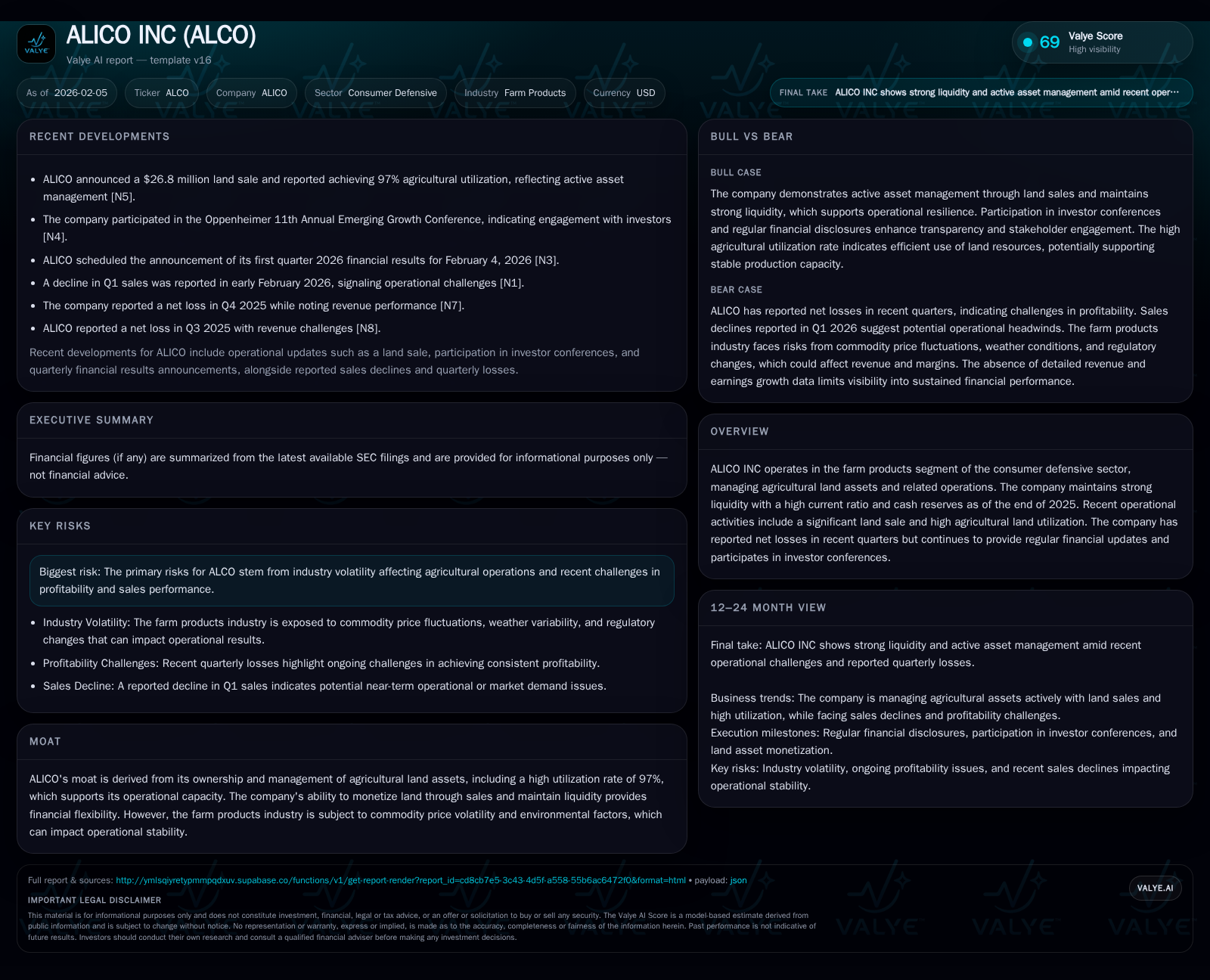
ALICO INC stands out in the consumer defensive sector through its ownership and meticulous management of agricultural land assets, achieving an outstanding 97% utilization rate that supports steady operations. Despite suffering recent net losses and a decline in sales, its strategic $26.8 million land sale has boosted cash reserves, underpinning a robust current ratio near 14.4, providing vital financial flexibility. The company faces inherent risks from commodity price fluctuations and environmental factors typical of the farm products industry but leverages its asset base and investor engagement to navigate these headwinds.
From Fields to Finance: The Core of ALICO’s Business Model
In the vast stretches where soil meets sky, ALICO INC operates not just as an agricultural enterprise but as a guardian of the earth's productive potential. Unlike typical farm product companies focused primarily on crop output or processing, ALICO anchors its business in the ownership and management of agricultural lands — assets that serve as both operational heartland and financial bedrock [S1][F1]. This farm products segment within the consumer defensive sector is distinctive because it intertwines agrarian stewardship with strategic asset management.
The company's filings reveal that its revenues derive partly from land utilization—yielding crops or leasing—and partly from land sales operations. This duality informs much of ALICO’s approach: maximize land productivity while retaining flexibility to monetize assets as needed [S1]. Such a model demands not just agricultural expertise but also prudent capital allocation decisions, setting ALICO apart from peers who may rely solely on commodity cycles.
Monetizing the Earth: Insights from the Recent $26.8 Million Land Sale
Mid-January 2026 marked a noteworthy episode when ALICO completed a $26.8 million sale of agricultural land [N5]. Far from being a routine transaction, this land sale represents both a tactical infusion of liquidity and possibly an early sign of asset portfolio optimization.
Financially, this transaction bolstered current assets significantly, contributing to the large cash holdings reported at year-end 2025—around $34.7 million in cash and equivalents [F1]. Strategically, divesting land parcels can reflect management's effort to reposition their holdings away from lower-margin or non-core tracts toward higher return properties or more diversified uses. In an industry sensitive to weather patterns, regulatory shifts, and price swings, having such capital flexibility offers a vital buffer.
Critically, this monetization does not appear to compromise operational throughput given the concurrent reported high utilization rate of remaining lands [N5]. Thus, ALICO’s disciplined approach to balancing immediate cash needs against long-term resource control is evident.
Agricultural Utilization: The Moat Behind Operational Capacity
One metric illuminates ALICO’s competitive edge clearly: a 97% agricultural land utilization rate [N5][S1]. In farm-centric businesses where idle acreage translates directly into lost output—and by extension lost revenue—achieving near full utilization is formidable.
This utilization percentage surpasses many industry averages which can often fluctuate widely based on climate conditions or crop rotation strategies. For ALICO, this figure signals rigorous land management efficacy. It ensures that nearly all owned acreage remains actively productive rather than idle or fallow.
Such operational discipline provides an effective moat; it maximizes revenue generation potential per managed acre while also dispersing fixed costs over higher output volumes. Through this lens, even when commodity prices are volatile, the company's ability to sustain consistent production levels cushions against sudden earnings shocks.
Balancing Profitability: Navigating Net Losses and Sales Decline
Despite a resilient operational base, recent quarterly disclosures paint a challenging financial portrait for ALICO. The first quarter of fiscal year 2026 exhibited a sales decline accompanied by continued net losses totaling approximately $3.48 million trailing year-end [N3][F1][S2].
This gap between operations and profitability appears driven by several converging pressures: softening crop prices amid wider commodity market fluctuations; elevated input costs such as labor or fertilizer; and potentially subdued demand dynamics globally [S2]. While operating expenses remain controlled relative to revenue drop-offs, margins have nevertheless been squeezed.
Management has acknowledged these trends but highlights ongoing efforts to stabilize revenue streams through targeted sales initiatives and enhanced cost oversight [S2]. However, absence of immediate profitability improvement implies the firm is still navigating through sectoral headwinds.
Cash is King: Assessing ALICO’s Robust Liquidity Position
Amid these operational headwinds lies perhaps ALICO’s most reassuring attribute: its financial liquidity. As of December 31, 2025, the company reported cash and equivalents exceeding $34 million alongside current assets totaling $48.8 million against current liabilities near $3.4 million—a robust current ratio around 14.4 [F1].
Such liquidity is an exceptional luxury within agriculture-related sectors often challenged by working capital constraints due to seasonality or unpredictable yield cycles. This substantial cash position permits ALICO considerable discretion in managing near-term obligations or funding strategic investments without resorting immediately to external financing.
This cushion is amplified by proceeds from recent asset sales as previously discussed [N5], underscoring how balance sheet strength serves as strategic armor amid cyclic income variability.
Industry Winds: Commodity Volatility and Environmental Risks
Interwoven with company specifics is the broader tapestry of inherent industry risks that define farm product enterprises like ALICO [S1][S2]. Commodity prices have historically fluctuated sharply due to global supply-demand imbalances, trade policy shifts, and speculative market behavior—all factors outside any single operator’s control.
Additionally, environmental challenges — including extreme weather events exacerbated by climate change — impose real risks on crop yields and land conditions. Regulatory frameworks enforcing water usage limits or pesticide applications introduce further complexity.
ALICO explicitly cites these macro-level risk factors without changes in their magnitude recently [S2], implying unchanged vigilance is necessary given their persistent nature. These uncontrollable variables mean financial discipline combined with operational prudence remains paramount for survival and eventual recovery.
Investor Engagement: What the Latest Conferences and Upgrades Signal
Against this backdrop of challenges lie signals of constructive investor relations activity possibly reflecting nuanced confidence in ALICO’s path forward. In late January 2026 the company participated in Oppenheimer’s 11th Annual Emerging Growth Conference—an event offering direct dialogue with analysts focused on firms demonstrating turnaround potential or growth opportunities [N4].
Simultaneously around mid-January an upgrade from sell-side analysts shifted ratings toward buy outlooks [N6], perhaps influenced by liquidity strength, asset quality reflected in high utilization rates, or expectations around strategic repositioning post-land sale.
Moreover, recent reviews have noted that despite setbacks this company has outpaced peers within consumer staples during parts of early 2026 trading sessions [N7], indicating selective market enthusiasm contingent on future execution ability.
These engagement layers frame current perceptions not simply as reactionary but as reflective of incremental faith in management’s stewardship amid cyclical difficulties.
Forward Look: Challenges Ahead and Strategic Flexibility
Looking forward into calendar 2026 and beyond, ALICO faces a delicate balancing act filled with both threats and options [S2][N3][N5]. The lack of material updates on risk exposures underscores ongoing external pressures will persist—commodity markets likely unsettled; environmental variables unpredictable.
Yet concurrently strong cash reserves following recent land monetizations afford strategic flexibility unusual for many farm product players under pressure. Whether deploying cash for selective acquisitions, enhancing operational efficiency measures, or simply weathering downturns comfortably without distress financing remains within reach.
This duality—the anchored foundation of productive land ownership combined with financial liquidity—allows management room to maneuver rather than retreat hastily under profit strain. Execution discipline around cost controls paired with nimble asset portfolio adjustments could well define how successfully they traverse these demanding times.
Disclaimer: This analysis is provided for informational purposes only based on publicly available data as of early February 2026. It does not constitute investment advice or recommendations regarding securities mentioned herein.
Disclaimer: This is research-only, informational analysis and not investment advice. It may include AI-generated interpretation and general industry context. Always verify important details using primary sources.

Comments