
APPlife Digital Solutions: Reverse Merger Pivot Amid Financial Strain and Opaque Fundamentals
APPlife Digital Solutions pursues a reverse merger to navigate acute liquidity pressures despite limited operational transparency.
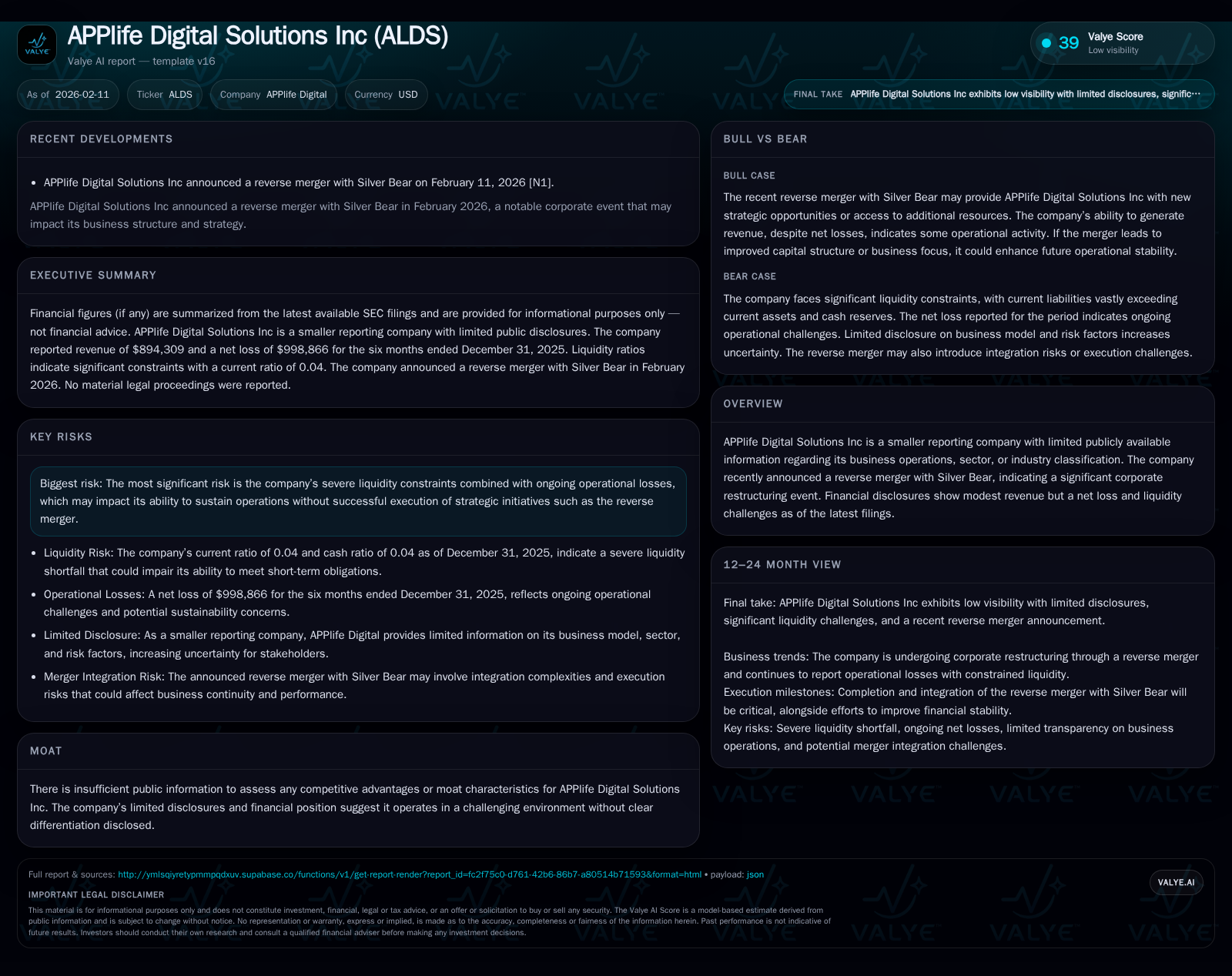
APPlife Digital Solutions Inc (ALDS) stands at a critical juncture following its announcement of a reverse merger with Silver Bear, signaling an attempt to reshape its corporate trajectory amid severe liquidity constraints and ongoing net losses. The company’s financial filings disclose modest revenues below $1 million but disproportionately high current liabilities, resulting in an alarming current ratio close to 0.04. Compounding the challenges is the paucity of information on its core business operations, sector classification, or competitive positioning, which clouds investor understanding and confidence. This analysis unpacks the merger’s strategic implications, the stark financial realities, and latent risks while emphasizing key unknowns that undermine full valuation clarity.
APPlife Digital: A Company at a Crossroads
APPlife Digital Solutions Inc occupies an enigmatic position as a smaller reporting company characterized by sparse public disclosures. According to mandated filings, it operates under regulatory thresholds requiring less expansive reporting [S1]. This limited transparency is compounded by minimal narrative surrounding its business operations or industry environment. Despite this opacity, APPlife has taken a decisive step through announcing a reverse merger with another entity, Silver Bear, an event implying substantial corporate restructuring amidst challenging circumstances [N1]. This juxtaposition—a bold strategic pivot against subdued visibility—raises essential questions about the company's survival tactics and future direction.
Decoding the Reverse Merger with Silver Bear
The February 2026 announcement detailed APPlife’s intent to execute a reverse merger with Silver Bear, a move often employed by companies seeking expedited public listing access or alternative routes to capital infusion [N1]. In this case, given APPlife's precarious financial status, the transaction appears aimed at resolving liquidity bottlenecks and enhancing operational scalability. Reverse mergers allow private entities to assume control of public shells or vice versa; they can provide balance sheet restructuring possibilities but also introduce integration complexities and transitional risk.
However, the company's public disclosures stop short of elaborating on deal specifics such as post-merger governance structures or synergy realization plans [S2]. Without these details, assessing how effectively this merger will remediate APPlife’s financial fragility remains speculative. Nonetheless, the maneuver signals management’s recognition of pressing capital deficiencies and willingness to pursue transformative corporate strategies.
Financial Reality Check: Revenues, Losses, and Liquidity
Turning to financial metrics for tangible clarity reveals a stark picture of operational strain. For the fiscal year ending December 31, 2025, reported revenues were approximately $894,309 [F1], modest in scale for sustaining substantial growth or investment into infrastructure. Conversely, net income registered at a loss of $998,866 over the same period [F1], reflecting persistent unprofitability.
More concerning is the liquidity profile: current assets totaled only $152,539 while current liabilities ballooned to $3,418,288 [F1]. This imbalance yields a perilously low current ratio near 0.04—far below generally accepted solvency thresholds indicating imminent cash flow stress. Furthermore, cash on hand was limited to a mere $137,330 at year-end [F1], insufficient to cover near-term obligations without immediate external funding.
These figures collectively depict a company struggling to maintain operational footing without structural overhaul or fresh capital injections—a context underpinning the urgency behind the merger strategy.
Risk Landscape: The Investment and Operational Challenges Ahead
APPlife’s SEC filings explicitly enumerate risks that spotlight underlying vulnerabilities [S1,S2]. Prominent among these are risks related to severe liquidity constraints coupled with ongoing operating losses. The company cautions that failure to secure additional financing or successfully implement strategic initiatives—such as the announced reverse merger—could materially impair its business continuity.
Other risk descriptions underscore typical dangers facing smaller reporting companies including susceptibility to market volatility, competitive pressures absent clear differentiation measures (which APPlife does not publicly articulate), and potential dilution risks tied to capital raising efforts. Collectively these highlight a fragile investment proposition wherein shareholder value could be eroded rapidly if turnaround efforts falter.
What We Don’t Know: Gaps in Business Transparency
One of the most notable issues complicating assessment is APPlife’s lack of disclosed sectoral or industry classifications [S1]. Without explicit industry assignment or description of product/service offerings, benchmarking against peers or understanding competitive dynamics becomes impractical.
This opacity extends to absence of any mentioned competitive moats or proprietary advantages within public documents—factors vital for predicting sustainable profitability or market defensibility [valye_report_excerpt]. As such, investors face pronounced informational asymmetry that restrains confident diligence or valuation modeling.
Management’s Strategy and Forward-Looking Ambiguities
Management commentary within recent quarterly filings touches on future plans predominantly in aspirational terms focused around expected benefits from the reverse merger integration [S2]. However, these forward-looking disclosures lack granular specifics regarding timelines for revenue ramp-up post-merger or measurable milestones for loss reduction initiatives.
Moreover, no detailed articulation exists on how management intends to address fundamental issues such as accelerated sales growth channels or cost structure rationalization. This leaves considerable strategic ambiguity at a time when precise roadmap articulation is crucial for credibility building.
Industry Positioning: Seeking Context Amid Limited Data
Absent direct knowledge of APPlife’s exact industry vertical diminishes our ability to contextualize market opportunities or threats comprehensively. Nonetheless, based on general patterns observed in comparable small-cap firms pursuing reverse mergers amid financial distress—as documented within broader industry scholarship—common challenges persist:
- Intense competitive environments requiring differentiated technology or services,
- Difficulty attracting institutional investor interest given risk-profile,
- Operational scaling hurdles exacerbated by tight liquidity,
- Dependence on successful restructuring transactions that may disrupt short-term operations. These inferred themes provide tentative backdrop though application should be cautious given limited company-specific data.
Investment Implications: Navigating High-Uncertainty Ground
For stakeholders considering engagement with APPlife Digital Solutions Inc., multiple critical factors converge into a high-risk profile characterized by potential reward contingent upon successful execution of complex restructurings with no assured outcomes. Its severe liquidity shortage paired with consistent net losses demands urgent resolution mechanisms epitomized currently by the Silver Bear reverse merger announcement.
Yet lack of transparent information regarding underlying business activities and absence of clear operational turnaround blueprints exacerbates uncertainty surrounding future performance trajectories. Investors must therefore balance acknowledgment of proactive corporate maneuvers against material risks emanating from financial frailty and informational opaqueness meticulously highlighted within regulatory disclosures.
Disclaimer: This analysis is provided solely for informational purposes based on publicly available data as of February 2026. It does not constitute investment advice or recommendations. Readers should conduct their own independent research before making any financial decisions and consider consulting professional advisors regarding individual circumstances.
Disclaimer: This is research-only, informational analysis and not investment advice. It may include AI-generated interpretation and general industry context. Always verify important details using primary sources.

Comments