
Align Technology’s Earnings Pressure and Growth Hurdles After 2025
Recent margin compression alongside macroeconomic pressures signal a pivotal challenge for Align Technology's sustained growth trajectory.
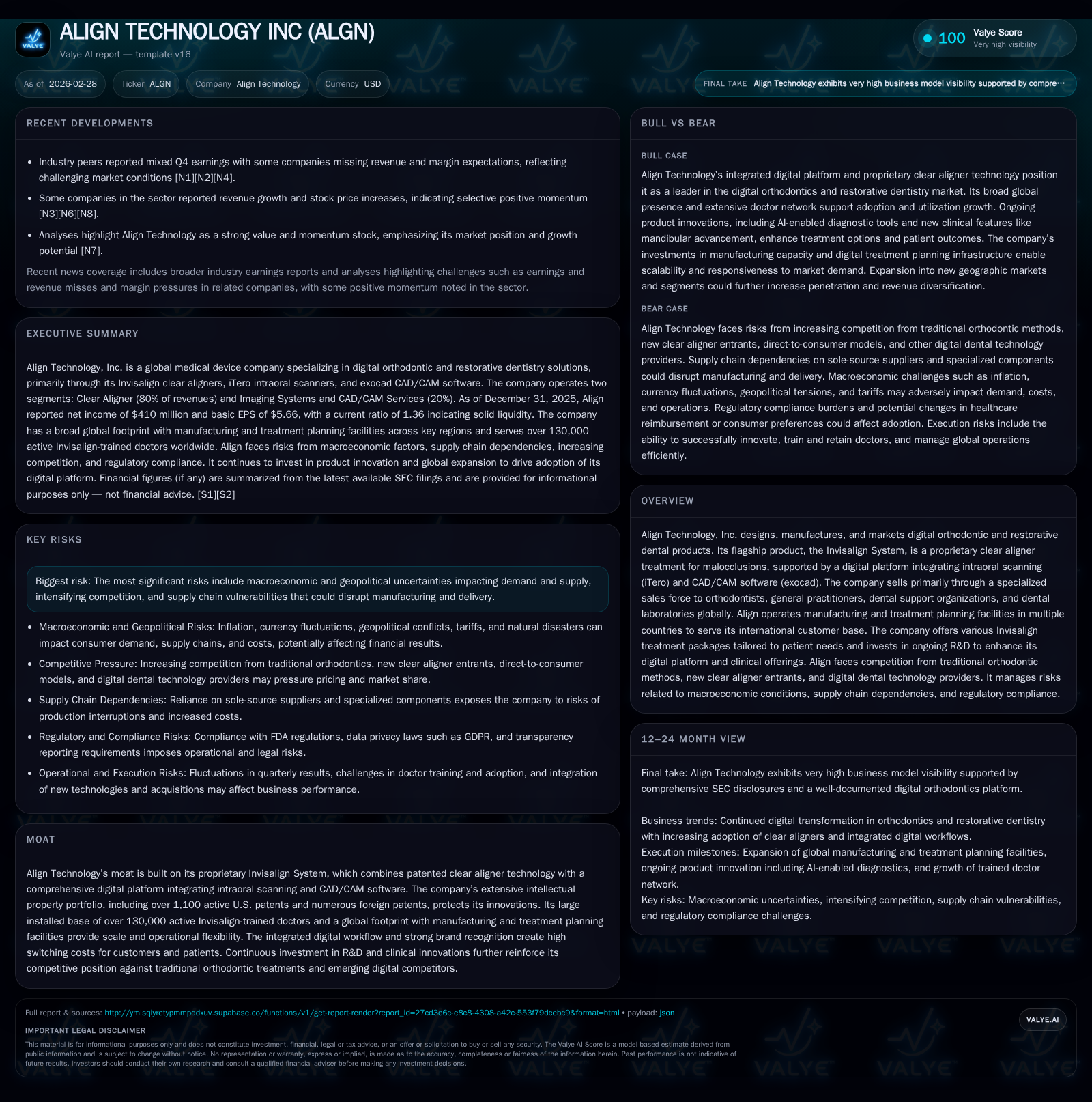
Align Technology exhibited robust revenue growth driven by its Invisalign clear aligner platform through 2024, but 2025 saw operating income decline by over 10% amid inflationary cost pressures and competitive headwinds. The company's integrated digital orthodontic platform underpins a strong moat, though discretionary consumer spending softness and intensifying competition constrain near-term growth. Capital returns remain significant via share repurchases, supported by solid free cash flow generation despite operating margin compression. Regulatory compliance risks and evolving AI-related challenges add complexity to Align’s strategic execution in a dynamic market environment.
Sustained Growth Fueled by Invisalign Platform: Historical Performance Review
Align Technology’s revenue growth has been predominantly driven by its flagship Invisalign System, which accounted for roughly 80% of worldwide net revenues in FY2025 [S13]. Over recent years, the company expanded its clear aligner adoption significantly through an extensive network of over 130,000 active Invisalign-trained doctors globally [S21]. This scale has entrenched the Invisalign treatment as a preferred solution for malocclusion correction among orthodontists and general practitioners (GPs).
The company’s integrated digital platform—combining Invisalign treatments with the iTero intraoral scanners and exocad CAD/CAM software—has broadened clinical workflows, boosting practitioner utilization rates . Demand for advanced digital orthodontics also benefited from rising acceptance of electronic impressioning and computer-aided design in restorative dentistry.
Financially, from FY2022 through FY2024, Align showed steady operating income growth (from approximately $642.6M to $607.6M) and net income trends supporting sustained profitability [F1]. However, a detailed view shows FY2025 as a turning point where margin pressure emerged (see table below).
Historical performance (annual)
| FY | Net ($mm) | CFO ($mm) | OpInc ($mm) | Capex ($mm) | Net YoY |
|---|---|---|---|---|---|
| 2025 | 410 | 593 | 546 | 102 | -2.6% |
| 2024 | 421 | 738 | 608 | 116 | -5.3% |
| 2023 | 445 | 786 | 643 | 178 | +23.1% |
| 2022 | 362 | 569 | 643 | 292 |
Source: SEC companyfacts cache [F1].
Capital returns and efficiency (annual)
| FY | Buybacks ($mm) | FCF ($mm) | ROE% |
|---|---|---|---|
| 2025 | 466 | 491 | 10.1 |
| 2024 | 353 | 623 | 10.9 |
| 2023 | 592 | 608 | 12.3 |
| 2022 | 435 | 277 | 10.0 |
Source: SEC companyfacts cache [F1].
Note: Absolute revenue figure is only available for FY2025; prior years’ revenue figures are not specified but known to have grown.
Margin Erosion and Operating Income Contraction: What Changed in 2025?
In FY2025, Align experienced a notable decline in operating income of approximately 10.2%, slipping to $546M from $608M in FY2024 [F1]. Net income decreased modestly by about 2.6%, indicating some mitigation from other income statement items or tax effects but still reflecting profit pressure.
Operating cash flow was hit more sharply with a nearly 20% drop year-over-year to $593M [F1], consistent with margin compression pressures reported during Q4 earnings [N1][S3]. The contraction correlates with increased inflation-driven costs affecting raw materials, labor rates, energy expenses, and shipping fees described extensively in SEC disclosures [S1][S2]. Additionally, pricing constraints to maintain competitive positioning inhibited full pass-through of these increased costs.
Supply chain inefficiencies likely contributed to elevated working capital demands further dampening cash flows and profitability [N1][S1]. These operational headwinds contrast against previous years when margin expansions accompanied volume growth.
The combination of inflationary pressure amid macroeconomic uncertainty has eroded Align’s historical operational leverage that powered prior earnings momentum.
Macroeconomic Headwinds and Competitive Pressures Shape Growth Outlook
Broader economic factors materially influence Align’s demand environment given the elective nature of orthodontic procedures [S1][S2]. Rising interest rates alongside elevated household inflation have constrained discretionary spending capacity among patients seeking cosmetic dental treatments such as clear aligners.
This outcome manifests in fewer case starts at practice levels as financial outlays for such treatments become subject to greater scrutiny both by consumers and healthcare providers [S1][N13]. Increased price sensitivity has encouraged some patients and doctors to revert toward traditional orthodontic options like wires and brackets which remain less costly though less aesthetic [S23].
Competition has intensified with regional entrants proliferating alongside mature direct-to-consumer models that offer cheaper products with limited clinical supervision [S23]. New technologies employing lower-cost intraoral scanning competitors also threaten the iTero ecosystem.
Practice-level capital investments have slowed due to economic uncertainty reducing purchases of high-end scanners and CAD/CAM solutions crucial for driving precision and efficiency gains in treatment workflows [S23][N13]. These dynamics temper Align’s near-term addressable market expansion potential.
Digital Platform Integration as a Moat Against Emerging Competitors
Despite these headwinds, Align’s substantial moat is anchored by its proprietary technology suite that integrates patented clear aligner formulations with digital capabilities—namely the iTero intraoral scanners intertwined with exocad CAD/CAM restorative software [S13].
This comprehensive end-to-end digital orthodontic workflow creates orthogonal value beyond product alone: efficient diagnosis via precise scans, sophisticated case planning enabled through CAD interfaces, ongoing treatment monitoring facilitated digitally—all contributing to higher-quality outcomes termed orthodontic case retention within the professional community.
With over 1,100 active U.S. patents protecting intellectual property coupled with sizable foreign patent holdings safeguarding international markets, addressing infringement risk remains central to competitive defense strategies [S12][S15]. The ecosystem effect also produces high switching costs for trained doctors who rely on integrated hardware/software workflows creating inertia favoring continued Invisalign utilization.
Further reinforcing this position are manufacturing scale benefits realized through global operations enabling flexible supply chains even as competitors struggle to match volume without sacrificing quality or compliance .
Capital Allocation: Buybacks, Dividends, and Free Cash Flow Generation
Align continues substantial capital returns emphasizing share repurchases that reached approximately $466 million in FY2025 compared with $353 million in FY2024 [F1]. This repurchase activity reflects management's prioritization of shareholder value despite margin challenges.
Free cash flow generation remains robust at nearly $491 million for FY2025 after deducting capital expenditures ($102 million) from operating cash flows ($593 million) [F1], highlighting persistent internal liquidity even during profitability pressure phases.
Equity base expanded somewhat reaching about $4 billion at December-end FY2025 resulting in a calculated return on equity close to 10.1%, illustrating moderate capital efficiency amidst challenging conditions [F1].
Such financial discipline suggests confidence in long-term structural advantages while balancing short-term profitability adjustments through operating expense control.
Regulatory Landscape and Risk Factors Impacting Business Trajectory
Align must navigate complex regulatory regimes globally including FDA medical device approvals dictating product designs safety efficacy labeling marketing practices [S5][S6][S9]. The fast-evolving nature of AI applications incorporated into new product development introduces potential new compliance burdens related to AI model validation data privacy cybersecurity risk management—risks highlighted explicitly within recent disclosures emphasizing scrutiny on third-party AI modules usage scenarios potentially exposing IP infringement liabilities or biased clinical outputs [S22][S24].
Additionally, antitrust investigations regarding dominant market positioning remain an ongoing concern alongside tightening global data protection laws governing healthcare information handling particularly concerning marketing data use via cookies or electronic communications channels impacting sales strategies [S4][S11][S16][S19].
Regulatory obstacles may cause launch delays or require costly process modifications leading to margin squeezes or forfeited addressable markets particularly when government agency staffing disruptions pose risks of approval timeline elongation highlighted since recent federal workforce contraction trends affecting FDA operations [S20].
Legal proceedings involving intellectual property enforcement add another layer of operational uncertainty potentially requiring licensing agreements or risking injunctions adversely impacting business continuity if unfavorable outcomes arise [S12][S15].
Catalysts to Watch: New Product Launches, Market Expansion, and Strategic Initiatives
Although explicit forward guidance post-2025 is limited within current filings, investor focus should center on anticipated innovation pipeline progress enhancing personalized care leveraging AI-enabled treatment customization likely building on existing SmartTrack aligner materials advancements outlined previously [N14]. Monitoring geographic penetration especially within emerging international markets where dental service adoption curves remain earlier-stage will be key signals for validating growth resumption potential.
Strategic emphasis on refining consumer marketing channels aimed at increasing patient awareness alongside simplified sales rebate schemes targeting incremental clinical utilization could stimulate doctor engagement improvements [N13][S21]. The evolution towards direct three-dimensional printing integration within manufacturing processes promises operational efficiencies that may enhance margins if successfully commercialized.
Expansion efforts targeting Dental Support Organizations (DSOs) present an emerging channel opportunity aligned with broader healthcare consolidation trends potentially augmenting scale advantage while diversifying revenue streams beyond traditional individual practitioner models [S13][N13].
Tracking regulatory approval cycles related to next-generation devices incorporating more extensive AI functionalities will provide insight into Align’s capability to stay ahead competitively while managing compliance risks effectively.
Disclaimer: This analysis summarizes publicly disclosed financials and regulatory information about Align Technology as of February 28, 2026. It is intended solely for informational purposes without constituting investment advice or recommendations. Users should consider all risks described in official filings when evaluating company prospects.
Disclaimer: This is research-only, informational analysis and not investment advice. It may include AI-generated interpretation and general industry context. Always verify important details using primary sources.

Comments