
Autonomix Medical’s Neural Sensing Catheter Balances Innovation with Nasdaq Compliance Challenges
Autonomix Medical pioneers a minimally invasive neural sensing and ablation platform targeting pancreatic cancer pain while confronting critical regulatory and market hurdles.
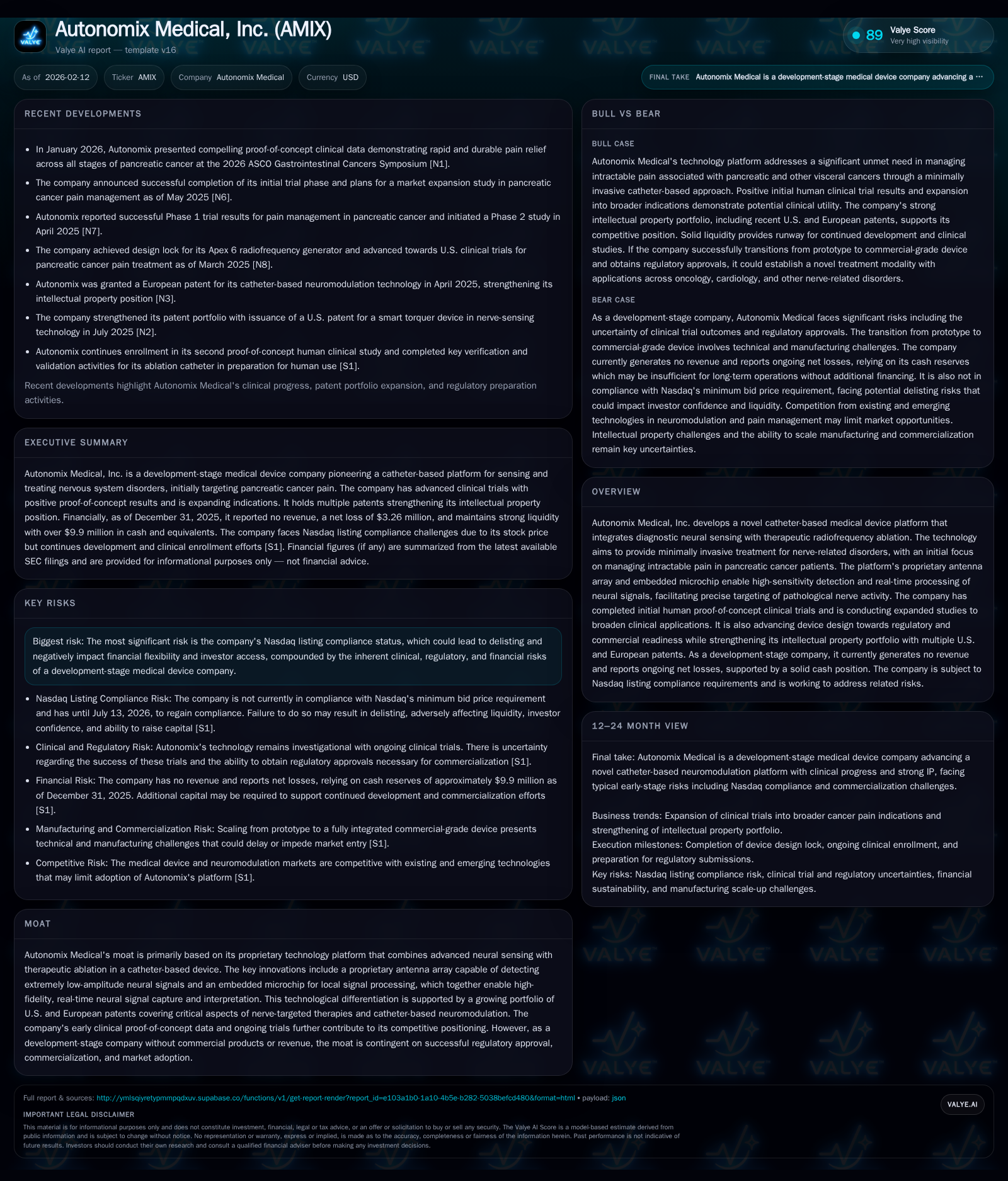
Autonomix Medical, Inc. has advanced an innovative catheter-based technology integrating diagnostic neural sensing with therapeutic radiofrequency ablation aimed initially at managing refractory pancreatic cancer pain. Recent proof-of-concept clinical data showcased at ASCO 2026 validates rapid and durable symptom relief, reinforcing potential clinical value. Yet, the company operates without commercial revenue and faces significant near-term risks, particularly regarding Nasdaq listing compliance due to sustained low share prices, which threaten delisting by mid-2026 unless remediated. Autonomix is actively progressing regulatory submissions, expanding clinical trials, and reinforcing its intellectual property estate to underpin future commercialization amid a challenging financial and competitive landscape.
Breaking New Ground: The Promise of Autonomix’s Neural Sensing Device
Autonomix Medical has crafted a paradigm-shifting approach within interventional neurotherapeutics through its novel catheter-based platform that marries diagnostic neural sensing with radiofrequency (RF) ablation therapy [F1]. This minimally invasive device stands apart by incorporating an advanced antenna array capable of capturing ultra-low amplitude nerve signals paired with an embedded microchip that processes these signals in real time. The immediate clinical indication — alleviating persistent pain in pancreatic cancer patients refractory to standard treatments — is a compelling use case given the significant unmet need for effective management of neuropathic pain associated with visceral tumors [F1]. The integration of precise neural diagnostics directly inside the catheter architecture enables selective targeting of pathological nerve activity rather than indiscriminate tissue ablation common to existing methods.
Clinical Highlights: PoC Trial Data Unveiled at ASCO 2026
At the 2026 ASCO Gastrointestinal Cancers Symposium, Autonomix presented encouraging proof-of-concept clinical trial results evidencing rapid reduction in pain scores among study participants at various stages of pancreatic cancer [N1]. Notably, the intervention demonstrated both rapid onset of analgesia and durability over follow-up intervals with minimal adverse events reported. While preliminary in scope, these data substantiate the device’s capacity to modify aberrant nerve signaling implicated in refractory cancer pain syndromes. This presentation marked an important clinical validation milestone supporting expansion into broader nerve-related disorder indications as well as underpinning further regulatory interactions [N1]. The attention garnered underscores the potential differentiation from conventional analgesics or purely ablative strategies that lack integrated neural feedback mechanisms.
Inside the Technology: Proprietary Antenna and Embedded Microchip Innovation
Central to Autonomix’s competitive differentiation is its proprietary antenna array design tailored for heightened sensitivity to low-amplitude neural signals embedded along the catheter shaft [F1]. This hardware synergy with a custom microchip performing localized signal processing bypasses latency issues inherent in external signal analysis platforms. Such integration enables closed-loop feedback during ablation to adjust energy delivery dynamically based on real-time nerve activity detection. This fine-grain control enhances safety by restricting unnecessary tissue damage while optimizing efficacious targeting of dysfunctional nerve fibers responsible for chronic pain generation.
Compared to incumbent neuromodulation technologies relying either on peripheral nerve stimulation or chemical neurolysis without direct signal feedback, Autonomix’s platform offers precision unavailable elsewhere. This technical distinction underpins its patent-protected moat.
Financial Snapshot: Balancing R&D Costs Against a Pre-Revenue Status
As reflected in its latest SEC filing ending December 31, 2025, Autonomix operates as a pure development-stage entity with zero reported revenue [F1]. The net loss stands at approximately $3.26 million over this period reflecting continued investment in R&D activities including clinical studies and device engineering [F1]. The company maintains roughly $9.93 million in cash and equivalents creating a comfortable short-term liquidity buffer.
Encouragingly, current assets exceed current liabilities by a factor exceeding six (current ratio = 6.18), highlighting prudent management of working capital [F1]. Nevertheless, sustaining R&D expenditure without incoming sales necessitates continued access to external capital markets or strategic partnerships underscored by existing risks outlined in SEC disclosures [S2].
NASDAQ Crossroads: Navigating Listing Compliance and Shareholder Impact
Following several consecutive months of share price trading below Nasdaq’s minimum $1 bid price threshold, Autonomix received a deficiency notice from Nasdaq’s Listing Qualifications Department on January 14, 2026 [S2]. This triggers an initial grace period extending until July 13, 2026, within which the company must restore compliance—that is achieve or sustain a closing bid above $1 per share over ten consecutive business days—or face potential delisting actions.
Failure to meet this threshold could result in either pursuit of an additional compliance window granted under specific criteria or outright removal from Nasdaq trading [S2]. To address this issue proactively, management has indicated consideration of corporate maneuvers including reverse stock splits aimed at artificially elevating per-share pricing [S2].
Delisting would pose significant ramifications impacting stock liquidity, investor confidence, institutional participation eligibility, and ability to raise capital publicly—each critical elements for funding late-stage development and eventual product commercialization [S2]. Shareholders may face volatility or diminished market access during such transitions.
Regulatory and Commercial Roadmap: From Clinical Trials to Market Launch
Progressing beyond proof-of-concept validation requires successful navigation through rigorous regulatory submission processes primarily led by FDA pathways within the United States complemented by CE mark considerations for Europe [F1][S2]. Ongoing expanded human studies seek not only to confirm initial efficacy but also broaden patient indications encompassing other nerve-related conditions.
Device design optimization continues concurrently focusing on manufacturability scale-up and quality assurance pivotal for eventual commercial release [S2]. Collaborations with contract manufacturers have been initiated but details remain sparse. Regulatory timelines inherently face uncertainties tied to trial outcomes, agency feedback cycles, and potential need for supplementary evidence or post-market surveillance commitments.
Commercial launch strategies presumably will target interventional oncology centers before scaling out into wider pain management practices pending reimbursement approvals—a path typical yet challenging given emerging technology adoption curves.
Patent Fortress: Evaluating Intellectual Property Strengths and Moat Sustainability
Autonomix has amassed a series of U.S. and European patents covering core components including antenna architecture design, embedded microchip algorithms for neural signal processing, as well as methods integrating diagnostic sensing with RF ablation therapy within catheters [F1]. This patent portfolio forms the backbone of its technological defense against competitors seeking equivalent neuromodulation solutions.
However, patent durability must be viewed within the context of medical device innovation cycles where rapid generational advancements can erode advantages unless continuously supplemented by updated filings or trade secrets protection. Moreover, enforcement costs related to potential infringement litigation could weigh on financial resources during commercialization phases.
Risks and Unknowns: Operational Hurdles and Market Pressures Ahead
The company's path forward faces multilayered risk vectors well detailed in recent SEC risk factor updates [S2]. Principal concerns stem from uncertainty around positive definitive clinical trial results needed for widespread regulatory approval; any setbacks here could delay approval timelines significantly.
Supply chain volatility impacting key components manufacture or part availability represents another operational vulnerability as third-party dependencies grow alongside scaling efforts [S2]. Intellectual property disputes loom as competitors intensify efforts toward neuromodulatory device innovation in this attractive niche potentially challenging patent claims.
Financially sustained losses without near-term revenues compound liquidity constraints forcing reliance on successful equity raises or partnerships amid volatile biotech capital markets disturbed additionally by possible Nasdaq delisting consequences.
Lastly external competition hailing from established device manufacturers pursuing alternative neuromodulatory approaches adds pressure on market acceptance once launched.
Analyst Take: Valuing Innovation Amidst Early-Stage Development Dynamics
Autonomix Medical’s neural sensing catheter platform embodies both cutting-edge technological promise and development-stage uncertainty characteristic of medtech pioneers. The clinical data showcased recently provide encouraging signals validating its fundamental premise: combining precise neural diagnostics with targeted therapeutic ablation yields meaningful clinically relevant benefits for an unmet pain management arena linked to pancreatic cancer.
Yet translating this promise into commercial success hinges critically on overcoming immediate hurdles—nasdaq compliance looming large among them—as well as sustaining robust trial progression accompanied by scalable manufacturing capabilities.
Investors monitoring this story should track key inflection points including subsequent clinical milestones beyond initial PoCs; FDA regulatory interactions revealing approval outlook; Nasdaq remediation engagements affecting stock liquidity; alongside capital raise executions preserving operational runway. In sum, Autonomix represents an innovative endeavor warranting cautious attention amidst dynamic developmental trajectories poised at an intersection between transformative healthcare impact potential versus standard early-stage execution risks common within emerging medtech enterprises.
This analysis is based solely on information provided by Autonomix Medical's SEC filings as of February 11, 2026 [F1][S2] and recent corporate disclosures including ASCO symposium presentations dated January 9, 2026 [N1]. It does not constitute investment advice or recommendations but aims to deliver a balanced evaluation grounded in available data relevant for professional investors following medtech innovation ecosystems.
Disclaimer: This is research-only, informational analysis and not investment advice. It may include AI-generated interpretation and general industry context. Always verify important details using primary sources.

Comments