
Amaze Holdings’ Transition to Creator-Commerce Platform Tests Scalability Amid Financial Strains
Recent quarterly disclosures highlight Amaze Holdings' strategic pivot from legacy product sales to a technology-driven commerce platform serving creators and brands.
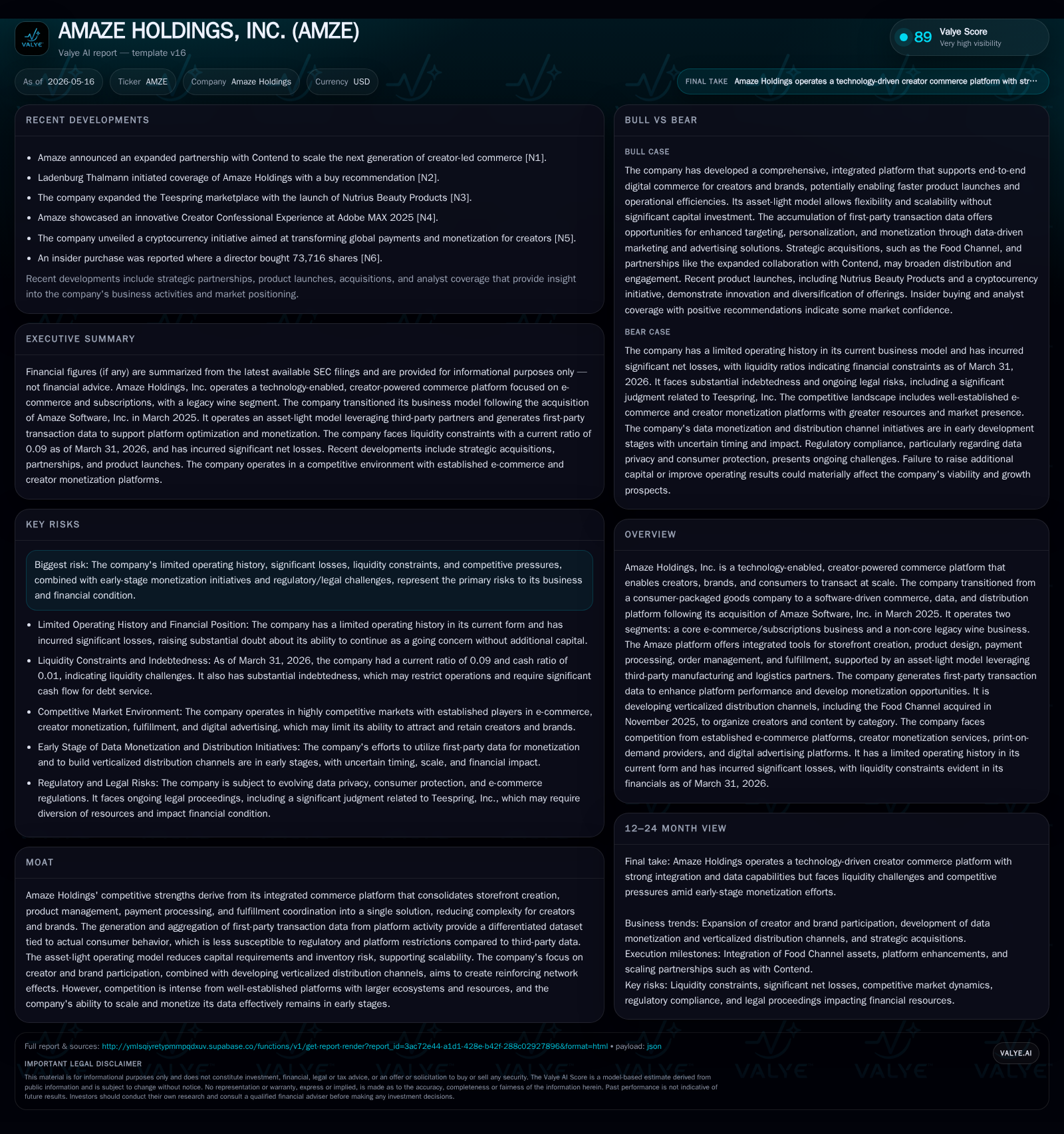
Amaze Holdings, Inc. has shifted its business model from consumer-packaged goods to a software-enabled creator-powered commerce platform following its acquisition of Amaze Software in early 2025. The latest quarterly filings reveal ongoing operational challenges including significant net losses, liquidity constraints, and underdeveloped monetization streams, despite progressive expansion initiatives such as acquiring the Food Channel. The company's asset-light platform integrates end-to-end commerce tools designed to attract and retain creators by simplifying storefront management, product development, payment processing, and fulfillment through third-party partnerships. Industry competition remains intense with larger platforms exerting significant pressure. Key risks center on Amaze’s limited operating history in its new model, heavy debt load, and legal contingencies. Upcoming milestones include further platform monetization development and scaling vertical distribution channels critical for sustaining growth momentum.
Recent Operating Update
In its latest quarterly report filed May 15, 2026 [S2], Amaze Holdings disclosed continued operational strain characterized by persistent net losses and tight liquidity. The balance sheet shows total debt of approximately $6.4 million against current assets near $2.1 million as of March 31, 2026, resulting in a current ratio around 0.09 [F1]. Such figures highlight constrained working capital that could impair short-term operations or require additional financing inflows. No material changes or explicit refinancing were disclosed recently.
While no new explicit guidance was issued in the quarter or subsequent event filings [S3], management reiterated ongoing development efforts targeting revenue growth through enhanced platform capabilities and expanded vertical distribution channels.
Business Model
Amaze Holdings undertook a transformative pivot in March 2025 when it acquired Amaze Software and repositioned itself from a legacy wine producer (Fresh Vine Wine) into a technology-driven commerce enabler focused on the growing creator economy [S1][S7]. Its business now centers around an integrated digital commerce platform that empowers individual creators and emerging brands to build online storefronts, design products rapidly, manage payments and orders seamlessly, and coordinate fulfillment all within one ecosystem [S8][S13].
Revenue is primarily derived from first-party transactions occurring on the platform within the e-commerce/subscription segment; this includes fees charged for use of the technology stack as well as ancillary services like marketing analytics and distribution support [S24]. Pricing drivers involve transactional volume influenced by user acquisition and retention rates plus pricing structures for platform subscriptions or service tiers. Margins depend heavily on efficient outsourcing arrangements since the firm operates an asset-light model leveraging external manufacturing and logistics providers [S13]. This setup reduces inventory risk but requires robust partner coordination.
A key future monetization vector lies in harnessing proprietary first-party data generated through user transactions—consumer behavior patterns, preferences, engagement metrics—which management plans to deploy toward targeted marketing solutions aiming to boost conversion rates for creators [S8][S24]. However, these data-based revenue streams remain nascent.
On the periphery, Amaze maintains its legacy wine business segment but acknowledges this line as non-core with minimal expected contribution to longer-term growth [S7].
Industry Structure & Competitive Position
The creator economy's digital commerce space is extremely competitive with dominant players such as Shopify, Etsy, Amazon’s influencer programs, and a myriad of social media platforms integrating direct-to-consumer shopping capabilities. Amaze seeks to differentiate itself by offering an end-to-end integrated solution tailored specifically for creators—bundling storefront setup through fulfillment alongside robust data insights in one platform—to reduce complexity inherent in managing scattered tools.
The generation of high-value first-party data tied directly to transactional activity offers potential competitive moat given rising regulatory restrictions curtailing access to third-party consumer data elsewhere. Additionally, adopting an asset-light operating model aligns with scalability ambitions while avoiding capex-intensive manufacturing or warehousing infrastructure commitments common in product-centric businesses.
Nevertheless, comparatively small scale relative to industry incumbents constrains Amaze’s ability to offer similarly comprehensive ecosystems or capitalize fully on network effects that accrue with large creator bases.
Growth Drivers
Growth initiatives focus on three main thrusts:
- Platform Adoption & Monetization: Increasing the number of active creators leveraging Amaze’s tools boosts transaction volume directly enhancing revenue opportunities. Concurrently refining pricing models promises higher revenue per user/transaction.
- Data-Driven Services: Developing capabilities that convert proprietary transaction data into effective marketing insights and personalized advertising solutions could unlock incremental monetization avenues beyond core subscription/transaction fees.
- Verticalized Distribution Channels: The Food Channel acquisition exemplifies efforts to cluster content creators according to thematic interests thereby enhancing discoverability for consumers and fostering repeat engagement on specific platforms [S7][S24]. Successfully scaling such channels may amplify cross-selling opportunities between creators sharing audiences.
Each driver depends heavily on execution quality including technology integration progress, creator recruitment & retention effectiveness, user experience refinements driving conversion rates; all remain works-in-progress.
Risks & Watchpoints
- Liquidity & Financial Condition: Low current ratios coupled with substantial debt elevate default risk; inability to secure timely capital infusions could disrupt operations or curtail expansion plans [F1][S1].
- Limited Operating History: Having transitioned recently into software-driven commerce from packaged goods production means unproven track record in execution reliability within this domain or predicting market demand dynamics accurately [S1].
- Competitive Pressures: Entrenched competitors benefit from broader ecosystems which may limit customer acquisition or exert downward pricing pressure.
- Regulatory Compliance: Evolving privacy laws (e.g., tighter consumer data protections) impose compliance costs on data handling practices essential for outperformance via data monetization strategies [S22].
- Legal Proceedings: Outstanding litigation related to vendor disputes may result in unexpected liabilities adding to financial strain [S1].
- Management Experience: Limited exposure among leadership managing public company complexities could hinder timely responses to operational challenges or investor communications [S12].
- Macroeconomic Conditions: Consumer discretionary spending volatility driven by economic downturns can affect transaction volumes across creator-driven marketplaces reducing top-line growth potential.
What To Watch Next
Key upcoming milestones include:
- Progress updates on vertical channel scaling outside Food Channel;
- Evidence of increased revenue per user driven by refined pricing structures or upselling additional services;
- Early traction metrics for data-driven advertising offerings;
- Capital raising activity details providing insight into financial runway sustainability;
- Resolution or developments regarding material litigation impacting balance sheet risk profile;
- Any shifts in management team composition strengthening public company governance.
These indicators will collectively signal whether Amaze can execute its strategic repositioning effectively amid financing constraints.
Financial Profile (Latest Snapshot)
Latest financial snapshot
| Metric | Value | Period |
|---|---|---|
| Total debt | $6.41 M | |
| 2026-03-31 | ||
| Net debt | $6.25 M | |
| 2026-03-31 | ||
| Current assets | $2.10 M | |
| 2026-03-31 | ||
| Current liabilities | $24.27 M | |
| 2026-03-31 | ||
| Current ratio | 0.09x | |
| 2026-03-31 |
Source: SEC companyfacts cache [F1].
| Metric | Value | Period End |
|---|---|---|
| Revenue | $1.97 M | |
| 2025-12-31 | ||
| Operating Income | -$54.4 M | |
| 2025-12-31 | ||
| Net Income | -$55.2 M | |
| 2025-12-31 | ||
| Cash & Equivalents | $156 K | |
| 2024-12-31 |
The most recent available annual results reflect significant operating losses heavily outweighing revenues consistent with investments in restructuring toward a tech-oriented model [F1]. Cash reserves are minimal relative to liabilities highlighting urgency around capital sourcing while supporting modest ongoing operations.
Disclaimer: This analysis is based exclusively on publicly available disclosures including recent SEC filings up to May 2026 without incorporating insider information or market speculation. It does not constitute investment advice.
Disclaimer: This is research-only, informational analysis and not investment advice. It may include AI-generated interpretation and general industry context. Always verify important details using primary sources.

Comments