
Annovis Bio Advances Clinical Frontiers with Buntanetap Amid Funding Challenges
Latest quarterly progress on Phase 3 trials underscores Annovis Bio's developmental momentum as liquidity pressures persist.
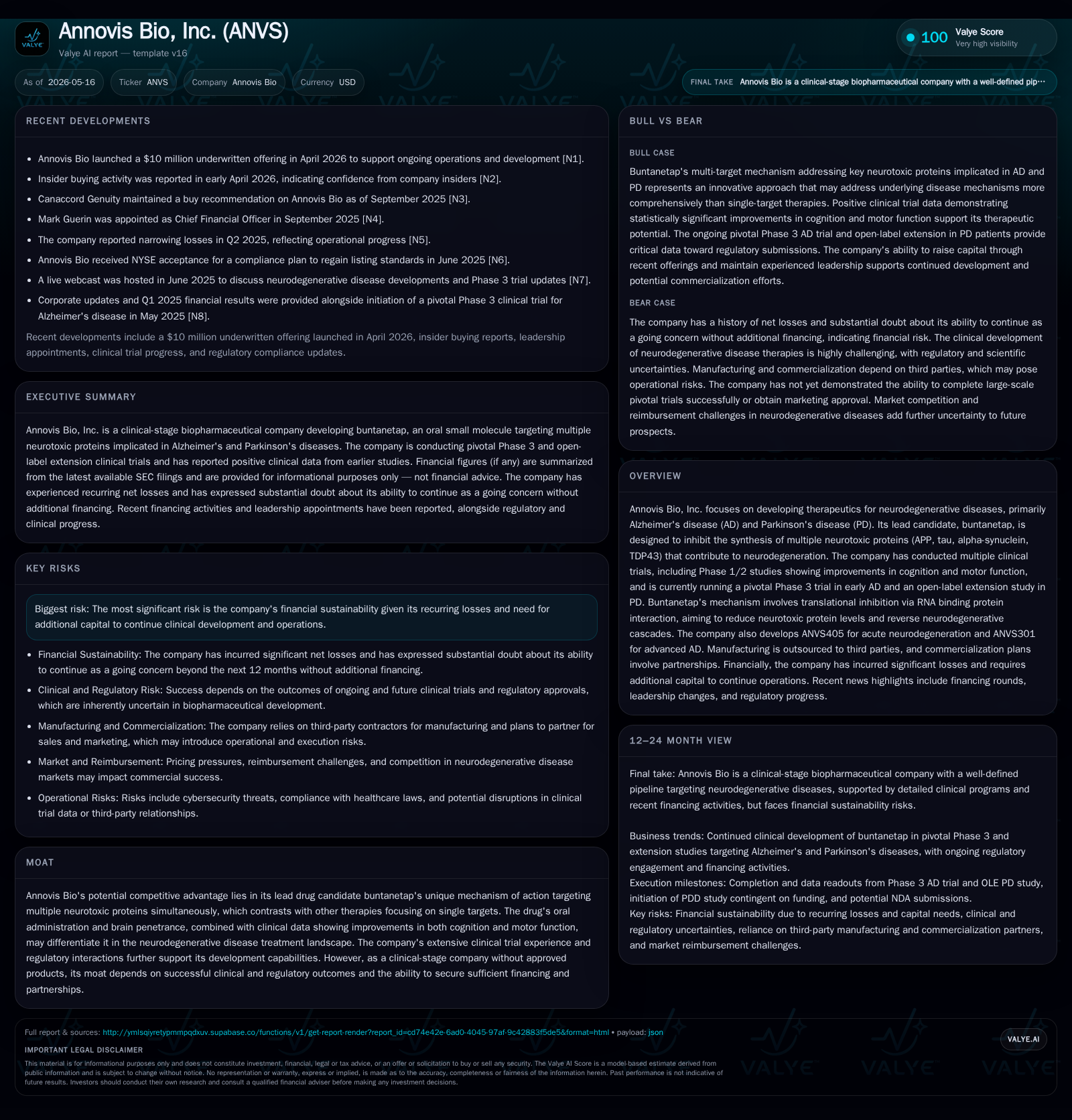
Annovis Bio's recent 10-Q filing highlights ongoing advancement in its pivotal Phase 3 trial for buntanetap targeting early Alzheimer's disease, alongside an open-label extension study in Parkinson’s disease. The company’s unique multi-target mechanism of translational inhibition distinguishes its lead candidate within a competitive and complex neurodegenerative treatment landscape. Despite clinical momentum, Annovis faces significant funding constraints given current liquidity below a 1.0 current ratio, necessitating additional capital raises to sustain operations. Critical upcoming milestones include Phase 3 symptomatic efficacy readouts and regulatory engagements shaping potential NDA submissions.
Latest Quarterly Operating Update: Clinical Progress and Financial Position
Annovis Bio's latest 10-Q filed May 15, 2026 reveals sustained operational activity around its core development programs. The pivotal Phase 3 trial of buntanetap for early Alzheimer's disease remains on track since initiation in February 2025. The randomized, double-blind, placebo-controlled study targets enrollment of approximately 760 patients with two sequential parts: a primary symptomatic efficacy evaluation at six months followed by a longer-term disease modification assessment at eighteen months using blinded treatment [S1][S2]. Outcome measures rely on industry standards such as ADAS-Cog13 cognitive scales and ADCS-iADL function assessments supplemented by volumetric MRI imaging and plasma biomarker sampling including phosphorylated tau (p-tau217), a recently advanced diagnostic marker.
Parallel progress is evident in the open-label extension (OLE) study launched January 2026 in Parkinson's disease patients to assess long-term safety and efficacy with planned enrollment of up to 500 participants treated up to three years or until market approval. The OLE has relevance beyond PD with intentions to expand into Parkinson's disease dementia (PDD) cohorts [S1][S2].
Financially, the company’s Q1 balance sheet shows $14.2 million in cash and equivalents. Operating expenses approximate $29.7 million annually reflecting intensive ongoing clinical costs with cumulative net operating losses eroding equity since inception [F1]. The substantial gap between burn rate and resources underscores the urgency for further capital infusion or partnering.
Annovis Bio’s Business Model and Unique Therapeutic Approach
Annovis Bio operates as a late-stage clinical platform company focused on neurodegenerative indications such as Alzheimer’s disease (AD) and Parkinson’s disease (PD). Its revenue-generation model is premised almost entirely on successful clinical development and eventual commercialization or licensing of its lead candidate bunantenap alongside pipeline assets (ANVS405 for acute neurodegeneration; ANVS301 targeting advanced AD) [S1].
Buntanetap is distinctive due to its multitarget mechanism inhibiting translation of several neurotoxic proteins—including amyloid precursor protein (APP), tau/phosphorylated tau, alpha-synuclein, and TDP43—all central to neurodegeneration pathophysiology. Unlike monoclonal antibodies or small molecules focusing singularly on amyloid plaques or tau aggregates, buntanetap acts upstream via modulation of RNA binding proteins controlling synthesis rates. This theoretically results in downstream effects like restoration of axonal transport and immune quiescence reducing neuronal death evidenced in preclinical models and human phase 1/2 studies showing cognitive and motor improvements [S1]. Orally bioavailable with brain penetrance affording patient convenience over injectable biologics further enhances strategic positioning.
Manufacturing is fully outsourced to contract manufacturing organizations ensuring cGMP supply chain scalability from clinical to prospective commercial volumes without internal facility burdens [S24]. Operational focus thus resides primarily on trial execution, regulatory engagement, intellectual property management—including recent patent strengthening related to buntanetap—and financing strategy.
Industry Structure: Competitive Landscape in Neurodegenerative Treatment
The neurodegenerative therapeutic sector is marked by enormous unmet medical need but equally substantial R&D risk given high failure rates historically for AD/PD drugs. Biopharma players range from large pharmaceutical majors with late-stage monoclonal antibodies targeting specific proteins such as amyloid beta or tau to smaller biotechnology firms developing novel modalities including gene therapies or multi-protein inhibiting compounds.
Annovis' standout feature is the translational inhibition mechanism that simultaneously reduces multiple pathogenic protein levels—a contrast to mono-target approaches susceptible to limited efficacy or resistance mechanisms [S1]. This multi-pronged targeting might command durable pricing power if approved by addressing both cognitive decline and motor symptoms absent so far from competitors.
Regulatory complexity remains formidable with agencies demanding rigorous symptomatic efficacy confirmation followed by durable disease-modification proof—both parts incorporated into Annovis' pivotal Phase 3 design complying with FDA expectations via standard cognitive-functional endpoints supplemented by evolving biomarker assays like plasma p-tau217 [S1]. However, regulatory uncertainty persists around acceptance criteria for multi-indication approvals necessitating careful ongoing dialogue.
Growth Drivers: Clinical Milestones, Trial Readouts, and Commercial Potential
Key growth catalysts center on successful interim readouts from the Phase 3 study's six-month symptomatic portion targeted near mid-to-late calendar year 2026 following patient enrollment progress noted through Q1 reporting [S2][N1]. Positive data would underpin initial NDA submission feasibility with subsequent opportunities deriving from the twelve-month extension phase aimed at disease modification claims potentially enabling a second NDA filing.
Additionally, results from the PD long-term OLE study commencing early 2026 represent important de-risking milestones showcasing safety/tolerability critical for market adoption across broader indications including Parkinson’s dementia expansion plans.
Commercial appeal benefits from oral administration facilitating patient adherence advantages over parenteral agents alongside mechanistic differentiation combining broad neuropathologic protein target engagement likely resonating with payors seeking cost-effective alternatives amidst increasing scrutiny around price justification particularly within Medicare/Medicaid formularies [S13].
Collaborative alliances or licensing agreements could provide financial ballast enabling accelerated development or later-stage commercialization support essential given sizeable forecasted clinical spending requirements outlined in filings [S22][N1].
Risks and Constraints: Funding Dependency, Clinical Execution, and Regulatory Challenges
The predominant risk remains financial sustainability amid stretched liquidity given cash reserves of $14.2 million and annualized operating expenses near $29.7 million, underscoring dependency on forthcoming capital raises or strategic partnerships urgently needed for continued operations beyond Q3-Q4 2026 horizon [F1][S2][N1].
Clinical execution risk also looms given historical volatility associated with neurodegeneration trials—patient recruitment delays, adverse event profiles including reported side effects (nausea, vomiting, dizziness), endpoint variability—and regulatory unpredictability surrounding biomarker incorporation acceptance or indication expansions influencing approval timing/label scope [S5][S28].
Manufacturing reliance on third-party CMOs introduces supply continuity vulnerability though mitigated somewhat by engagement with multiple providers; any disruption could impede trial progress or commercialization readiness [S24].
Legal/regulatory compliance poses additional understated risks encompassing fraud/abuse laws enforcement potential under complex healthcare statutes impacting marketing/sales activities post-approval plus GDPR considerations when conducting European trials adding operational overheads [S5][S19].
Collectively these factors contribute to 'substantial doubt' disclosures regarding going concern status if financing fails—highlighting fragility typical for clinical-stage biotech poised at pivotal development junctures without commercial revenues yet realized [S22][F1].
Upcoming Catalysts and Key Milestones to Monitor
Investors should track several material events over the coming months:
- Interim topline data release from the six-month symptomatic efficacy segment of the Phase 3 early AD trial anticipated approximately mid-to-late calendar year 2026 contingent on enrollment speed & retention metrics disclosed periodically [S2];
- Enrollment status updates in the Parkinson’s disease open-label extension trial are important markers indicating scalability toward longer-term indications like PDD;
- Any announcements related to new strategic partnerships or licensing deals that may alleviate funding pressures provide critical valuation inflection points;
- Regulatory interaction outcomes such as FDA feedback meetings clarifying NDA filing pathways will sharpen timeline visibility;
- Patent portfolio strengthening efforts ongoing around buntanetap should be observed for implication on competitive moat enhancement [N3];
- Insider transactions reported hinting at management confidence levels also warrant attention as sentiment cues.
Latest Financial Snapshot and Capital Considerations
Latest financial snapshot
| Metric | Value | Period |
|---|---|---|
| Cash & equivalents | $14mm | |
| 2026-03-31 | ||
| Current liabilities | $13mm | |
| 2026-03-31 | ||
| Current ratio | 0.61x | |
| 2026-03-31 |
Source: SEC companyfacts cache [F1].
| Metric | Value |
|---|---|
| Cash & Equivalents | $14.2 million |
| Current Liabilities | $12.8 million |
| Current Ratio | 0.61 |
As of March 31, 2026, cash reserves stand at $14.2 million against $12.8 million current liabilities revealing constrained liquidity despite recent equity infusions during April's $10 million offering reported publicly [F1][N1]. Operating losses remain pronounced at nearly $30 million annually reflecting extensive clinical expenditure commitments without offsetting revenues common for developmental-stage biopharma firms but accentuating runway sensitivity absent new capital infusion sources soon.
This precarious financial posture influences strategic considerations heavily favoring partnership formation or further fundraising initiatives while clinical progress provides validation steps moving toward commercial viability thresholds necessary for substantive licensing negotiations or outright product launch investments once approved.
Disclaimer: This analysis is based solely on publicly filed SEC documents and reported financial data as of May 15–16, 2026. It is intended for informational purposes only without any recommendation regarding investment decisions.
Disclaimer: This is research-only, informational analysis and not investment advice. It may include AI-generated interpretation and general industry context. Always verify important details using primary sources.

Comments