
American Public Education’s Turnaround: From Deficits to Profit in 2025
APEI reversed multi-year losses by leveraging its military and nursing education focus, operational improvements, and capital discipline to achieve notable profitability.
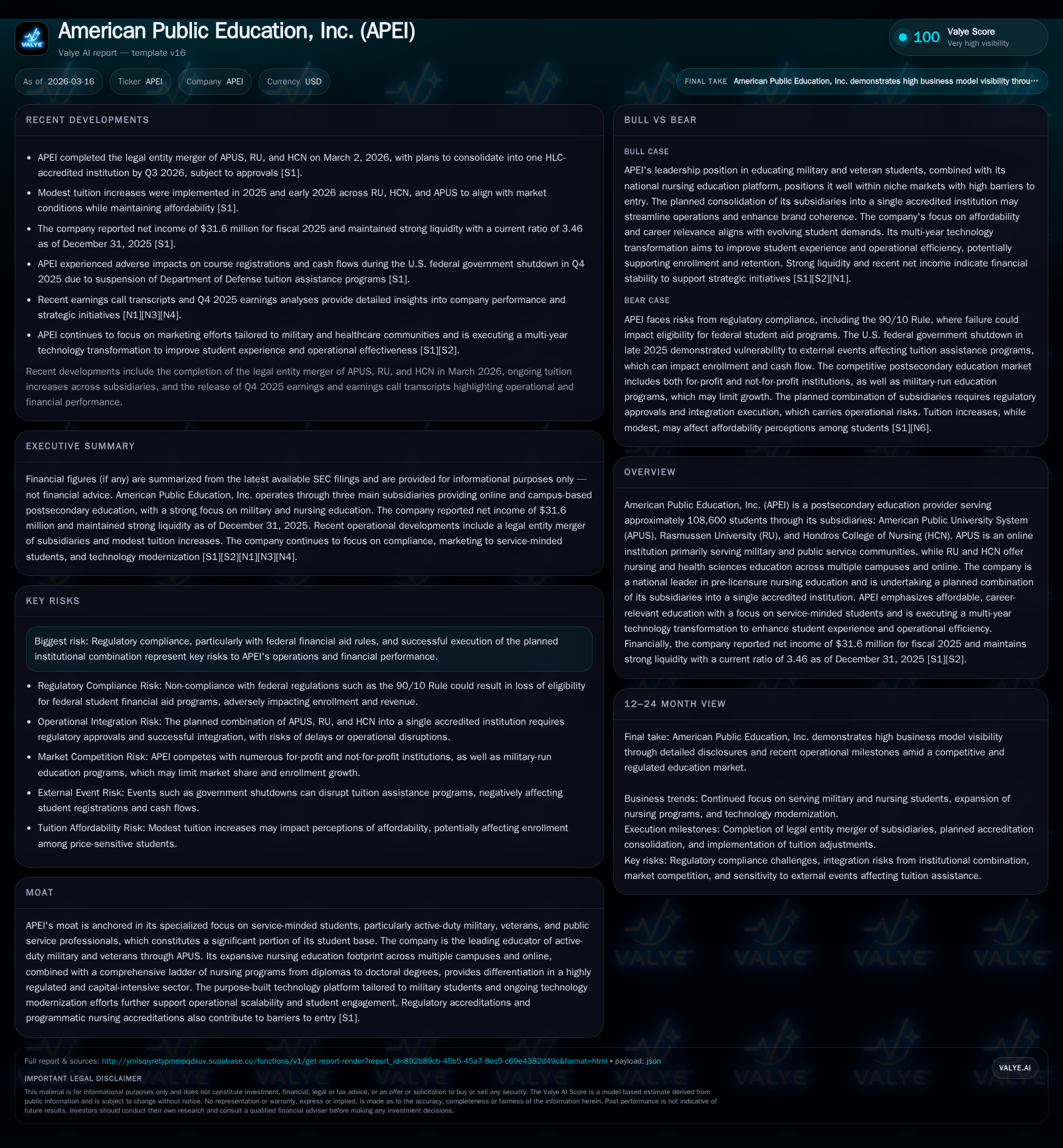
American Public Education, Inc. (APEI) demonstrated a significant financial turnaround in fiscal 2025, posting $198.2 million in revenue with a 33% increase year-over-year and returning to profitability with $31.6 million net income—nearly doubling prior year earnings. This recovery was driven by stable enrollments concentrated on active-duty military and nursing students, ongoing institutional consolidation efforts, and targeted technology investments enhancing student engagement and operational efficiency. Capital allocation remained disciplined, with consistent share buybacks and robust free cash flow generation supporting a roughly 10.7% return on equity. Regulatory compliance and successful execution of the institutional combination remain key watchpoints for future performance.
Historical Financial Performance and Return to Profitability
American Public Education, Inc. experienced a dramatic financial swing between fiscal years 2022 through 2025, transitioning from steep losses to profitable operations. In FY2022 and FY2023, APEI suffered net losses of approximately -$115 million and -$47 million respectively, reflecting operational challenges across its diversified portfolio [F1]. The company’s strategic efforts culminated in FY2025 with revenue reaching $198.2 million—a robust 33% increase year-over-year—which directly contributed to a significant 45% boost in operating income to nearly $48 million [F1]. Net income followed suit with a near doubling from $16.1 million in FY2024 to $31.6 million [F1].
Operating cash flow showed steady growth over the period, rising from $29.2 million in FY2022 to over $61.9 million in FY2025 while capital expenditures moderated downward from peaks seen earlier [F1]. This operational leverage indicates improved expense management alongside top-line growth—a notable inflection point after years of restructuring and integration following the Rasmussen acquisition and other portfolio adjustments.
Historical performance (annual)
| FY | Net ($mm) | CFO ($mm) | OpInc ($mm) | Capex ($mm) | Net YoY |
|---|---|---|---|---|---|
| 2025 | 32 | 62 | 48 | 16 | +95.8% |
| 2024 | 16 | 49 | 33 | 21 | +134.1% |
| 2023 | -47 | 46 | -48 | 14 | +58.9% |
| 2022 | -115 | 29 | -137 | 16 |
Source: SEC companyfacts cache [F1].
Capital returns and efficiency (annual)
| FY | Buybacks ($mm) | FCF ($mm) | ROE% |
|---|---|---|---|
| 2025 | 4 | 46 | 10.7 |
| 2024 | 4 | 28 | 5.3 |
| 2023 | 11 | 32 | -16.2 |
| 2022 | 2 | 13 | -32.9 |
Source: SEC companyfacts cache [F1].
*Prior year figures are referenced but detailed disclosures are limited; all figures cited per [F1].
Niche Market Focus Drives Enrollment Stability and Differentiation
APEI's enduring moat lies principally in its specialized focus on service-minded students—active-duty military members, veterans, extended military families—and public service professionals served predominantly through American Public University System (APUS). As of late-2025 data,[S1] APUS educates roughly 88,700 online learners with approximately two-thirds self-reporting as active-duty at enrollment.
Alongside APUS's virtual reach, Rasmussen University and Hondros College of Nursing represent national leaders in pre-licensure nursing education, offering diplomas through doctoral degrees across multiple physical campuses augmented by online offerings [S1]. This dual approach fortifies APEI’s position within highly regulated sectors where programmatic accreditation forms critical barriers against commoditization.
Operational success ties deeply into adherence with federal financial aid regulations like the '90/10 Rule', which mandates at least ten percent of revenue be sourced outside Title IV funds [S1]. APUS’s lower tuition model relative to competitors constrains marketing budgets yet compels focused recruitment strategies particularly toward non-federal funding streams.
Therefore, while the military-centric student base offers stable enrollments amid shifting civilian markets, it also introduces distinct regulatory dependencies that must be vigilantly managed.
Institutional Integration: Combining Subsidiaries into One Accredited Entity
APEI is actively pursuing an ambitious planned combination of its three primary subsidiaries—APUS, Rasmussen University (RU), and Hondros College of Nursing (HCN)—to operate under one unified accredited institution [N1][S1]. The strategic rationale includes aligning accreditations for greater operational scalability, simplifying regulatory oversight pathways, unifying branding for enhanced market clarity, and driving cost efficiencies through shared services.
This 'accreditation synergy' holds promise for margin expansion by reducing duplication across legacy systems; however it also introduces execution risk factors [S1][N1]. The complexity of merging disparate educational models—purely online APUS versus RU/HCN hybrid formats—and integrating IT infrastructures without disrupting student experience represent operational challenges closely watched by management.
Success here depends upon flawless coordination among academic affairs teams, rigorous regulatory compliance maintenance during transition phases—including continuing Title IV program eligibility—and communication strategies ensuring retention across the combined student body.
Technology Investment Enhancing Student Experience and Operational Efficiency
Aligned with its niche mission, APEI has been executing a multi-year enterprise technology transformation designed specifically to address the needs of military-connected learners who deal with irregular schedules, deployments, mobility constraints, and family responsibilities [S7].
In recent years the company insourced core platform ownership, moving away from outsourced vendors like Collegis LLC to establish internal governance over learning management systems, student information systems, and CRM platforms [S7]. This shift aims at reducing third-party dependency risks while enabling faster responsiveness tailored to student feedback.
By organizing technology teams into 'domains' accountable for defined platform sets [S7], APEI is instituting clearer ownership structures that promote continuous improvement cycles rather than fragmented ad hoc fixes common in higher education IT estates.
Technology modernization extends beyond instructional delivery; innovations include AI-driven career services integrated into cohorts and customized user experiences that improve engagement metrics relevant to retention—a key performance indicator within this sector.
Risks: Regulatory Compliance and Execution of Strategic Initiatives
The highest risk vectors center on regulatory compliance embedded within federal financial aid programs governing Title IV fund access [S20]. APUS faces ongoing scrutiny regarding adherence to Section 504 accessibility requirements following an OCR review identifying non-compliance issues as recently as August 2024 [S20]. Failure to remediate these concerns could jeopardize critical funding sources.
Moreover, marketing challenges persist due to APEI's relatively low tuition pricing limiting advertising spend compared with competitors [S1]. This pressure complicates efforts to diversify enrollment pools beyond military-connected communities necessary under the '90/10 Rule' imposed by the Department of Education.
Execution risks related to the institutional combination are equally material [S1][N1]. Delays or inefficiencies could disrupt revenue realization timelines or cause attrition among students uncertain about program continuity.
Finally, macroeconomic uncertainty including inflationary pressures on operating costs or changes in government education budgets remains a background concern.
Capital Allocation: Cash Flow Generation and Share Repurchases
APEI demonstrated substantial capital discipline during its turnaround phase [F1][S28], generating operating cash flow of approximately $61.9 million in FY2025—an increase of roughly +27% from prior year [F1]. Capital expenditures decreased nearly one-quarter year-over-year to about $15.9 million [F1], yielding free cash flow near $46 million for the year.
The company executed share repurchases totaling approximately $4.26 million in FY2025 [F1], continuing buyback activity consistently since FY2022 though at reduced scale relative to peak restructuring periods.
Return on equity reached around 10.7% based on net income over shareholders’ equity as of FY2025 [F1], indicating improved profitability underpinning shareholder value creation.
Liquidity remains strong with a current ratio above 3x supported by approximately $174 million cash & equivalents at year-end alongside manageable debt levels following refinancing activities documented in filings [F1][S6][S18].
What Investors Should Monitor Moving Forward
Given limited explicit forward guidance available publicly [N1][N2], investors should prioritize tracking enrollment trends post-institutional consolidation—the degree to which combined branding drives pipeline growth remains uncertain.
Milestones within the multi-domain technology rollout will provide insight into operational efficiency gains tied directly to cost structure leverage.
Margins will be closely watched for evidence that integration yields quantifiable benefits offsetting acquisition-related expenses incurred during transition phases [S14].
Regulatory updates concerning accessibility compliance audits or federal aid eligibility changes may quickly alter funding dynamics within core markets; sustained transparency here will influence investor confidence.
Capital deployment decisions—whether scaling share repurchases or initiating dividends—will signal management’s confidence regarding sustainable free cash flows versus reinvestment needs going forward.
Disclaimer: This document is provided solely for informational purposes based on publicly available data as of March 16, 2026 [F1][S#][N#]. It does not constitute investment advice or recommendations.
Disclaimer: This is research-only, informational analysis and not investment advice. It may include AI-generated interpretation and general industry context. Always verify important details using primary sources.

Comments