
Apogee Therapeutics Expands Clinical Pipeline Amid Rising Losses and Strong Capital Raises
Clinical-stage biotech Apogee focuses on antibody therapies while relying on substantial equity financing to fund escalating R&D costs.
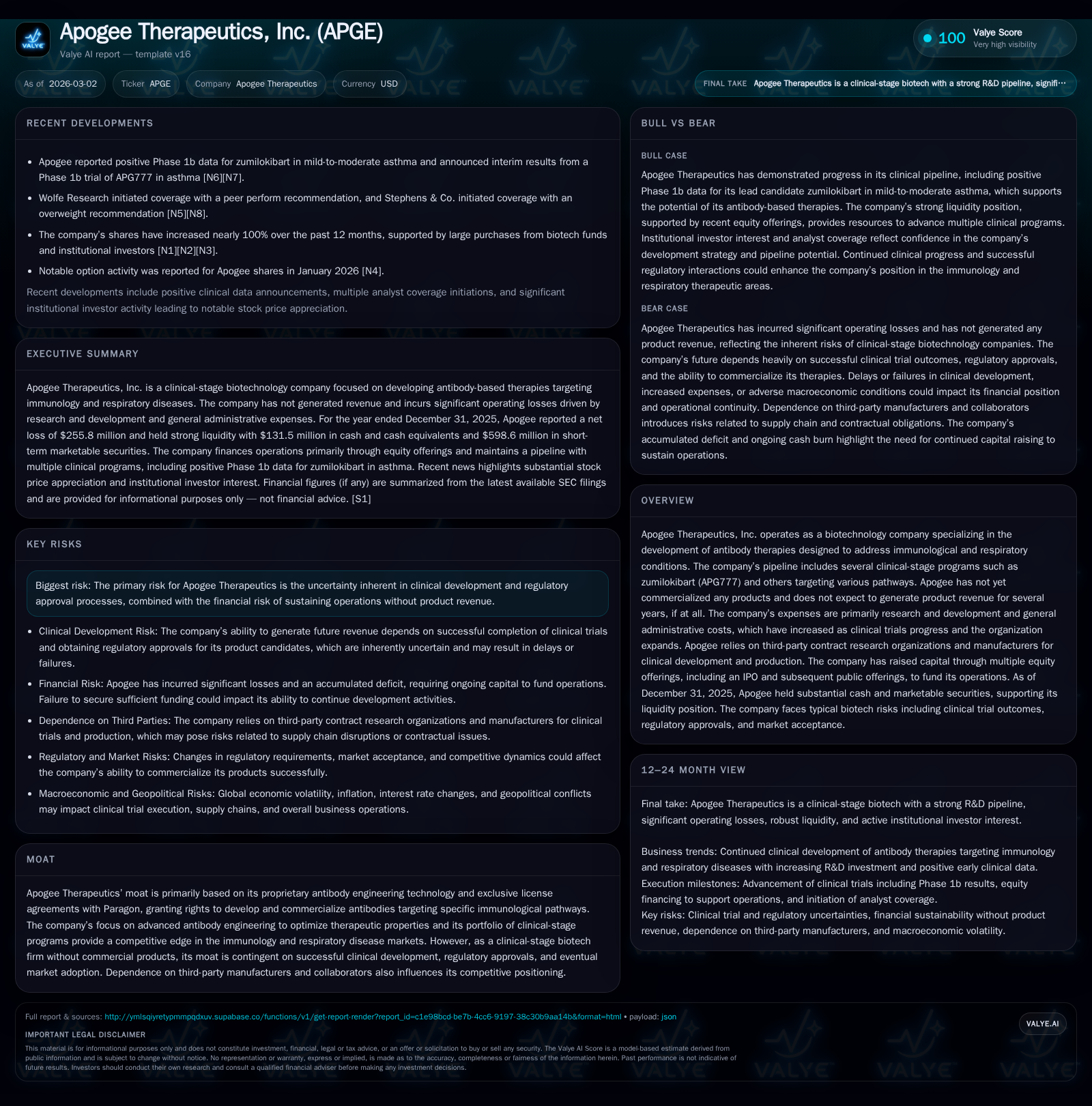
Apogee Therapeutics, Inc. remains a pre-revenue biotechnology company developing antibody-based therapies targeting immunological and respiratory diseases. In 2025, the company significantly increased R&D expenditure, driven largely by its lead candidate zumilokibart (APG777) and related programs, leading to a widening net loss of $255.8 million and negative operating cash flow of $227.5 million. Despite this, Apogee conducted multiple equity offerings in 2024-25, raising over $1 billion cumulatively to sustain operations, leaving it well-funded through 2028. The company’s future hinges on successful clinical milestones and regulatory approvals amid inherent biotech risks.
Business Overview and Pipeline
Apogee Therapeutics is a biotechnology firm dedicated to developing advanced antibody therapies aimed at immunological and respiratory diseases. Its proprietary antibody engineering technology, developed under exclusive license agreements with Paragon, forms the backbone of its competitive moat. The company’s key pipeline candidates include zumilokibart (APG777) alongside combination programs such as APG279 (zumilokibart + APG990), APG273 (zumilokibart + APG333), and APG808. These candidates are in various phases of preclinical or clinical development but have not yet generated any product revenue [S1][S9].
Given its focus on early-stage molecules, Apogee relies extensively on third-party contract research organizations (CROs) and contract manufacturing organizations (CMOs) for clinical trials execution and drug production—a common reliance in biotech that introduces operational risk depending on vendor performance.
Historical Financial Performance
The company remains clinical-stage with zero revenues to date; thus, all financial results reflect investment in R&D and G&A rather than product commercialization.
Historical performance (annual)
| FY | Net ($mm) | CFO ($mm) | OpInc ($mm) | Capex ($mm) | Net YoY |
|---|---|---|---|---|---|
| 2025 | -256 | -227 | -286 | 5 | -40.5% |
| 2024 | -182 | -171 | -217 | 1 | -116.9% |
| 2023 | -84 | -75 | -93 | 0 |
Source: SEC companyfacts cache [F1].
Capital returns and efficiency (annual)
| FY | FCF ($mm) |
|---|---|
| 2025 | -233 |
| 2024 | -172 |
| 2023 | -75 |
Source: SEC companyfacts cache [F1].
(All figures sourced directly from SEC filings and SEC-approved XBRL data [F1], [S13], [S28])
In the trailing three years ending December 31, 2025, operating income losses expanded substantially — nearly tripling from roughly -$93 million in 2023 to nearly -$286 million last year (-31.7% YoY worsening vs prior year). Correspondingly, net losses deepened sharply by over 40% year over year from $182 million in 2024 to $256 million in 2025.
Research & development expenditures accounted for the bulk of these losses as the company ramped up clinical trial activities notably for zumilokibart (APG777), whose related external development costs increased by about $27 million in the latest period compared to the previous year alone [S21][S23]. There were offsetting declines in some other programs such as APG990/APG279 due to reduced manufacturing activities and milestone payments compared with prior years.
General & administrative expenses climbed markedly (+45%) owing mainly to personnel hiring surges and higher equity-based compensation linked to share awards granted during rapid company expansion phases.
Capital expenditures remained modest but jumped over fourfold year-on-year as Apogee invested more heavily in lab infrastructure supporting advanced research capabilities.
Operating cash flow also reflected these trends with a twelve-month cash burn of approximately $227 million as of end-2025—significant negative cash flow reflective of heavy upfront investment typical of pre-commercial biotech firms [F1][S7].
Capital Structure and Liquidity
As a non-revenue generating entity focused solely on R&D, Apogee funds operations almost entirely through equity raises:
- The initial public offering (IPO) occurred in July 2023 raising net proceeds of approximately $315 million.
- A large follow-on underwritten offering completed in March 2024 generated around $450 million net.
- An At-The-Market (ATM) facility initiated mid-2024 provided incremental proceeds totaling roughly $112 million across late-2024 and full-year 2025.
- Most recently in October 2025, an additional underwritten public offering yielded net proceeds of about $324 million after fees.
Collectively these efforts accumulated cash reserves inclusive of marketable securities exceeding $900 million as of December 31, 2025 [S19][F1], providing substantial runway coverage expected into the latter half of calendar year 2028 based on current expenditure forecasts.
The balance sheet remains strong with current assets over $740 million versus current liabilities near $28 million—yielding a current ratio above 26x—providing operational flexibility amid volatile biotech financing markets [F1].
R&D Focus: Zumilokibart Leading Development Efforts
Zumilokibart (APG777) is clearly the flagship compound driving much of Apogee’s current clinical activity spend:
- It targets critical immunological pathways with the goal of differentiated antibody therapeutics for respiratory conditions.
- Clinical trial expenses including patient enrollment and manufacturing scale-up spiked notably through 2025.
- Parallel pipeline candidates APG279, APG273, and APG808 reached varying developmental milestones but contributed less materially to current-year spend patterns reflecting staggered timelines.
Apogee’s forward strategy depends heavily on achieving timely IND approvals followed by successful Phase I/II results that can meaningfully de-risk pivotal regulatory submissions ahead.
Future Growth Prospects
Growth drivers stem from advancing key assets through clinical milestones enabling transition from preclinical status towards potential registration-enabling studies over the coming years:
- Successful Phase II data readouts would significantly enhance valuation outlook given unmet immunology indications targeted.
- Planned continued investments signal management confidence but heighten near-term cash burn requirements.
- Opportunities exist for licensing deals or partnerships which could offset internal funding needs but none are guaranteed or currently disclosed explicitly.
Risks and Uncertainties
While technological innovation represents a moat via proprietary antibody engineering platforms licensed from Paragon—which confers some differentiation—the company's fate remains tightly coupled with typical biotech risks:
- Completion risks inherent in complex multi-year clinical trials pose a threat for delays or failure to demonstrate safety and efficacy endpoints necessary for approval.
- Regulatory authorities may impose additional requirements inflating timelines or costs unexpectedly.
- Reliance on limited third-party contractors for manufacturing & trials introduces supply chain vulnerabilities particularly under strained global health environments.
- Continuous capital needs persist until revenue generation milestones materialize; failure to raise future funds could force scaling back key programs or operational reductions [S6][S9].
Capital Allocation Philosophy
Given its early-stage status without commercial revenues, Apogee has not declared dividends nor undertaken share repurchases:
- Equity issuances remain the primary mechanism for funding ongoing growth initiatives.
- Equity-based compensation expense increased alongside headcount expansions reflecting talent recruitment priorities vital for innovation capacity [F1][S18].
Conclusion
Apogee Therapeutics typifies a high-investment profile clinical-stage biotech company aggressively expanding its product pipeline through advanced antibody engineering programs without current commercial revenues. The company’s financials reflect intensifying spending across R&D domains commensurate with scaling clinical operations especially around its flagship program zumilokibart while maintaining a robust liquidity position supported through multiple capital raises since IPO launch mid-2023.
Going forward, execution success hinges upon delivering meaningful clinical progress coupled with securing sustained funding sources beyond mid-decade horizons toward eventual commercialization milestones under highly uncertain industry conditions shaped by regulatory scrutiny, scientific complexity, partner engagement possibilities, and macroeconomic influences affecting capital markets accessibility.
Disclaimer: This is research-only, informational analysis and not investment advice. It may include AI-generated interpretation and general industry context. Always verify important details using primary sources.

Comments