
Digital Turbine in 2026: Weighing Innovation Against Debt-Driven Constraints
Digital Turbine’s latest earnings outpaced expectations, but mounting leverage and refinancing pressures temper market enthusiasm.
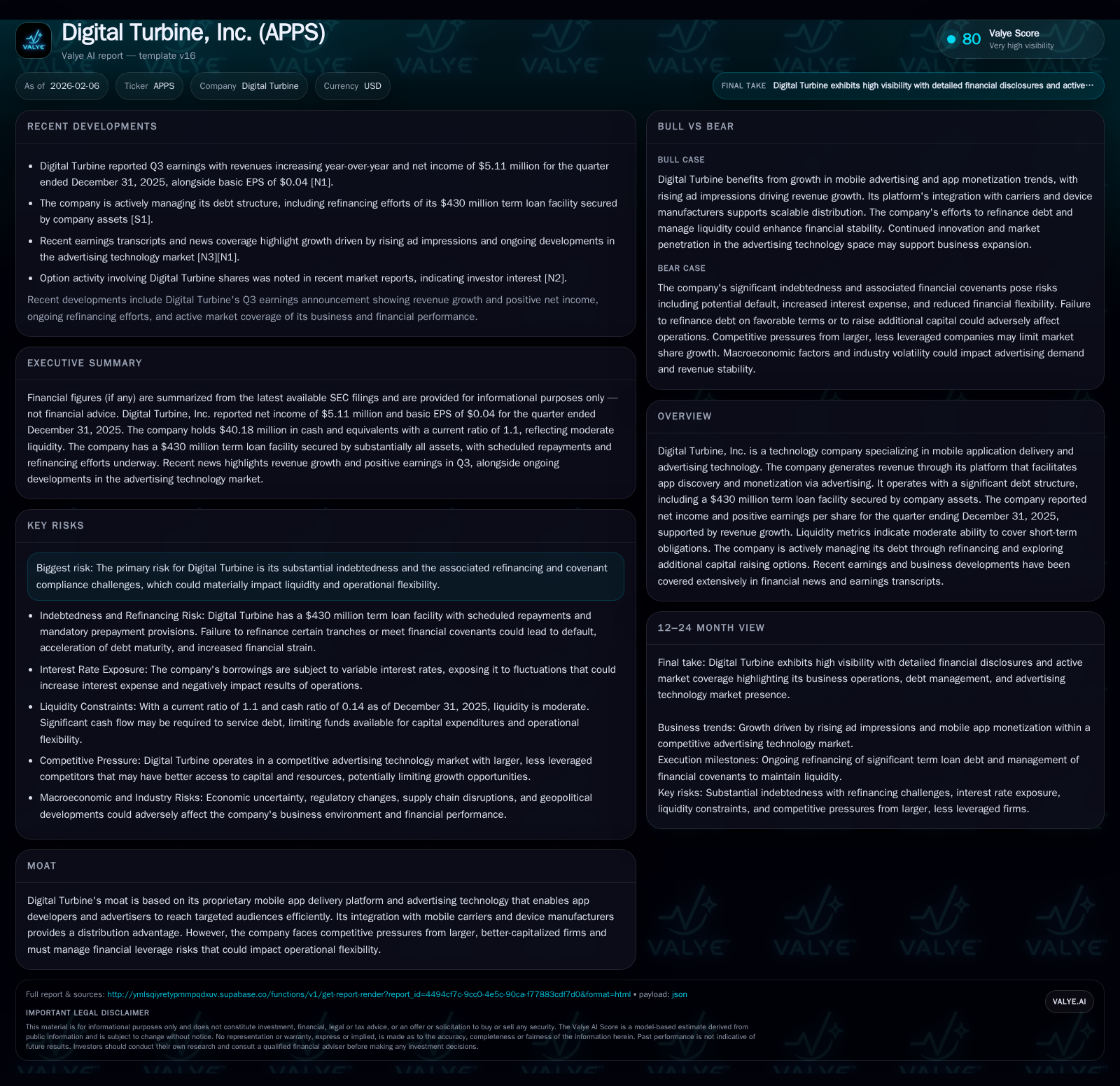
Digital Turbine reported solid revenue growth and net income gains in Q3 2026, underscoring the strength of its mobile app delivery platform. Despite this operational progress, its substantial indebtedness—anchored by a $430 million term loan facility with mandatory repayments and refinancing risks—clouds near-term flexibility. The company’s strategic partnerships continue to amplify distribution scale, yet competitive intensity from larger players and financial covenant constraints remain critical headwinds. Navigating capital structure challenges while leveraging its proprietary technology defines Digital Turbine’s current trajectory.
Earnings Upside Meets Market Skepticism
Digital Turbine’s Q3 2026 financial results captured a nuanced moment: the company surpassed consensus revenue estimates with over $30 million recognized for the quarter ending December 31, 2025, alongside a net income of approximately $5.1 million [F1], signaling operational momentum. However, this positive EPS performance was met with a paradoxical share price decline following the earnings release [N1], exposing investor anxiety centered less on top-line execution and more on the heavy debt footprint weighing on balance sheet health and future growth optionality.
Earnings call commentary revealed management cognizance of this disconnect—the firm highlighted robust demand for its mobile application delivery services but also flagged uncertainties surrounding refinancing timing and covenant compliance risks embedded in its capital structure [N2]. This dynamic underscores a tension where operational advances are overshadowed by structural financial constraints.
Decoding Digital Turbine’s App Delivery Moat
At the heart of Digital Turbine’s value proposition lies a proprietary platform facilitating seamless application discovery interwoven tightly with mobile carriers and device manufacturers — a nexus delivering targeted advertising at scale [valye_report_excerpt.moat]. This integration is not just technological but also relational, securing preferential access to preloaded apps on devices distributed globally.
Such embedded distribution creates network effects advantageous for developers seeking efficient user acquisition while enabling advertisers to leverage rich data signals. Yet this moat faces erosion threats; larger competitors with far greater capital resources can diversify offerings or undercut pricing models, threatening to dilute Digital Turbine's exclusivity in select channels.
Debt Dynamics and Refinancing Risks in Focus
The company’s financing arrangement commands substantial scrutiny. On August 29, 2025, Digital Turbine consummated a $430 million term loan facility with three tranches drawn in full upon closing [S2]. The loan instruments carry quarterly principal repayments of roughly $2.344 million extending through maturity four years hence, compounded by escalating exit fees if tranche-specific repayment milestones are missed.
Significantly, starting fiscal year 2027, the company must allocate half of any excess cash flow towards mandatory prepayments. This covenant not only imposes rigid cash deployment patterns but heightens refinancing urgency; failure to refinance could precipitate accelerated debt paydowns or defaults restricting operational latitude [S2]. Concurrently, variable interest rates expose Digital Turbine to upward pressure from macroeconomic rate trends, inflating interest expense unpredictably.
Strategic Partnerships and Distribution Leverage
Strategic alliances serve as critical pillars underpinning Digital Turbine's platform expansion. Recent earnings disclosures confirm ongoing renewals and incremental integrations with key mobile carriers and device OEMs [N2], fueling user acquisition funnels vital for scaling app delivery reach.
These relationships enhance data granularity which improves advertising targeting precision—valuable in a landscape where advertisers demand measurable ROI against escalating spend scrutiny. These partnerships arguably act as commercial moats alongside the technology itself, anchoring business continuity amidst shifting market conditions [valye_report_excerpt.moat].
Revenue Trends Amid Competitive Pressures
Latest filings reveal steady revenue progression dominated by fees tied to app discovery facilitation and monetized advertising placements [F1]. This revenue mix demonstrates exposure not just to end-user engagement volumes but also advertiser budget allocations that are increasingly scrutinized within broader digital ad wars involving firms like Google and Facebook.
Competition from these giants complicates sustainability: they wield massive balance sheets enabling aggressive discounting or complementary service bundling which can blunt Digital Turbine’s growth vectors over time [N3]. Hence, maintaining innovative service enhancements remains vital for differentiation.
Liquidity Metrics and Operational Flexibility
Evaluating liquidity posture reveals current assets around $318 million against current liabilities approximating $288 million, yielding a narrow current ratio in the vicinity of 1.1 [F1]. While technically above the critical threshold of unity, this thin margin suggests limited buffer against unforeseen cash drains or market shocks.
Moreover, roughly $40 million in unrestricted cash on hand constrains runway given existing debt servicing commitments including mandatory amortizations embedded in financing agreements [F1,S2]. Consequently, operating cash flow generated must be judiciously allocated between servicing leverage while still funding capex or innovation efforts essential to competitive standing.
Forward-Looking Capital Strategies and Market Positioning
Public disclosures hint at management’s active pursuit of alternative capital avenues to offset looming maturities—potential equity raises or debt refinancings on improved terms figure centrally in near-term plans [S2,N2]. The nature of mandatory excess cash flow sweeps starting next fiscal year further propels urgency toward these initiatives.
Prudent execution here would ease refinancing risks that currently color investor sentiment adversely despite fundamental revenue traction. Yet equity issuance may exert dilutive pressures complicating valuation perceptions—a delicate balance for shareholder alignment amid capital markets uncertainty.
Risk Management: Covenant Challenges and Interest Exposure
The Financing Agreement embeds financial covenants presenting significant monitoring overhead: breaches could accelerate debt repayment triggers disrupting planned operational cadence or necessitating costly waivers without accompanying boost to results [S2]. Variable rate exposure is another stressor amid volatile interest rate environments prevalent during early 2026 globally.
Compared to less leveraged peers within digital ad tech ecosystems, Digital Turbine carries amplified vulnerability to macro-financial shocks or sector downturns impacting advertiser spend patterns — factors potentially constraining strategic agility until deleveraging succeeds.
Analyst Sentiment and Option Market Signals
Market intelligence points toward heightened option volume activity around Digital Turbine shares shortly post earnings announcements [N6], signaling speculative positioning or protective hedging among sophisticated investors. Such signals often presage expectations of increased price volatility tethered to perceived binary outcomes relating to refinancing success or covenant compliance clarity.
Analyst previews ahead of Q3 results were generally optimistic on growth prospects yet tempered by cautions over capital structure fragility underscoring an overall cautious stance permeating investor community [N3].
This analysis highlights the dual narrative defining Digital Turbine’s current position: it has made meaningful strides in bolstering technology platforms fundamental to mobile app monetization while simultaneously grappling with debt-induced financial constraints challenging near- to medium-term flexibility. Navigating this crossroads effectively will require balancing ongoing innovation investments with prudent capital management amid evolving industry competitive dynamics.
Disclaimer: This document is prepared solely for informational purposes based on publicly available data as of early 2026. It does not constitute investment advice nor an offer or solicitation for securities trading.
Disclaimer: This is research-only, informational analysis and not investment advice. It may include AI-generated interpretation and general industry context. Always verify important details using primary sources.

Comments