
AMC Networks in Transition: Balancing Legacy Strengths and Emerging Digital Frontiers
AMC Networks navigates a complex media landscape marked by streaming expansion, financial variability, and regulatory challenges.
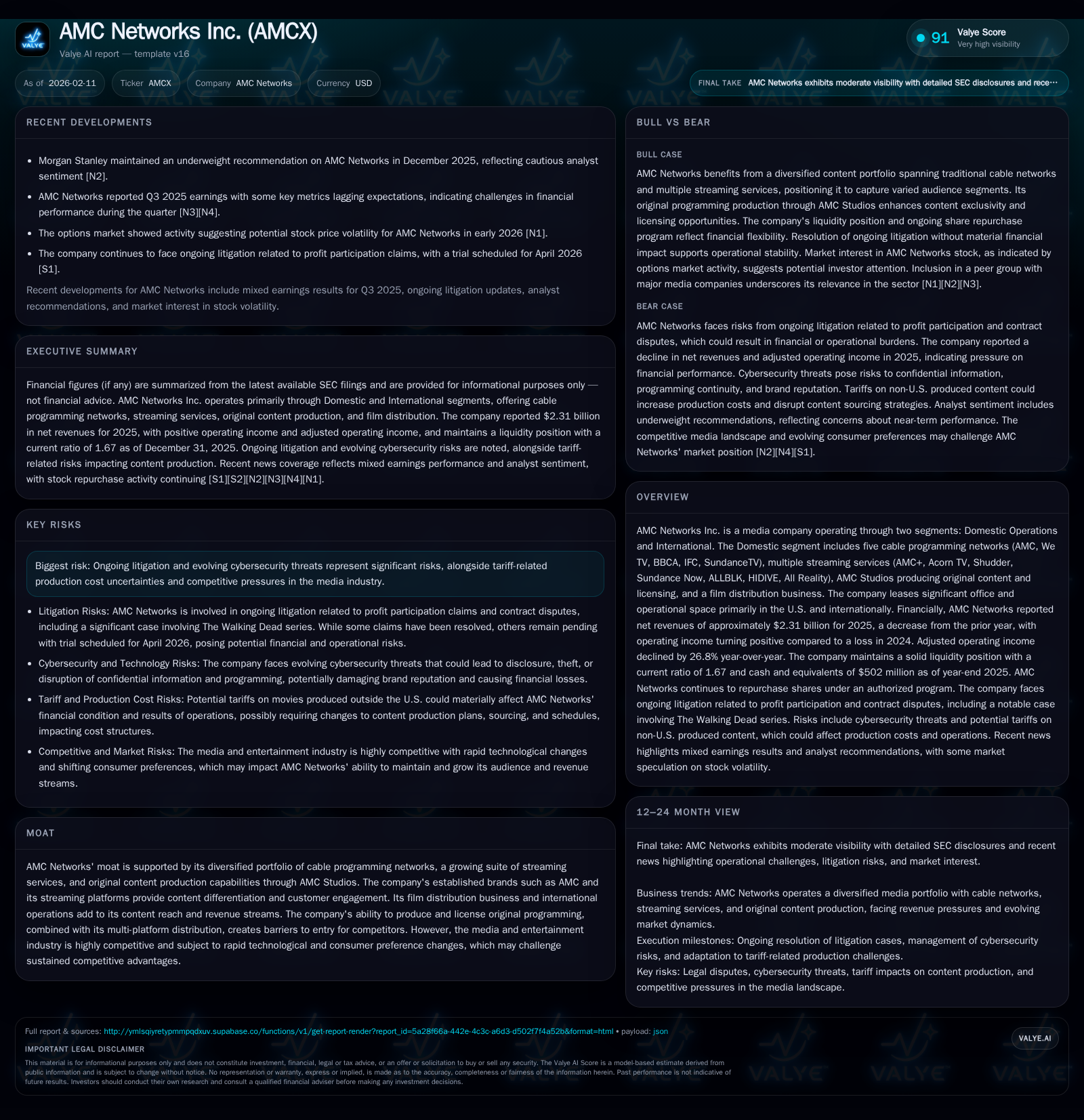
AMC Networks Inc. has evolved from a traditional cable network operator to a multi-faceted media company blending cable programming with an expanding streaming portfolio and original studio production. Despite experiencing a revenue decline in 2025, the company achieved an operating income turnaround, reflecting strategic adjustments amid competitive pressures. Ongoing legal disputes, government tariff uncertainties, and cybersecurity threats present layered risks, while cost optimization and international diversification underscore AMC's efforts to redefine its value proposition within a shifting entertainment ecosystem.
From Cable Legacy to Streaming Vanguard: AMC Networks Today
AMC Networks stands at an inflection point where its traditional cable network heritage converges with a growing constellation of streaming platforms. The company's Domestic segment anchors its foundation with flagship cable channels including AMC, We TV, BBCA, IFC, and SundanceTV, brands that retain loyal audiences through distinctive content narratives. Complementing this are burgeoning streaming services—AMC+, Acorn TV, Shudder, Sundance Now, ALLBLK, HIDIVE, and All Reality—each targeting specific viewer niches such as horror aficionados or multicultural audiences [S1]. This hybrid model illustrates AMC’s strategic pivot toward diversified distribution pathways designed to capture fragmented consumer demand across platforms. Furthermore, AMC Studios’ integration within this ecosystem strengthens vertical control over content creation and monetization.
Financial Pulse Check: Revenue Declines Amid Operating Income Recovery
The financial footage through 2025 portrays a nuanced performance. Net revenues declined to circa $2.31 billion from prior-year levels [F1], signaling headwinds likely induced by cord-cutting trends impacting cable subscriptions alongside intensifying competition within streaming markets. However, a silver lining emerges as operating income flipped positive compared to losses endured in 2024—a testament to managerial focus on cost discipline or perhaps efficiency gains from evolving content strategies [S1]. Notably, adjusted operating income fell by 26.8% year-over-year, spotlighting margin pressures that cannot be overlooked. Maintaining robust liquidity—with a current ratio of 1.67 and over $500 million in cash equivalents—provides a buffer as AMC executes its transformation blueprint [F1]. This mixed financial tableau underscores ongoing recalibration balancing growth investments against near-term profitability constraints.
Original Content and Studio Strength: Driving AMC's Distinctive Moat
A pivotal pillar supporting AMC’s moat lies in its proprietary content production capabilities through AMC Studios. Owning the creative process enables the firm to develop tailored original programming that differentiates it amid a crowded marketplace increasingly driven by unique narratives rather than volume alone [S1]. Moreover, licensing of such bespoke content opens diversified revenue streams less vulnerable to commoditization typical in third-party syndicated offerings. This blend of creative autonomy and multi-platform reach translates into enhanced customer engagement around marquee franchises. In effect, AMC leverages storytelling as currency—anchoring subscriber retention within both cable viewership and growing streaming subscriber bases.
International Expansion and Property Strategy: Real Estate Footprint Analysis
AMC holds extensive leased facilities spanning roughly 713,000 square feet domestically—including its corporate headquarters at 11 Penn Plaza in New York City—and approximately 157,000 square feet internationally across Spain, Hungary, and the U.K [S1]. A recent lease amendment reflects intent to reduce office footprint significantly (from approximately 326,000 to 178,000 square feet), effective May 2026 while extending lease tenure until September 2032 [S1]. This downsizing aligns with broader industry trends embracing hybrid work models post-pandemic but also signals deliberate cost management aimed at boosting operational efficiency in fixed overheads. Internationally dispersed properties support global content distribution ambitions providing physical assets underpinning localized operations.
Legal Battles and Their Ripple Effects: The Walking Dead Litigation Case Study
Litigation involving the "Walking Dead" franchise encapsulates complexities inherent in media rights governance. Initiated in August 2017 concerning alleged underpayment claims by writers/producers on multiple series spinoffs (The Walking Dead, Fear the Walking Dead), the dispute progressed through motions, trials, appeals, and confidential binding arbitration concluding with an award of approximately $7.8 million payable to plaintiffs [S1]. Importantly, this sum was deemed immaterial relative to AMC’s financial standing. The drawn-out legal saga highlights vulnerabilities related to contractual interpretation disputes and profit-sharing audits common within entertainment IP ecosystems. While reputational impact was contained thus far, the episode accentuates the need for rigorous contract clarity amidst high-stakes franchise management.
Tariffs and Technology Risks: Navigating an Uncertain Regulatory Environment
Tariff regimes introduced primarily under previous U.S. administration frameworks elevate cost risk profiles for film production conducted outside American borders [S2]. Announcements targeting movies produced abroad signal possible increases in expenses for content sourcing—a challenge given AMC's partial reliance on international production locales leveraging tax incentives or lower labor costs [S2]. Such tariffs also trigger retaliatory actions from other governments complicating predictability around global supply chains. The dynamic regulatory environment necessitates agility; potential mitigation could involve shifting production footprints or reconfiguring project scales though these come with logistical trade-offs.
Simultaneously technological risks—especially cyber threats—pose systemic challenges [S1]. Cybersecurity vulnerabilities threaten confidential data exposure or disruption of broadcasting activities potentially undermining audience trust and brand equity.
Crisis Management in Cybersecurity: Safeguarding Content and Reputation
With accelerating digital interconnectivity of assets comes heightened exposure to cyberattacks capable of compromising intellectual property or customer information [S1]. For media companies like AMC reliant on timely content delivery and brand integrity, breaches could erode competitive advantages rapidly. Documented acknowledgement of evolving cybersecurity threats underscores institutional awareness; however effectiveness rests on dynamic defenses encompassing network safeguards, employee training programs, incident response readiness, and continuous threat monitoring.
Investor Sentiment and Market Speculation: Decoding Options Activity
Market indications—as reflected by recent upticks in options market volumes—suggest episodes of speculative interest or hedging activity around AMCX shares during early 2026 [N1]. Such derivatives activity often presages changing investor expectations tied to earnings announcements or corporate developments. This volatility narrative introduces an ancillary dimension complementing fundamental analyses; it simultaneously signals perceptible uncertainty or opportunity perceived by market participants hinging on forthcoming catalysts or risks.
Strategic Divestitures and Lease Optimization: Office Space Downsizing Plans
Acknowledgment of evolving work paradigms informs AMC’s decision to shrink its New York headquarters space by almost half while extending lease duration well into the next decade [S1]. This reflects both tactical cost containment initiatives as well as adaptation toward hybrid remote work adoption prevalent across media industry peers in post-pandemic operational restructuring cycles. Rationalizing real estate commitments directly impacts fixed cost base while enabling reinvestment flexibility toward content innovation or technology infrastructure upgrades.
Looking Ahead: Potential Growth Catalysts and Industry Challenges
AMC Networks faces a dual-edged horizon where opportunities entwine tightly with formidable obstacles. Prospective growth drivers include expansion of premium original content drawing diverse subscribers across demographically targeted streaming services coupled with international viewership amplification via localized offerings [S1]. However intensified competition from entrenched streaming giants alongside emerging players heightens content acquisition costs pressuring margins further. Concurrently tariff uncertainties inject cost volatility particularly relevant for cross-border productions while cybersecurity hazards require sustained investment posing incremental expense burdens [S2][S1]. Investor sentiment exhibits oscillation reflective of broader market skepticism around legacy media transitioning paradigms evidenced by mixed financial results alongside structural recalibrations [N1][F1]. Overall AMC’s future contours will depend heavily on execution precision managing innovation pipelines integrated with meticulous risk mitigation frameworks within an ever-shifting regulatory technosocial landscape.
Disclaimer: This analysis is provided for informational purposes only and does not constitute investment advice or recommendations regarding securities mentioned herein. It is based on publicly available information as of February 11, 2026. Readers should conduct their own research before making any financial decisions.
Disclaimer: This is research-only, informational analysis and not investment advice. It may include AI-generated interpretation and general industry context. Always verify important details using primary sources.

Comments