Viking Therapeutics: Navigating Clinical Development in Metabolic and Endocrine Disorders
An in-depth look at Viking Therapeutics’ clinical pipeline, business model, and risks amid a competitive metabolic disease landscape.
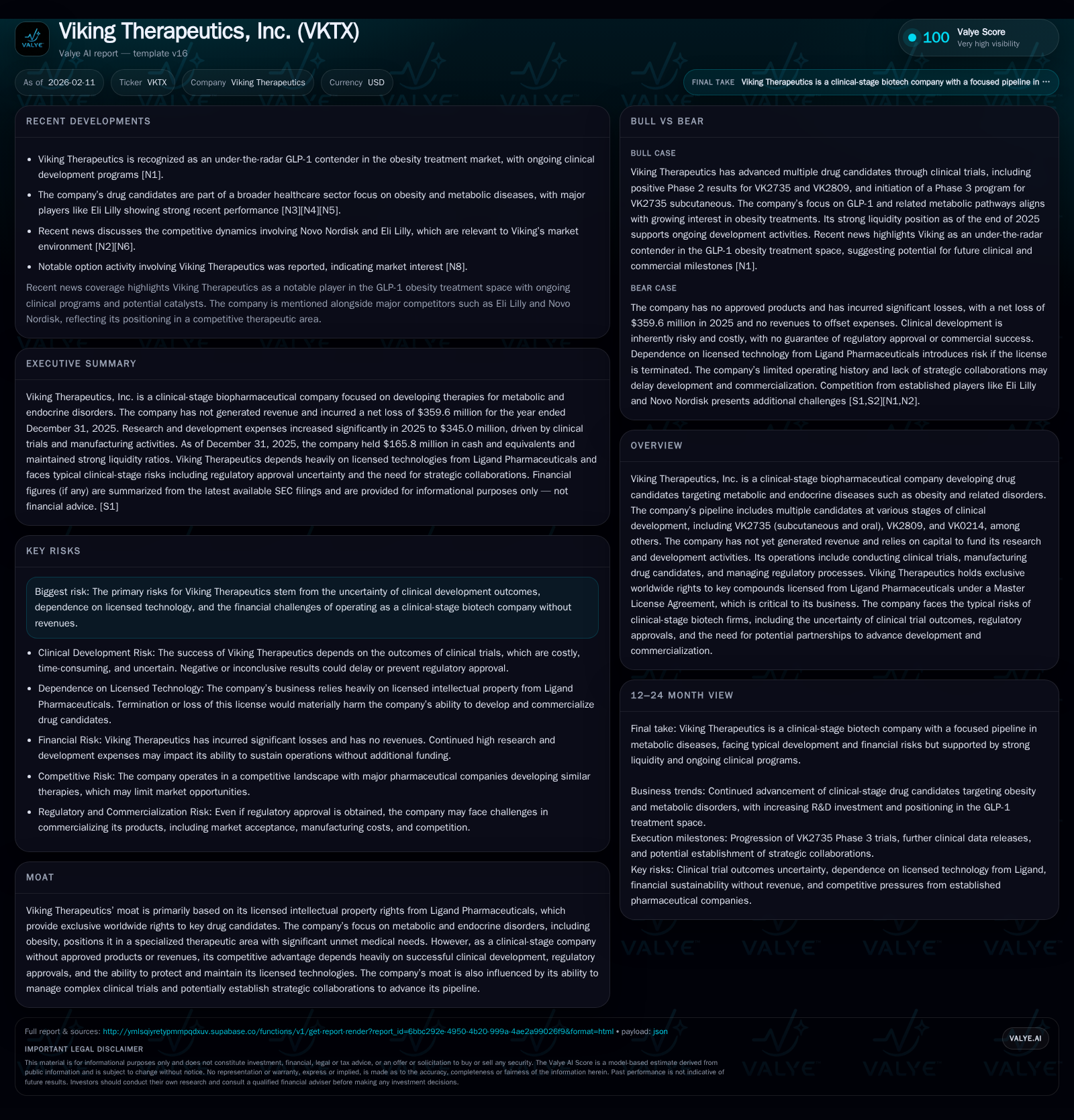
Viking Therapeutics, a clinical-stage biotech company focused on metabolic and endocrine disorders including obesity, is advancing multiple drug candidates through Phase 1 to Phase 3 trials, prominently VK2735—a GLP-1/GIP dual agonist with both subcutaneous and oral formulations showing promising weight loss results. Despite the absence of revenue and ongoing R&D expenses reaching $345 million in 2025, Viking’s licensed rights from Ligand Pharmaceuticals underpin its intellectual property moat. The company faces substantial development, regulatory, and financial risks typical of clinical-stage biotechs but continues to move key programs toward late-stage evaluation and eventual commercialization potential.
Company Overview and Focus
Viking Therapeutics, Inc. operates as a clinical-stage biopharmaceutical company targeting therapies for metabolic and endocrine disorders, notably obesity—a condition with significant unmet medical needs worldwide. The company's approach emphasizes the development of novel or improved therapeutics that modulate key hormonal pathways influencing metabolism and weight regulation. This niche focus places them within a rapidly evolving yet highly competitive segment of biotech.
Their portfolio includes several drug candidates at various stages of clinical development. The flagship program centers on VK2735, a dual agonist engaging glucagon-like peptide-1 (GLP-1) and glucose-dependent insulinotropic polypeptide (GIP) receptors—targets validated by market leaders but still ripe for innovation given issues such as patient tolerance and administration routes.
VK2735 Program Progress
VK2735 constitutes both subcutaneous injection and innovative oral formulations. The initial Phase 1 study completed in early 2023 demonstrated safety and tolerability across escalating doses administered subcutaneously. Following this, Viking initiated the Phase 2 VENTURE trial focusing on obese or overweight adults with comorbidities to assess efficacy over a 13-week period.
The reported results were encouraging: patients receiving weekly subcutaneous doses experienced up to a 14.7% placebo-adjusted mean reduction in body weight—a clinically meaningful figure that aligns competitively against current standards ([S1]). Based on positive signals from this proof-of-concept study, Viking advanced two Phase 3 trials—VANQUISH-1 and VANQUISH-2—supporting regulatory filings toward potential approval.
Parallel to injection dosing efforts, the oral formulation of VK2735 underwent Phase 1 multiple ascending dose studies followed by a successful Phase 2 trial completed in mid-2025. This oral candidate achieved statistically significant weight loss (~5.3% mean reduction) compared to placebo after daily administration over 13 weeks ([S1]). Aiming to capitalize on patient preference for oral therapies versus injections seen across obesity treatments, Viking plans to initiate pivotal Phase 3 studies later in 2026.
Additionally, Viking launched an exploratory maintenance dosing study blending both oral and subcutaneous regimens designed to optimize long-term management post-initial weight loss ([S1]). Such efforts underscore their strategic emphasis on differentiated treatment paradigms addressing adherence challenges.
Pipeline Beyond VK2735: DACRA Program
Apart from VK2735, Viking initiated an internally developed dual amylin and calcitonin receptor agonist (DACRA) program intended for obesity treatment. Preclinical studies showed promising effects in reducing food intake and improving metabolic profiles in animal models. The anticipated Investigational New Drug (IND) application filing is slated for early 2026 ([S1]).
This dual approach combining peptide hormone pathways could potentially provide complementary or alternative mechanisms in obesity management beyond GLP-1/GIP receptor targeting competitors.
Intellectual Property and Strategic Licensing
A foundational aspect of Viking’s operating model lies in its exclusive global rights to key compounds licensed from Ligand Pharmaceuticals under a Master License Agreement. These rights form the backbone of their intellectual property moat by restricting competitor access to proprietary molecules such as VK2735. While this licensing arrangement fuels pipeline development, it also exposes Viking to concentration risk around retaining these agreements long-term ([S2]).
Financial Position and R&D Investments
As expected for a clinical-stage biotech without commercial products or revenues, Viking reported zero revenue through the latest fiscal periods ([F1]). The net loss for fiscal year ending December 31, 2025 was approximately $360 million—a steep increase from prior years driven primarily by expanded R&D activities related to multi-trial progression.
Research and development expenses rose dramatically from around $102 million in 2024 to $345 million in 2025 ([S1],[F1]). This reflects significant investment not only into VK2735 trials—including both formulations—but also other pipeline programs such as VK2809 (targeting NASH/MASH) and VK0214 among others.
Operational expenditures largely comprise clinical trial site payments, contract research organization fees, manufacturing agreements (notably with CordenPharma Colorado securing API and final product supply), employee compensation including stock-based awards, as well as facility costs ([S1]).
Year-end liquidity remains solid with cash & equivalents totaling approximately $166 million providing runway for continued development pursuits through upcoming catalytic milestones ([F1]). Current liabilities stand much lower than current assets resulting in a strong current ratio (~9.3), suggesting good short-term financial health despite ongoing burn rate.
Industry Landscape Context: Competitive Pressures
Metabolic disease drug development has become one of the most hotly contested arenas within pharmaceuticals. Market leaders such as Novo Nordisk continue their dominance with highly effective GLP-1 receptor agonists both injectable and oral forms entering expansive global use ([N9],[N4]). Eli Lilly similarly made significant successes demonstrated by substantial sales growth projecting further gains ahead ([N7],[N8]).
Recent strategic moves including partnerships such as AstraZeneca's deal enhancing pipeline access in China indicate accelerating innovation paces globally ([N3]). These dynamics raise the bar for newer entrants like Viking seeking differentiation through mechanistic innovation (multi-receptor agonism), alternative dosing strategies (oral plus injectable options), or combination therapies.
Risks Inherent to Viking’s Business Model
Operating as a purely clinical-stage biopharmaceutical enterprise entails inherent material risks:
- Clinical trial risk: Success remains uncertain; failed or delayed studies lead not only to financial setbacks but reputational damage impacting future funding capacity ([S2]).
- Dependency on licensed assets: Termination or inability to extend agreements with Ligand could derail current programs entirely given no self-owned core IP outside these licenses ([S2]).
- Regulatory hurdles: Even positive data must translate into regulatory approvals which vary widely by region; unexpected safety signals could arise upon larger-scale testing ([S2]).
- Capital demands: Continuous high cash burn mandates successful capital raises under favorable terms; adverse market shifts can restrict access to needed funding ([S2],[F1]).
- Pricing/reimbursement uncertainties: Assuming eventual approval exists no guarantees around global payer acceptance especially amid healthcare cost containment measures ([N10]).
These factors combine into a complex risk profile typical within the biotech sector where binary outcomes heavily influence enterprise value.
Strategic Outlook — Advancing Toward Late-Stage Milestones
Viking’s near-term trajectory focuses on successful completion of ongoing Phase 3 VANQUISH trials for subcutaneous VK2735 while preparing pivotal Phase 3 studies for the oral formulation planned later this year or early next year based upon currently available timelines ([S1]). This timeline marks critical inflection points possibly culminating in New Drug Application submissions if outcomes accrue favorably.
Parallel advancement of their newly created DACRA endeavor broadens potential future therapeutic options while reinforcing internal innovation capabilities beyond externally sourced molecules.
While operating under pronounced competition from giants entrenched in GLP-1 space remain challenges—Viking’s focus on multi-targeted peptides with differentiated delivery approaches addresses unmet needs related to patient convenience and enhanced efficacy profiles highlighted during recent obesity treatment evolutions ([N5],[N6]).
Financial prudence coupled with strategic collaborations or licensing deals may provide necessary flexibility longer term depending on market conditions.
Conclusion
Viking Therapeutics positions itself squarely within an intense metabolic therapy development arena distinguished by high scientific complexity juxtaposed against enormous commercial potential. Its portfolio anchored by VK2735’s transitioning progress into late-stage clinical evaluation offers tangible hope albeit accompanied by typical early-stage biotech risks largely tied to licensing dependency, capital intensity, competitive landscape pressures, and unpredictable regulatory paths.
Robust financial reserves currently provide needed operational stability; however continued execution excellence will be required to convert promising biological profiles into approved safe products capable of addressing widespread obesity-related health burdens globally.
This analysis is based solely upon publicly available information including recent SEC filings [S1][S2], news reports [N#], company disclosures [F1], and general industry context as understood at the time of writing. It does not constitute investment advice or recommendations.
Disclaimer: This is research-only, informational analysis and not investment advice. It may include AI-generated interpretation and general industry context. Always verify important details using primary sources.

Comments