
W. P. Carey Inc.: Harnessing Net-Lease Discipline and Diversification for Stable Growth Amid Economic Flux
W. P. Carey’s operationally-critical net-leased commercial real estate strategy and broad diversification underpin resilience and income stability in turbulent markets.
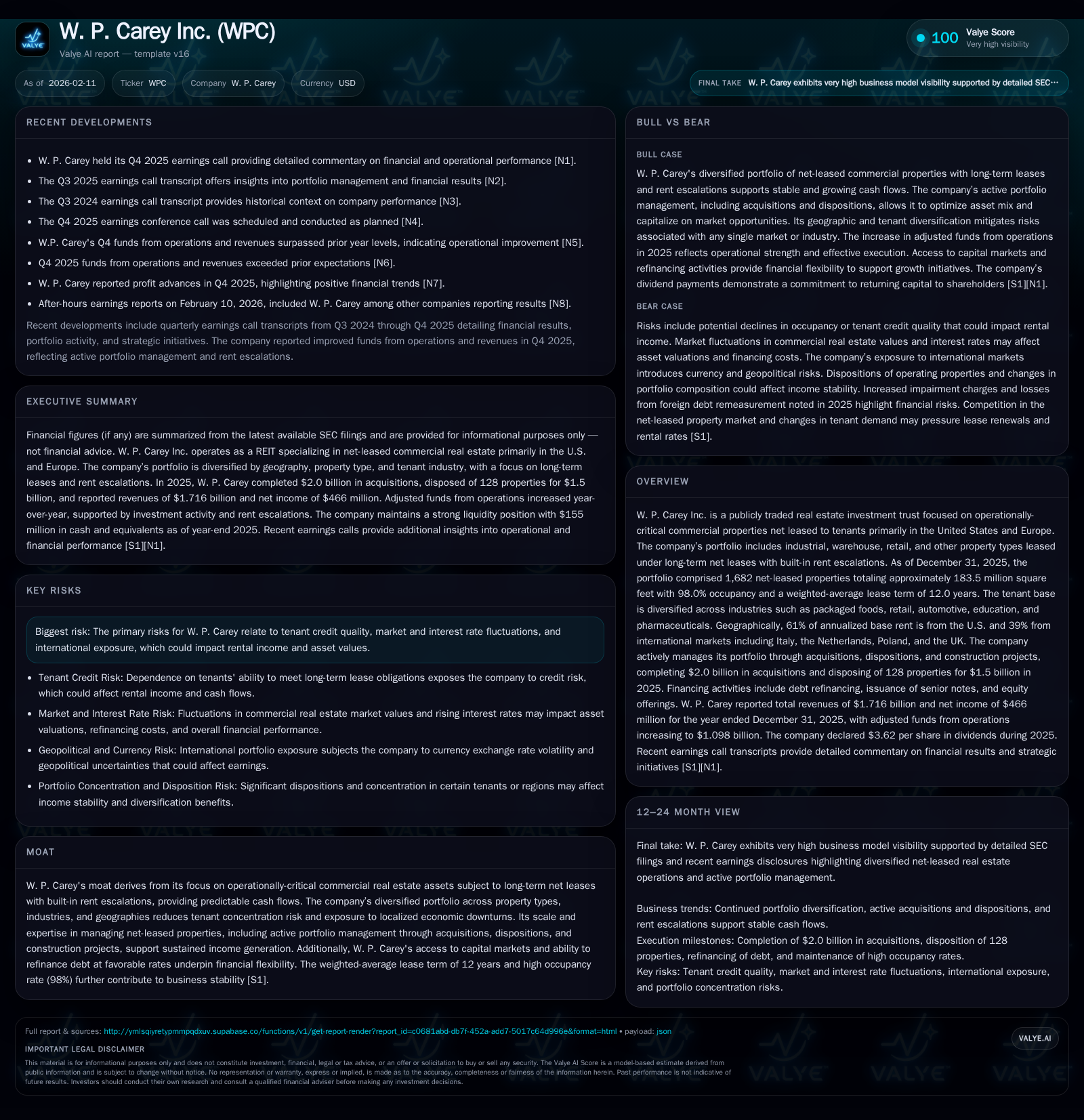
W. P. Carey Inc. continues to demonstrate resilience through its disciplined focus on long-term net leases in operationally essential commercial properties, spanning industrial, warehouse, retail, and other sectors across the U.S. and Europe. With a vast portfolio of over 1,600 properties covering 183.5 million square feet and maintaining high occupancy (98%) alongside a weighted-average lease term of 12 years, the company benefits from strong built-in rent escalations that secure predictable cash flows. Its geographic and industry diversification mitigates localized risks, while recent refinancing and capital market activities safeguard financial flexibility. However, tenant credit quality and fluctuating interest rates remain watch points as global economic dynamics evolve.
A Fortress Built on Long-Term Net Leases: Inside W. P. Carey's Portfolio
W. P. Carey Inc.'s strategic bedrock lies in its substantial portfolio of net-leased commercial real estate assets that are operationally critical to tenants’ businesses. As of December 31, 2025, the company managed an expansive collection of 1,682 properties aggregating approximately 183.5 million square feet [S1]. These span industrial complexes, warehouse facilities, retail stores, and other specialized property types predominantly net leased under long-term contracts.
The hallmark lease structure is the triple-net lease containing built-in rent escalations which graduate rental income predictably over time—key to producing stable cash flows that investors can count on even amid economic volatility [S1]. With occupancy holding strong at 98%, almost the entire portfolio consistently generates income; meanwhile, leases feature a weighted-average remaining term of an impressive 12 years—a duration considerably longer than many peers' portfolios [S1].
Such lease tenors afford WPC visibility into revenue streams far beyond short-term cycles, limiting turnover costs or frequent renegotiation risk. The sheer scale also enables efficient operational oversight and negotiation leverage with tenants on renewals or expansions.
Key Highlights:
- Vast geographic footprint enhances resiliency
- Operationally-essential tenants underpin sustained demand
- Rent escalations embedded in leases bolster inflation resistance
- Lease terms average a dozen years ensuring tenancy duration consistency
This structural foundation creates a formidable defensive moat by combining scale with contractual protections that collectively support reliable earnings even when broader market conditions fluctuate.
Geographic and Industry Diversification: Mitigating Risks, Enhancing Stability
The company's revenue mix is well-balanced geographically: approximately 61% of annualized base rent emanates from the United States while the remaining 39% is sourced from key European markets including Italy, the Netherlands, Poland, and the United Kingdom [S1]. This transatlantic diversification diminishes exposure to domestic economic downturns or policy shifts localized in one region.
Moreover, tenant industry diversity further cushions performance unpredictability. The tenant roster spans sectors such as packaged foods — typically steady demand staples — alongside retail outlets resistant to sudden closures through long-term occupancy agreements; automotive parts providers benefitting from ongoing supply chain needs; educational institutions; and pharmaceutical firms whose operations tend to be less cyclical [S1].
This spread across both geography and industry effectively reduces concentration risk while hedging against sector-specific disruptions or regional recessions — a key consideration given increasing uncertainty around global supply chains and regulatory environments.
Financial Fortitude Evident in Q4 2025 Results and Capital Market Maneuvers
Demonstrating operational excellence amid macro headwinds, WPC reported fourth quarter 2025 revenues above $1.7 billion with full-year net income attributable to shareholders rising slightly to $466 million compared with prior periods [F1][N12][N13][N14]. The continued ability to beat top-line estimates underscores disciplined property leasing coupled with astute portfolio management.
Capital markets activities illustrate savvy financial stewardship enhancing liquidity and reducing refinancing risk:
- In early 2025 repaid maturing senior notes ($450 million) fulfilling obligations without disruption [S1].
- Executed variable-to-fixed interest rate swaps against €500 million unsecured term loans due in 2029 locking low fixed coupon rates near post-pandemic lows (around ~2.8%) through end-2027 for greater cost certainty [S1].
- Similarly substituted floating components on £270 million GBP term loans due in 2028 to steady fixed interest expense at roughly ~4.7% through late 2027 [S1].
- Launched a well-received $400 million underwritten public offering of senior notes maturing in five years priced slightly below par but yielding attractive fixed coupons (~4.65%), strengthening debt maturity profile [S1].
- Raised additional equity capital via ATM sales (approximately $423 million gross proceeds pending settlement) providing liquidity for acquisitions or opportunistic investments [S1].
These funding maneuvers exhibit proactive balance sheet management geared toward optimizing cost of capital whilst maintaining ample financial flexibility which supports ongoing investment programs.
Navigating Tenant Credit Quality and Interest Rate Challenges
Notwithstanding WPC's robust model and diversification benefits, risks around tenant creditworthiness persist given evolving economic landscapes globally [S1][S2]. Operationally-critical tenants do not render immunity from bankruptcies or downsizing especially amid inflationary pressures or sectoral disruptions.
Interest rate fluctuations pose another challenge by impacting both borrowing costs and asset valuations since capitalization rates tend to correlate positively with prevailing yields — higher interest rates could pressure fair values of underlying properties reducing borrowing capacity if sustained.
The company mitigates these risks through:
- Rigorous tenant screening complemented by staggered lease expirations limiting lumpiness.
- Leases structured as triple-net pass-throughs transferring many operating expenses back to tenants reducing landlord margin volatility.
- Use of long-term fixed-rate debt instruments hedged against floating-rate exposures as referenced earlier provides interest cost stability.
Nonetheless, these factors require ongoing vigilance given the potential for credit deterioration or unfavorable rate environments that could ripple through future earnings [S2].
Strategic Asset Acquisitions, Dispositions, and Construction Projects Driving Growth
Capital deployment remains central to WPC's strategy for sustaining growth despite macro uncertainties:
- In 2025 alone completed $2 billion of acquisitions focusing on accretive property additions aligned with core net-lease criteria emphasizing operational necessity [S1].
- Invested $68.9 million in completing three construction projects addressing tenant-driven expansions or repositionings bolstering portfolio quality.
- Committed to fund an additional eleven construction projects with anticipated expenditure totaling ~$277 million scheduled for completion through 2026–27 signaling confidence in organic growth opportunities within existing assets [S1].
- Concurrently executed dispositions of 128 properties totaling over $1.5 billion primarily divesting non-core or lower-yielding assets such as self-storage units ($772 million) plus a student housing property ($77 million), largely recycling capital into higher-return avenues [S1].
This active rotation approach balances prudence with opportunism preserving portfolio strength while capturing evolving market dynamics.
Dividend Reliability and Shareholder Returns: Tracking Consistency amid Change
A critical appeal of WPC’s model is its dependable distribution track record supported by resilient cash flows underlying their funds from operations (FFO). For fiscal year 2025 total dividends declared per common share rose incrementally quarter-over-quarter from $0.89 up to $0.92 culminating in an aggregate payout of $3.62 per share [S1].
Steady dividend hikes align closely with measured rental escalations embedded within net leases reinforcing trust among income-focused shareholders who value reliability alongside growth prospects.
Accounting Judgments that Shape WPC’s Real Estate Valuations
Behind reported numbers lie important accounting estimates warranting scrutiny given their bearing on asset carrying values:
- Acquisition accounting involves detailed allocation between tangible assets (land/buildings) versus intangible elements (above/below market rents plus tenant relationships). These allocations employ assumptions around discount rates, capitalization rates, market rents and expected leasing commissions which materially influence recognized fair values upon acquisitions [S1].
- Impairment testing follows a two-step process comparing carrying values to undiscounted future cash flows typically projected over up to ten years given WPC’s long-hold strategy; significant judgments here include estimated market rents trends, residual property values at disposition dates, expected holding periods, all informed by third-party appraisals and market data [S1].
- Given inherent uncertainties especially amid changing economic environments these subjective estimates introduce valuation sensitivities possibly affecting quarterly results or balance sheet metrics although management applies probability-weighted scenarios reflecting realistic outcomes.
Transparency around these estimates provides investors confidence that reported valuations rest on rigorous processes rather than arbitrary adjustments.
What Lies Ahead: Risks and Opportunities in a Changing REIT Landscape
Looking forward into an evolving commercial real estate environment shaped by shifting macroeconomic conditions including inflation trajectories identified environmental regulations impacting property operations alongside geopolitical considerations influencing international holdings—WPC confronts several challenges yet simultaneously benefits from distinct advantages:
Risks:
- Elevated tenant credit risks amid cost pressures could strain lease performance.
- Rising interest rates may increase capital costs or depress asset prices complicating future financing/refinancing efforts.
- Exposure across international jurisdictions introduces currency, regulatory compliance complexity plus potential political risks affecting cash flow stability.
- Changing preferences for commercial space utilization post-pandemic may reshape demand patterns requiring tactical agility.
Opportunities:
- Leveraging seasoned expertise for accretive acquisitions fueling portfolio enhancement aligned with stable cash flow characteristics.
- Continuing active portfolio management reallocating capital away from non-core segments toward higher-quality assets benefiting from secular tailwinds like logistics/industrial spaces crucial for e-commerce supply chains.
- Deploying flexible financing structures profiting from current credit markets enhancing strategic initiatives.
- Capitalizing on long-term lease escalations insulating against moderate inflation fostering dividend growth supporting investor appeal.
While no business operates immune from economic cycles or market disruptions—the combination of disciplined underwriting coupled with broad diversification across sectors/geographies alongside deep operating knowledge ensure W.P Carey remains well positioned within its niche REIT landscape continuing to deliver on its mandate amid shifting external forces.
This analysis reflects a synthesis of available SEC filings through February 11, 2026 [S1,S2], recent earnings transcripts [N1,N12,N13,N14], and companyfacts data [F1], integrated with industry context without offering investment recommendations.
Disclaimer: This is research-only, informational analysis and not investment advice. It may include AI-generated interpretation and general industry context. Always verify important details using primary sources.

Comments