CleanCore Solutions: Navigating Innovation with Nanobubble Ozone Tech Amid Growth Challenges
CleanCore Solutions pioneers chemical-free cleaning through patented nanobubble aqueous ozone technology while wrestling with early-stage financial volatility.
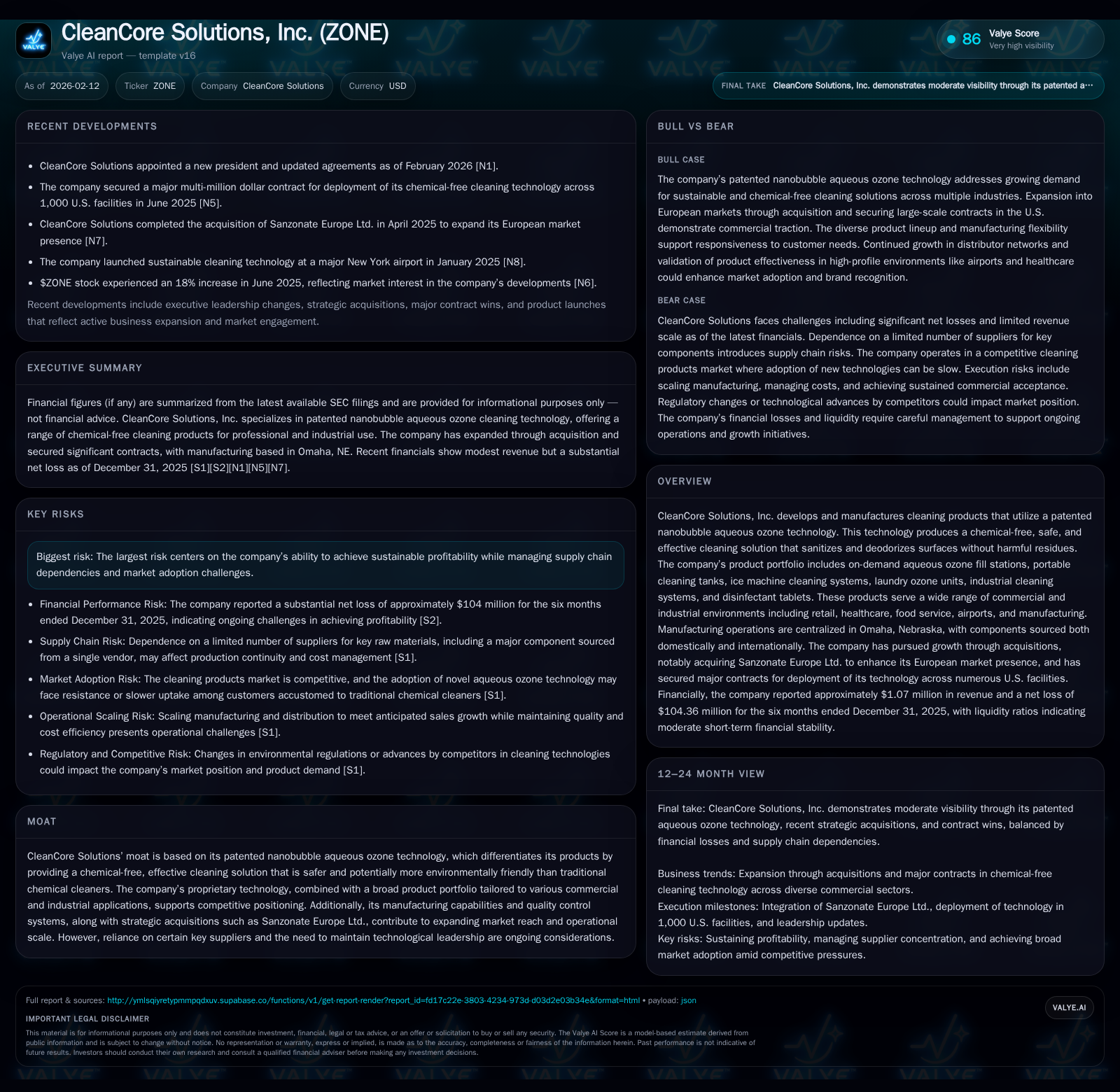
CleanCore Solutions, Inc. leverages proprietary nanobubble technology to deliver effective, residue-free cleaning products targeting commercial and industrial sectors. Despite technological promise and strategic acquisitions broadening its international reach, the company confronts significant financial headwinds marked by substantial net losses and liquidity pressures. Manufacturing centralized in Omaha supports quality control but also highlights supply chain dependencies that could affect scalability. Going concern opinions underscore the imperative for successful market adoption and sustained capital raises as CleanCore balances breakthrough innovation with operational reality.
Nanobubbles: The Heart of CleanCore’s Tech Revolution
At the core of CleanCore Solutions’ product innovation lies a patented nanobubble aqueous ozone technology that sets it apart from conventional cleaning methods. Unlike traditional ozone gas applications—which pose inhalation risks—CleanCore infuses ozone into tap water producing an aqueous ozone solution that is safe to handle yet retains potent oxidizing properties beneficial for sanitization [S1]. The defining attribute is the nanobubble size: tiny gaseous cavities approximately one-billionth of a meter in diameter. This nanometric scale conveys critical functional advantages.
Scientific analyses describe how these nanobubbles lack buoyancy and therefore remain suspended underwater far longer than larger microbubbles. With a negatively charged surface, they attract positively charged pollutants such as bacteria, viruses, molds, and toxins [S1]. Upon contact, these bubbles release ozone gradually, disrupting pathogen cell walls efficiently over treated surfaces. Research published in Environmental Science Nano highlights how this mechanism delivers superior surface coverage and oxidative action compared to previous aqueous ozone variants. Independent studies cited by CleanCore even suggest microbial killing capacity exceeding bleach for organisms like E. coli, Listeria, and Salmonella [S1]. By circumventing harsh chemicals altogether, the product aligns with rising environmental safety standards.
Yet despite its compelling biochemical profile and encouraging third-party validations, scalable demonstration of consistent performance across diverse real-world contexts remains an ongoing endeavor. The science is promising but still subject to further validation through broader adoption.
From Labs to Markets: Assessing Product Portfolio Reach
CleanCore's product line extends beyond foundational aqueous ozone generation devices to specialized equipment designed for operational versatility across multiple commercial landscapes. These include on-demand fill stations for immediate solution generation, portable cleaning tanks enabling mobility within facilities, ice machine cleaning systems addressing niche hygiene challenges, laundry ozone units reducing detergents’ ecological footprint, industrial cleaning setups tailored for heavy-duty environments, as well as disinfectant tablets complementing liquid solutions [S1].
Target sectors are diverse—retail outlets requiring routine surface sanitization; healthcare environments where pathogen control is paramount; food service operations sensitive to both hygiene and product residues; transport hubs like airports exposed to high foot traffic; manufacturing plants demanding robust contamination mitigation. By addressing several verticals simultaneously, CleanCore attempts revenue stream diversification to reduce vulnerability inherent in any single end-market.
This approach suggests a strategic intent to validate technology applications iteratively rather than betting all resources on one flagship offering or industry niche. Expanding distribution networks reflects efforts at penetrating wider geographic markets while product variety aims to adapt to heterogeneous customer needs.
Financial Pulse: Unpacking Persistent Losses and Capital Needs
Financially, CleanCore inhabits a challenging phase characterized by sizable losses dwarfing modest revenues [F1]. For fiscal year ending December 31, 2025, reported revenue approximated $1.07 million contrasted sharply against a staggering net loss exceeding $104 million [F1]. Such disparity underscores the difficulty early-stage companies face translating promising tech into profitable operations.
Liquidity metrics provide a mixed picture: current assets stood at nearly $10.4 million against $7.1 million in current liabilities yielding a current ratio of roughly 1.47—indicative of reasonable short-term solvency buffering [F1]. However, auditors issued a "going concern" opinion warning substantial doubt about continuity past twelve months without additional financing support [S1]. Management acknowledges cash reserves might not suffice for planned expenditures without capital raises.
The company has historically depended on equity sales, debt issuance (including related party financing), bank lines of credit alongside operational cash flows—all strained given growth ambitions and cost structure [S1]. High operating expenses reflect investments in R&D, manufacturing upgrades in Omaha, sales expansion strategies including establishing new distribution channels internationally.
Sustaining operations will likely require further fundraisings which may dilute shareholders or impose restrictive covenants depending on debt terms obtained [S1]. Navigating this financial tightrope remains paramount.
Strategic Moves: Acquisitions and Expanding Global Footprint
Growth ambitions manifest clearly through strategic acquisitions exemplified by CleanCore’s purchase of Sanzonate Europe Ltd., signaling intent to penetrate European markets more aggressively [S1], [N1]. Bringing established regional expertise under its umbrella facilitates channel building amidst competitive pressures abroad and shortens time-to-market locally.
Recent corporate governance developments compound this narrative. On February 12, 2026, a new president was appointed alongside updates to key agreements potentially linked to recalibrating leadership strength amid expansion demands or capital restructuring efforts [N1]. Such changes often accompany transitional phases wherein operational scalability and investor confidence must be balanced carefully.
These moves intertwine with underlying product validation campaigns currently underway focused on high-visibility venues like restaurants, airports, and hotels per management statements [S1]. Successful integration of acquired entities combined with leadership realignment can catalyze faster commercialization but also pose integration risks.
Supply Chain and Manufacturing: Operational Backbone Insights
Manufacturing operations are concentrated primarily at the company's facility in Omaha, Nebraska—a locus combining domestic production control with international component sourcing [S1]. This centralization promotes quality oversight essential for maintaining strict industry compliance relevant to cleaning efficacy claims.
However, reliance on specific suppliers for proprietary components introduces supply chain vulnerabilities flagged in risk disclosures [S1]. Geopolitical factors or disruptions at key nodes could delay production or increase costs impacting delivery schedules critical for customer retention.
Balancing centralized manufacturing efficiency with supply chain resilience represents an ongoing operational challenge especially as production scales from pilot volumes toward mainstream commercialization.
Assessing Risks in an Early-Stage Disruptor
CleanCore embodies quintessential early-stage company risks detailed extensively by its own filings [S1]. Limited operating history imparts inherent unpredictability compounded by substantial accumulated losses questioning profitability timelines.
Dependence on external financing remains acute; failure to secure adequate funds could precipitate insolvency leading investors facing considerable downside risk including potential total capital loss [S1]. Market adoption hurdles also loom large given entrenched competition from traditional chemical cleaners reliant on decades-established customer preferences.
Technological competition requires vigilant innovation pace preservation lest rival firms develop superior or more cost-effective alternatives making patent protections vulnerable over time. Supply chain complexities add operational uncertainty while governance changes inject execution unpredictability.
Combined these factors portray a company whose ultimate fate hinges critically on effective risk management layered atop commercial break-even achievement.
Outlook: Market Adoption, Technology Leadership, and Sustainability
Looking ahead, tailwinds favoring environmentally friendly sanitation solutions offer encouraging macro-level context supporting CleanCore’s product ethos [S1], [N1]. Regulatory trends limiting harmful chemical usage elevate demand potential for non-toxic technologies especially across hospitality venues actively trialing aqueous ozone systems per corporate disclosures.
The platform’s scientific foundations position it well amidst growing public health awareness post-pandemic emphasizing surface hygiene without residual toxicity concerns. Yet cautious appraisal remains warranted as translating demonstrated laboratory efficacy into scalable commercial success involves myriad variables including customer acquisition cost control and supply chain optimization.
Leadership transitions announced recently likely reflect acknowledgment of execution gaps needing correction coupled with adaptive strategies responsive to competitive feedback loops [N1]. Ongoing validation projects within targeted industries will provide bellwethers measuring technology acceptance velocity potentially unlocking longer-term profitability pathways.
In sum, CleanCore operates at the intersection where pioneering green chemistry confronts startup growth pains—a juxtaposition immersed in opportunity yet fraught with executional hazards demanding prudent navigation by stakeholders worldwide seeking sustainable clean solutions.
Disclaimer: This analysis is informational only and does not constitute investment advice or recommendations.
Disclaimer: This is research-only, informational analysis and not investment advice. It may include AI-generated interpretation and general industry context. Always verify important details using primary sources.

Comments