
Apex Treasury Corp: SPAC Execution, TECfusions Deal, and the High-Stakes Path to AI Infrastructure Value
The next phase will test management’s deal execution, capital strategy, and TECfusions’ ability to scale in a capital-intensive market.
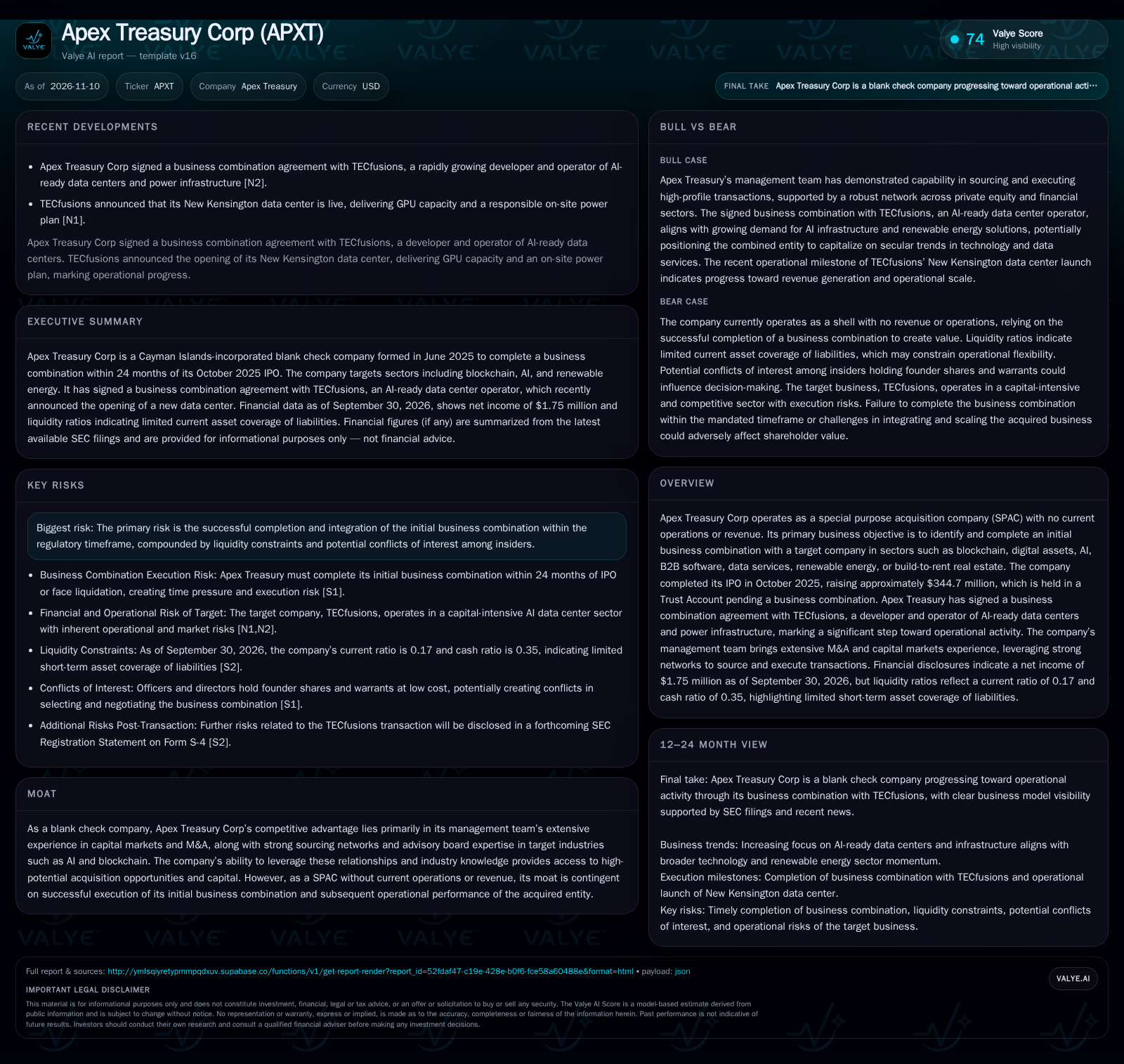
Apex Treasury Corp, a SPAC with $344.7 million in trust, has signed a $4.0 billion all-stock merger agreement to acquire TECfusions, an AI-ready data center and infrastructure company. With no operating business or revenue to date, Apex faces a 24-month deadline from its October 2025 IPO to close the deal. The TECfusions deal, if successful, could position the combined entity as a Nasdaq-listed AI infrastructure platform, but execution, integration, and sector competition risks are significant. [S1] [S2] [N2]
Apex Treasury Corp sits at a critical juncture as a newly minted SPAC, having secured a business combination agreement with TECfusions, a rapidly scaling AI-ready data center operator. With approximately $344.7 million in trust and a ticking 24-month clock from its October 2025 IPO, Apex has staked its future on closing a $4.0 billion all-stock merger. This move offers exposure to surging demand for AI infrastructure, but also exposes the company to the execution risks, capital requirements, and integration challenges that have defined the SPAC landscape. The coming quarters will determine whether Apex can convert its M&A expertise and target selection into durable public-market value—or succumb to the pitfalls of deal complexity and sector competition.
Apex Treasury’s Present State: SPAC Structure, TECfusions Deal, and Time Constraints
Apex Treasury Corp is a blank check company formed in June 2025, structured as a Cayman Islands exempted company with the sole purpose of effecting a business combination. It completed its IPO in October 2025, raising $344.7 million, which is held in a trust account pending deal closure. The company has not commenced operations nor generated revenue, and is classified as a shell company under the Exchange Act. [S1] [S2]
The most consequential current development is the July 2026 signing of a definitive business combination agreement with TECfusions, an AI infrastructure company focused on next-generation data centers and power infrastructure. The deal values TECfusions at $4.0 billion, to be paid in 400 million newly issued Apex shares at $10 per share, with TECfusions becoming a wholly owned subsidiary of the post-combination entity. [S2] [N2]
Apex Treasury is under a 24-month deadline from its IPO closing to consummate a business combination, or it must liquidate and return trust proceeds to shareholders. As of September 30, 2026, its current ratio stands at 0.17 and cash ratio at 0.35, indicating limited short-term asset coverage for its liabilities, though the bulk of IPO capital is sequestered in trust until deal close. [S2]
How Value Could Be Created (or Destroyed) in the TECfusions SPAC Transaction
The economic engine for Apex Treasury is the successful completion of its initial business combination, as the company itself has no operating business, no revenue streams, and minimal recurring expenses outside of deal-related costs and trust fund management. All value hinges on the terms and execution of the merger with TECfusions.
If completed, the economics of the combined entity would pivot to TECfusions’ business model: designing, building, and leasing AI-ready data centers and associated power infrastructure. This sector is characterized by high capital intensity, long project lead times, and revenue models based on multi-year leasing contracts with technology, cloud, and enterprise clients. Gross margins can be attractive if occupancy and utilization ramp efficiently, but fixed costs and depreciation are substantial.
From a SPAC perspective, Apex’s trust assets (originally $344.7 million) provide a potential capital injection for TECfusions, but actual deal proceeds may be reduced by redemptions and transaction costs. The all-stock structure (400 million shares at $10 each) means dilution is substantial, and the implied valuation sets a high hurdle for post-merger market acceptance and future capital raising. The company may issue additional securities or incur debt to close the deal or fund post-merger growth. [S1] [S2]
Operating leverage in data center businesses can be significant as facility-level utilization increases, but initial ramp periods often involve negative free cash flow. The ability of TECfusions to secure anchor tenants, achieve high pre-leasing rates, and control construction costs will drive medium-term economic outcomes.
SPACs, AI Data Centers, and the Race for Infrastructure Scale
Apex Treasury’s competitive position as a SPAC is largely defined by its management team’s M&A and capital markets expertise, which enhances its ability to source, negotiate, and execute complex transactions. This is an advantage in a crowded SPAC market, but only if it translates into the selection and successful integration of a high-quality target.
Post-merger, the competitive landscape shifts to TECfusions’ operating environment. The AI-ready data center space is highly competitive, with established REITs, private equity-backed platforms, hyperscale cloud providers, and infrastructure funds all vying for market share. Barriers to entry include site acquisition, power procurement, construction expertise, and customer relationships. However, the sector’s growth is propelled by surging AI compute demand and the need for specialized power and cooling.
Potential substitutes include traditional data centers, cloud service providers, and emerging edge-compute networks. TECfusions’ ability to differentiate via technology, speed to market, or unique power solutions could be a source of advantage, but these claims remain unproven absent detailed disclosures.
If the TECfusions Deal Catalyzes a Scalable AI Infrastructure Platform
The favorable scenario requires several links in the causal chain: Apex must close the TECfusions merger on time, minimize redemptions to preserve trust capital, and support a smooth public listing. If TECfusions leverages the SPAC proceeds to accelerate data center development, secure anchor customers, and demonstrate rapid revenue ramp, the combined entity could achieve scale and market credibility as a publicly traded AI infrastructure platform.
Upside would be confirmed by evidence such as: a successful merger closing with low shareholder redemptions; strong initial customer contracts or pre-leasing activity at TECfusions facilities; robust utilization and margin expansion versus initial projections; and the ability to access additional growth capital on attractive terms post-listing.
A re-rating of the stock would likely require demonstration of both operational execution (facility delivery, customer wins) and financial discipline (capex management, cash flow improvement) within the first few quarters post-deal.
Most Likely Outcome: Execution Strain, Capital Friction, and Post-Merger Uncertainty
The most plausible scenario is that Apex Treasury completes the TECfusions merger, but not without headwinds. SPACs frequently experience high redemption rates, which could materially reduce the cash delivered to TECfusions and constrain initial growth plans. The all-stock deal structure means existing TECfusions shareholders will own the majority of the post-merger entity, but market volatility or skepticism about valuation could pressure the stock price.
Integration risks are significant: TECfusions must rapidly scale operations, manage complex construction projects, and compete for both customers and capital. Initial quarters may be marked by negative free cash flow and operational growing pains as the business transitions to public-market scrutiny.
Key confirming evidence for this scenario would include: completion of the merger with moderate-to-high redemptions; post-merger financial updates showing high capex, slow revenue build, and tightening liquidity; and early-stage volatility in public market trading of the new TECfusions entity.
How Execution Failure or Deal Breakdown Could Destroy Shareholder Value
The adverse scenario is triggered if the merger with TECfusions is delayed, terminated, or fails to secure sufficient shareholder approval. Apex Treasury faces a hard 24-month deadline from IPO to close a business combination, or else must liquidate and return trust proceeds—likely at a loss to sponsors and warrant holders.
Even if the deal closes, high redemptions could starve the combined company of cash, forcing fire-sale asset dispositions or dilutive emergency financings. If TECfusions fails to ramp revenue, secure key customers, or execute on construction, the public entity could quickly face liquidity stress and eroding market confidence.
Downside evidence would include: regulatory or shareholder roadblocks to deal closure; disclosure of high redemptions leaving minimal cash for growth; post-merger restatements, missed milestones, or negative surprises in facility delivery or customer acquisition.
Milestones and Evidence That Will Define the Apex-TECfusions SPAC Thesis
Shareholder redemption rates at the merger vote: High redemptions would materially reduce cash available for TECfusions’ growth and signal market skepticism.
SEC effectiveness and approval timeline for the Registration Statement on Form S-4: Delays here could jeopardize the timeline for closing the business combination.
Final terms and structure of the merger, including any PIPE (private investment in public equity) financing or additional capital arrangements, if disclosed.
TECfusions’ disclosed backlog, pre-leasing rates, or signed anchor tenant agreements at the time of deal close or first public update—these would provide evidence of commercial traction.
Post-merger financial guidance for revenue, capex, and free cash flow, if disclosed, as a test of management’s growth and capital allocation assumptions.
Integration milestones—such as the delivery of new data center capacity or power infrastructure—within the first 12 months post-combination.
Any changes in leadership, business strategy, or capital structure between signing and closing, which could indicate internal friction or shifting priorities.
Disclosures of additional risk factors or adverse developments in the forthcoming S-4 registration statement.
Disclaimer: This is research-only, informational analysis and not investment advice. It may include AI-generated interpretation and general industry context. Always verify important details using primary sources.

Comments