
Li Bang International: Acquisition Ambition Meets Financial and Integration Hurdles
Li Bang International Corp Inc.
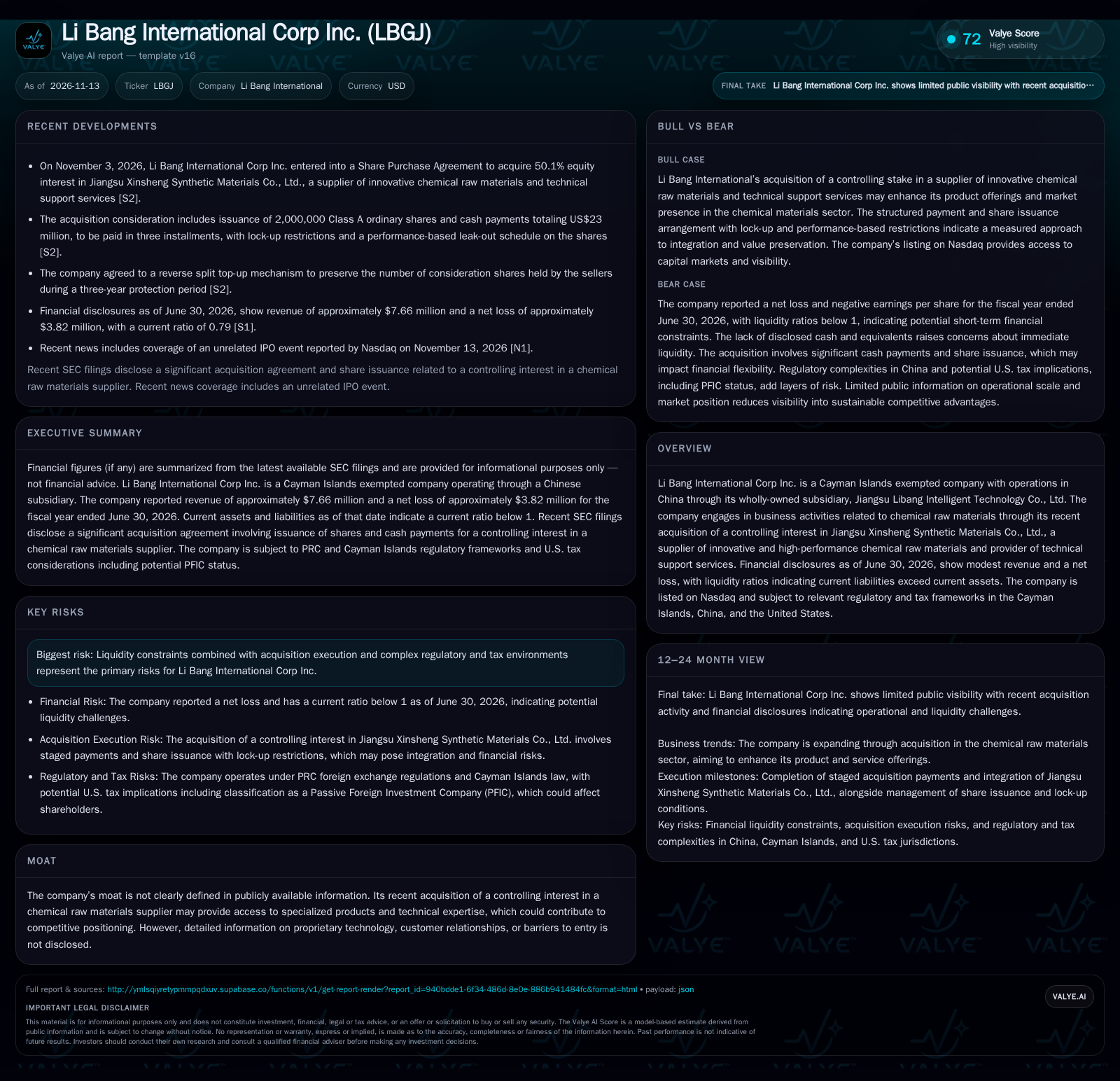
Li Bang International Corp Inc. has acquired a controlling interest in Jiangsu Xinsheng Synthetic Materials, aiming to deepen its presence in innovative chemical raw materials. Integration and regulatory complexity add further uncertainty to the path forward. [S1] [S2]
Li Bang International’s recent acquisition of a controlling stake in Jiangsu Xinsheng Synthetic Materials marks a high-stakes pivot into the Chinese chemical raw materials sector. The $23 million cash outlay and share issuance come at a time when the company’s liquidity is stretched, with current liabilities exceeding current assets and no disclosed cash reserves. This bold move could catalyze growth if integration delivers, but execution, regulatory, and financial risks loom large. The coming quarters will test whether the acquisition can transform Li Bang’s market position—or deepen its vulnerabilities.
Acquisition and Financial Snapshot Reshape Li Bang’s Risk Profile
Li Bang International Corp Inc. entered into a Share Purchase Agreement on November 3, 2026, to acquire 50.1% of Jiangsu Xinsheng Synthetic Materials, a supplier of innovative chemical raw materials and technical support services. The consideration includes the issuance of 2 million Class A ordinary shares and $23 million in cash payments, structured in three installments. These shares are subject to lock-up and performance-based leak-out restrictions, and the agreement includes a reverse split top-up to protect sellers’ share counts for three years. [S2]
The company reported cash and liquidity metrics for the period; these figures do not by themselves establish operating runway, investment capacity, financial flexibility, or financing capacity. Notably, no cash or cash equivalents were disclosed, underscoring immediate liquidity pressure. [S1]
The strategic acquisition and associated financial commitments are set against a backdrop of regulatory complexity: the company operates through a Chinese subsidiary but is incorporated in the Cayman Islands and listed on Nasdaq, with potential U.S. PFIC tax classification risk.
How Li Bang Could Monetize in the Chemical Value Chain
Li Bang’s core economics hinge on sourcing, processing, and distributing high-performance chemical raw materials, now augmented by technical support services following the Xinsheng acquisition. Revenue likely derives from B2B sales to manufacturers in industries such as plastics, coatings, or advanced materials, where supply reliability and technical expertise can command premium pricing—if differentiation is proven.
Gross margins in the chemical distribution sector tend to be modest, often in the mid-to-high single digits, unless proprietary formulations, specialty chemicals, or bundled technical support allow for higher value capture. The Xinsheng acquisition may provide access to such higher-margin niches, but this depends on the uniqueness and defensibility of its offerings.
Operating leverage is possible if the combined entity can scale volumes without commensurate increases in fixed costs, but the capital intensity of the sector—inventory, working capital, compliance, and R&D—means that cash flow can be volatile. The company’s need to fund $23 million in acquisition payments, potentially from external sources, raises questions about dilution, debt capacity, or operational cash flow sufficiency.
The reverse split top-up and lock-up provisions on the consideration shares may align seller incentives with integration success, but also create latent dilution risk if performance targets are met. The absence of disclosed cash or short-term investments suggests near-term funding decisions will be critical to operational continuity and deal completion.
Assessing Li Bang’s Prospects in a Fragmented and Competitive Market
China’s chemical raw materials market is highly fragmented, with a mix of state-owned giants, regional distributors, and niche specialty suppliers. Competitive advantages in this sector typically arise from proprietary technologies, established customer relationships, supply chain reliability, and regulatory compliance capabilities.
Li Bang’s acquisition of Xinsheng could provide access to innovative products and technical service capabilities, which may help carve out a defensible niche among higher-end or specialty customers. However, the lack of disclosed proprietary technology or long-term customer contracts tempers confidence in sustainable differentiation.
Barriers to entry are moderate: regulatory compliance, safety certification, and capital requirements are significant but not insurmountable for well-capitalized entrants. Switching costs for customers are typically low unless products are highly customized or integration with customers’ processes is deep.
The company’s Nasdaq listing offers some visibility and potential access to global capital, but also subjects it to heightened scrutiny and disclosure standards—factors that may matter in future competitive positioning if the company seeks to scale or diversify further.
Integration Success and Specialty Differentiation Drive Relevance
If Li Bang rapidly and smoothly integrates Xinsheng, leverages its technical support services, and successfully targets specialty chemical segments with higher margins, the combined entity could transition from a modest regional player to a recognized supplier in China’s value-added chemical ecosystem.
Upside would be confirmed by evidence such as: revenue growth outpacing sector averages; improving gross and operating margins; disclosure of multi-year customer contracts in specialty applications; or successful cross-selling of technical services alongside material sales.
A positive scenario also assumes that the company sources external funding or improves working capital efficiency to meet acquisition payment obligations without dilutive equity raises or distress financing, and that regulatory and tax complexities are navigated without material penalties or disruptions.
If realized, this would validate the acquisition as a catalyst for scale and profitability, positioning Li Bang for further sector expansion or strategic partnerships.
Operational Integration and Funding Needs Limit Near-Term Progress
The most plausible path is that Li Bang completes the acquisition but faces operational and financial friction in the next 12-24 months. Integration costs, cultural alignment between management teams, and the practicalities of merging systems and processes could weigh on both expenses and management bandwidth.
Revenue may grow modestly as Xinsheng is consolidated, but margin expansion is likely constrained by competition, lack of clear proprietary differentiation, and ongoing working capital needs. The company will need to secure additional funding to meet staged acquisition payments, which could come with dilution or leverage.
Evidence confirming this scenario includes: modest revenue growth tracking industry averages; continued net losses or flat margins; incremental funding events; and limited disclosure of new or expanded customer relationships.
Progress may be made toward a more stable platform, but the risk of ongoing operational strain and limited potential financial flexibility remains unless integration unlocks significant synergies or new market opportunities.
Liquidity Strain and Integration Failure Compound Structural Weakness
In a negative outcome, Li Bang’s stretched liquidity and lack of cash reserves could result in missed acquisition payments or inability to fund day-to-day operations, particularly if external financing is unavailable or prohibitively expensive. Integration of Xinsheng may falter due to cultural, operational, or regulatory missteps, leading to customer attrition or supplier disruptions.
Downside signals would include: delayed or renegotiated acquisition payments; disclosure of covenant breaches, distress financings, or emergency equity raises; further deterioration of the current ratio; and continued or widening net losses.
Regulatory or tax complications—such as adverse rulings on PFIC status, capital controls in China, or cross-jurisdictional compliance failures—could further erode shareholder value or restrict the company’s ability to repatriate profits and service obligations.
In this scenario, the acquisition exacerbates rather than alleviates underlying weaknesses, and the company risks value destruction or forced restructuring.
Milestones That Will Reveal Li Bang’s Strategic Direction and Viability
Integration updates—milestones in merging Xinsheng’s operations, realization of cost or revenue synergies, and retention of key customers and technical personnel.
Gross margin trends post-acquisition, especially if specialty or value-added segments are targeted, to assess whether product mix is improving.
Evidence of new or expanded customer contracts, particularly in higher-margin specialty chemical applications, if disclosed.
Timely completion of all three acquisition payment installments without distress financing or excessive dilution.
Updates on regulatory or tax developments, including PFIC determination and PRC capital transfer compliance.
Management commentary or disclosures on competitive positioning, proprietary technology, or entry into new markets or segments.
Disclaimer: This is research-only, informational analysis and not investment advice. It may include AI-generated interpretation and general industry context. Always verify important details using primary sources.

Comments