
Guru App Factory: Early-Stage App Developer Confronts Funding Gaps and Market Entry Hurdles
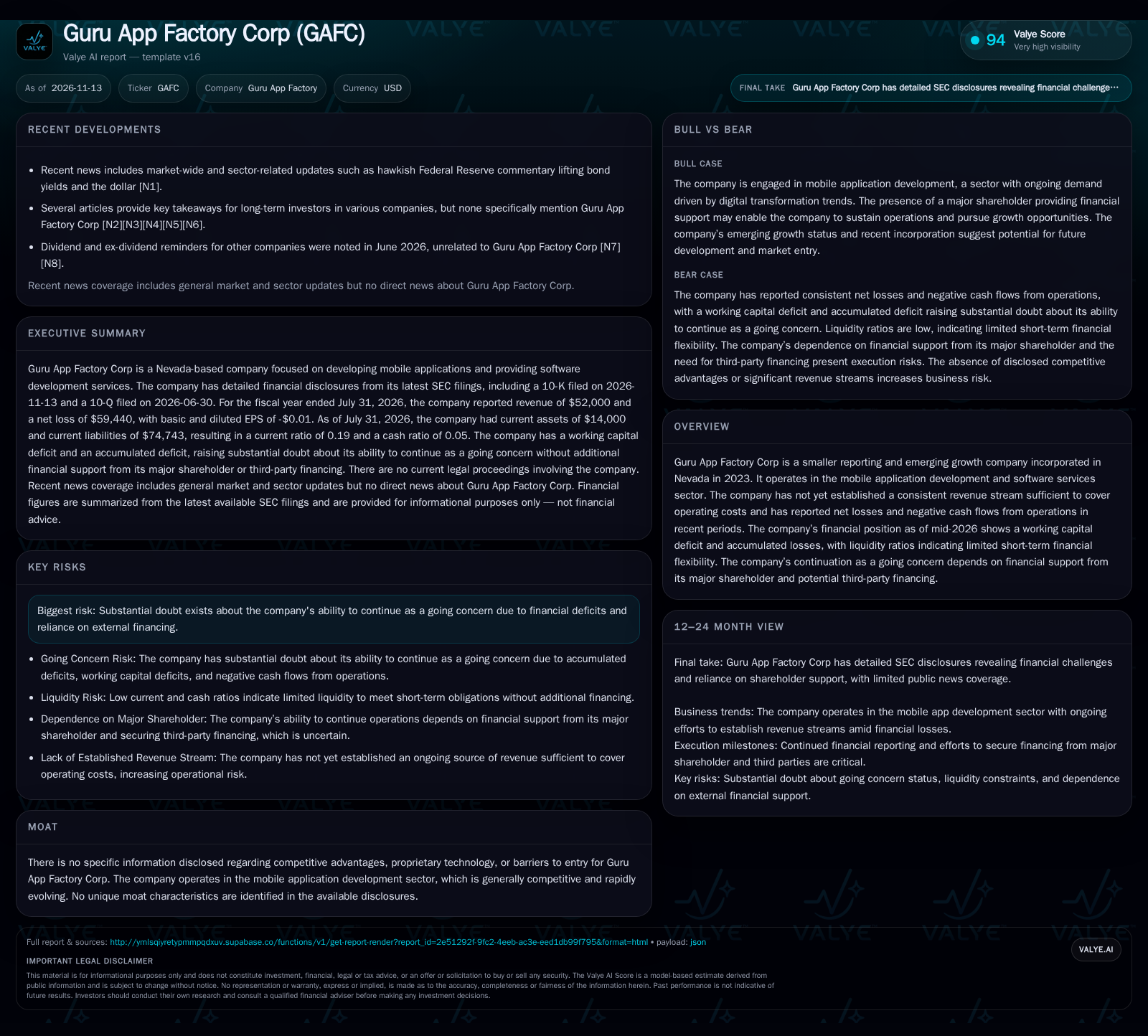
Guru App Factory Corp, a newly established mobile app developer, faces acute funding and operational deficits as it seeks to establish itself in a competitive digital services market. With minimal cash, ongoing losses, and reliance on shareholder support, the company's viability now hinges on external financing and its ability to carve out a differentiated niche.
The company’s future depends on securing additional funding and demonstrating a credible path to sustainable revenue in the fiercely competitive mobile app development sector. No unique technological or commercial moat is currently identified, heightening execution and survival risk. [S1] [S2]
Guru App Factory Corp, incorporated in Nevada in 2023, is attempting to gain traction in the crowded mobile application development and software services sector. With no evidence of a proprietary platform or defensible market niche, Guru App Factory’s survival rests on its capacity to attract new capital and demonstrate differentiated value in a sector notorious for intense competition and rapid technological change. [S1] [S2]
Acute Financial Strain Defines Present Reality
Guru App Factory Corp’s most recent filings highlight a precarious financial position: for the fiscal year ended July 31, 2026, the company generated $52,000 in revenue but posted a net loss of $59,440. Its current assets ($14,000) are dwarfed by current liabilities ($74,743), resulting in a current ratio of 0.19 and a cash ratio of only 0.05. As of April 2026, cash and equivalents stood at just $3,500. The company has accumulated an operating deficit of over $100,000, and ongoing losses from operations have resulted in negative cash flow. Most critically, management explicitly states substantial doubt about Guru App Factory’s ability to continue as a going concern for the coming year without further shareholder or third-party financial support. [S1] [S2]
Revenue Mechanics and Cost Structure in a Service-Driven Model
Guru App Factory’s topline is derived from mobile application development and software services—businesses that, at this early stage, are likely project-based and transactional rather than subscription-driven. In the absence of disclosed recurring contract structures, revenue predictability is likely low, with each project win constituting a discrete event. Pricing in this segment is typically constrained by intense competition, limiting gross margins unless the company can deliver specialized expertise, proprietary features, or serve niche verticals. Fixed costs for a small developer are generally dominated by labor, minimal infrastructure, and compliance expenses, but even modest overhead can quickly exceed sporadic revenue inflows. The company’s negative operating cash flow and working capital deficit suggest that current revenue does not support the fixed cost base. Absent a shift to higher-value or recurring revenue streams, Guru App Factory will likely require ongoing external funding to cover operating losses and support any meaningful growth attempt.
In addition to the transactional nature of its revenue, Guru App Factory’s cost structure likely includes variable expenses tied to project delivery, such as subcontractor fees or licensing costs for development tools and platforms. These variable costs can fluctuate significantly with project volume, complicating cash flow management. Moreover, the absence of scale economies at this early stage means that per-project margins may be compressed, especially if the company competes primarily on price. Effective cost control and project management discipline will be critical to prevent margin erosion. If the company can transition toward standardized app components or reusable codebases, it could reduce development time and costs, improving gross margins and enabling more competitive pricing or higher profitability.
Another important consideration is the potential impact of customer concentration risk. If Guru App Factory’s revenues are dependent on a limited number of clients or a few large projects, any delay or cancellation could disproportionately affect financial stability. A diversified client base or multi-project engagements would help smooth revenue volatility and reduce dependence on sporadic wins. Additionally, the company’s ability to maintain a skilled development team is crucial, as talent retention challenges can lead to project delays or quality issues, further impacting client satisfaction and repeat business. Investing in employee development or incentivization schemes might improve retention but would also add to fixed cost pressures in the short term.
Competitive Landscape: No Evident Moat Amid Commodity Pressures
Guru App Factory operates in a market saturated with freelance developers, boutique agencies, offshore software houses, and large digital consultancies—all competing for similar mobile app and software contracts. No evidence is disclosed of proprietary technology, platform effects, or exclusive customer relationships that could confer a defensible moat. Entry barriers in mobile app development are low, and switching costs for clients are minimal unless a vendor is deeply embedded in a client’s workflow or ecosystem. Without demonstrable specialization, IP, or a unique go-to-market approach, Guru App Factory is exposed to client churn, price-based competition, and substitution by both larger firms and globalized talent pools.
What It Would Take for a Breakout: Securing Funding and Differentiating the Offering
With fresh capital, the company could target a defensible niche—such as industry-specific app solutions, proprietary frameworks, or recurring service agreements—thereby improving margin profile and revenue predictability. Confirmation of this scenario would come from announcements of significant funding events, onboarding of anchor clients with multi-phase contracts, or the launch of a proprietary tool or platform that enables recurring revenue. Evidence of positive operating cash flow, increased gross margins, or client retention would further validate a pivot toward sustainability.
Most Likely Trajectory: Ongoing Struggle for Cash and Contract Wins
The most plausible near-term outcome is that Guru App Factory continues to operate hand-to-mouth, dependent on sporadic project revenues and periodic infusions of shareholder or external capital. In this scenario, the company may win some contracts but remains exposed to lumpy cash flows and ongoing losses, with little room for investment in R&D or marketing. The absence of a recurring revenue base or meaningful differentiation means that any improvement in financial results is likely to be incremental and fragile. Confirmation would come from continued disclosures of minimal revenue growth, persistent net losses, and working capital deficits, with no major funding or strategic partnership events.
Failure to Secure Funding or Revenue Triggers Forced Restructuring or Cessation
If Guru App Factory is unable to secure additional funding—either from its major shareholder or third parties—the company’s acute liquidity deficit could force it to curtail operations, restructure, or cease business altogether. In this downside scenario, delayed payments, inability to meet payroll or vendor obligations, and mounting payables could precipitate insolvency proceedings or a distressed asset sale. Evidence supporting this path would include disclosures of missed payments, legal proceedings, resignation of key personnel, or a formal announcement of strategic alternatives or liquidation.
Milestones and Metrics That Will Clarify Guru App Factory’s Survival Prospects
Successful closure of a significant equity or debt financing round, or disclosure of material financial support from the major shareholder.
Announcement of multi-project or recurring revenue contracts that would establish greater revenue visibility and client stickiness.
Monthly or quarterly revenue growth rates—if disclosed—that would demonstrate an ability to scale the business beyond sporadic project wins.
Gross margin trends, which would indicate the company’s ability to command premium pricing or achieve operational efficiency.
Evidence of proprietary technology launches, platforms, or differentiated service offerings that could increase switching costs.
Operating cash flow improvement or transition to positive cash flow from operations.
Any signals of staff reductions, delayed payments, or restructuring measures that would indicate mounting financial distress.
Disclosures of legal or regulatory proceedings, which could further complicate the company’s operational outlook.
Disclaimer: This is research-only, informational analysis and not investment advice. It may include AI-generated interpretation and general industry context. Always verify important details using primary sources.

Comments