
Arrive AI Charts Next-Gen Autonomous Last Mile Infrastructure
Arrive AI’s latest quarterly disclosures highlight advancements in smart locker technology and pilot deployments amidst significant liquidity constraints.
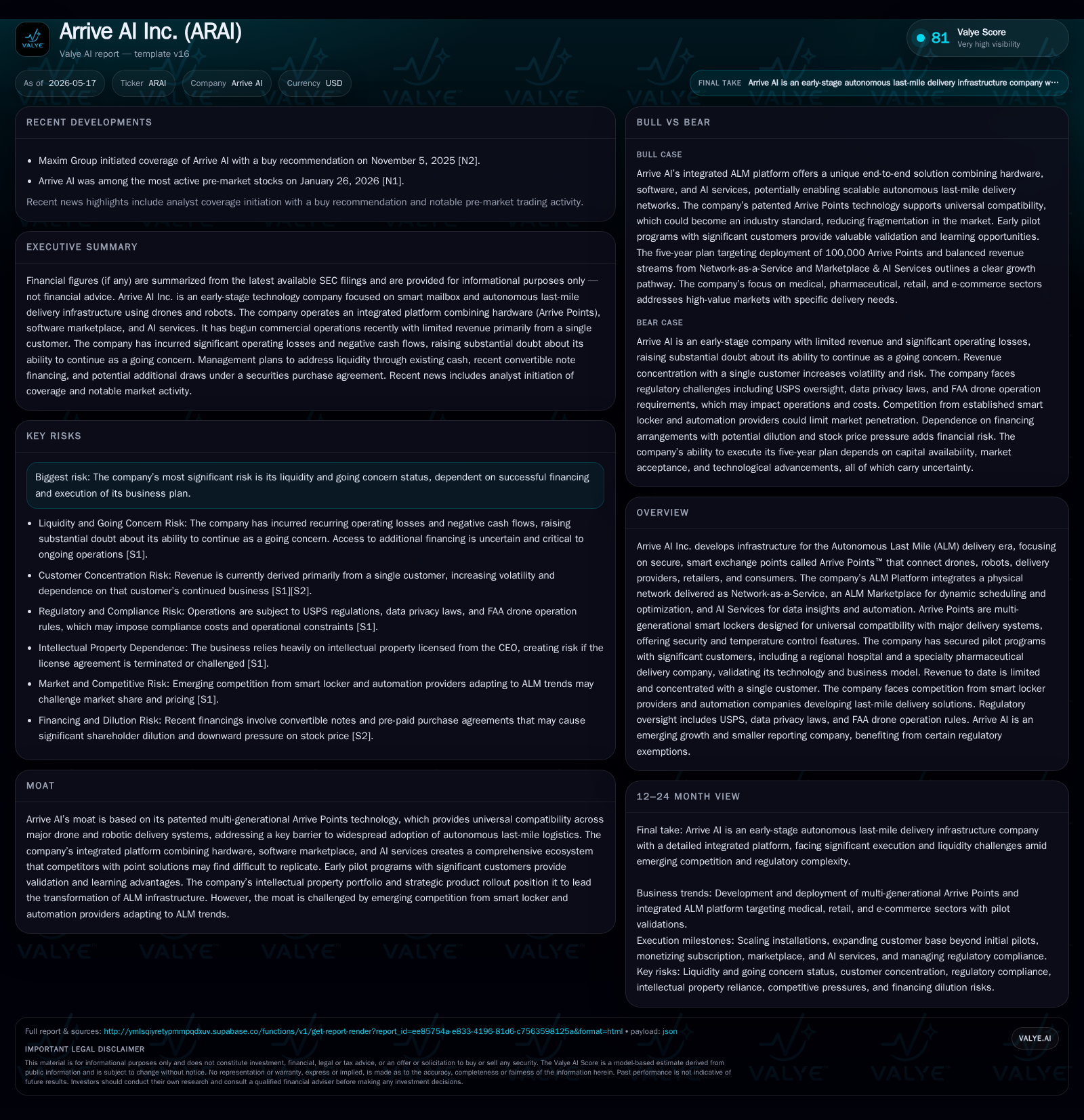
Arrive AI Inc. reported continued progress in its autonomous last-mile (ALM) delivery infrastructure within its recent 10-Q filing, emphasizing pilot programs with key healthcare and specialty logistics customers. The company’s Arrive Points™ ecosystem, comprising patented multi-generational smart lockers integrated with AI-powered scheduling and data services, underpins its differentiated platform approach in an evolving ALM market. Despite technological validation, Arrive AI faces pressing liquidity and Nasdaq listing compliance challenges that constrain execution and scaling prospects. Management’s ability to expand subscription revenues and optimize its ALM Marketplace will be critical near-term milestones.
Latest Operating Update: Quarterly Filing Insights
Arrive AI’s latest quarterly filing dated May 15, 2026 [S2] underscores continued operational strides predominantly centered on the deployment of the third-generation Arrive Points (AP3) units installed since late 2024. These multi-generational smart lockers have entered revenue-producing phases in 2025 with initial subscription fees and installation agreements, albeit overall revenue remains concentrated with a single large customer—the regional Hancock Health hospital system [S1]. The quarterly report does not disclose significant new risk updates beyond referencing the detailed annual risk narrative from April 2026.
Complementing this, the April 28, 2026 event filing [S3] reveals key corporate governance updates including the cessation of controlled company status as of April 9, 2026. However, critical attention is drawn to Nasdaq Listing Qualification notices signaling non-compliance with minimum Market Value of Publicly Held Shares (MVPHS) at $15 million and minimum Market Value of Listed Securities (MVLS) at $50 million thresholds. The Company has a defined window until September 28, 2026, to regain compliance or face potential transfer or delisting risks. This presents a material near-term governance and market presence challenge.
The filings confirm steady progress in technology pilots but also elevate the stakes on achieving broader commercial traction to support liquidity needs and market valuation metrics.
Business Model and Product Offering: The Arrive Points Ecosystem
Arrive AI’s business model revolves around deploying its flagship Arrive Points™—secure, smart exchange points designed for autonomous last-mile delivery involving drones, robots, retailers, and consumers [S1]. The company generates revenue primarily through subscription-based Network-as-a-Service offerings that include hardware provision (the lockers), software orchestration including remote monitoring/support, installation services, maintenance contracts, and financing structures for long-duration asset deployment.
The hardware aspect is notable for its patented universal compatibility feature. The multi-generational product strategy spans AP3 units currently deployed through AP5 units in development/piloting phase incorporating more advanced AI inference capabilities at the edge—processing local IoT data for environmental sensing and interaction management with delivery bots [S1]. These devices incorporate robust security protocols and temperature-controlled compartments essential for pharmaceuticals and food logistics.
Beyond physical infrastructure, Arrive AI leverages machine learning (ML) models embedded locally in AP4/AP5 units for device-level automation along with broader artificial intelligence (AI) capabilities analyzing network-wide transactional data. This dual ML/AI service layer supports predictive insights, optimization of delivery flows, scheduling algorithms via an ALM Marketplace inspired by Google AdSense-style dynamic prioritization concepts [S1]. This marketplace aims to efficiently match deliveries with available locker capacity based on real-time demand forecasts, weather conditions tracking, regulatory constraints, and route optimizations.
Overall, Arrive AI’s integrated ecosystem approach addresses longstanding ALM industry fragmentation by providing both a physical universal platform complemented by a digital service layer fostering stakeholder interconnectivity.
Competitive Positioning and Industry Dynamics
The autonomous last-mile delivery infrastructure sector is nascent but rapidly evolving amid growing e-commerce pressures and labor automation trends. Arrive AI competes against specialist smart locker providers as well as robotic delivery technology companies—many offering point solutions lacking broad interoperability or scalable platform architectures.
Its patent portfolio protects critical aspects of the multi-generational locker designs assuring compatibility across multiple drone/robot manufacturers—a significant barrier given current ALM ecosystem fragmentation. This intellectual property moat enhances switching costs for customers reluctant to adopt proprietary single-vendor systems.
Regulatory environments impose additional complexity; municipal acceptance of autonomous delivery vehicles varies widely alongside restrictions on operational parameters such as weight limits or geographic coverage zones. Arrive AI leverages these challenges by embedding compliance-oriented features such as secure chain-of-custody tracking within its hardware/software offering.
Pricing power appears modest at this stage reflecting early pilot adoption; however, the envisioned network effect from marketplace aggregation promises incremental monetization potential as ecosystems mature. Strategic risks hinge on emerging competitors adapting existing locker automation technologies to mimic ALM-tailored functionalities without Arrive’s integrated platform breadth.
Growth Drivers: Scaling a Universal ALM Network
The company’s five-year blueprint outlined in its annual report [S1] articulates a phased growth trajectory from pilot validation towards production ramp-up culminating in network scalability through progressively advanced hardware generations (AP3 to AP5).
Key growth levers include:
- Expanding pilot contracts into commercial-scale deployments generating recurring subscription revenues that bundle access point hardware, connectivity services, software updates, support/maintenance fees.
- Advancing AP4/AP5 rollout featuring enhanced edge ML processing allowing localized decision-making accelerating robotic/delivery coordination.
- Activating ALM Marketplace functions providing dynamic scheduling/space optimization which create value-added services monetized through transactional fees or data insights subscriptions.
- Broadening vertical market penetration beyond healthcare into specialty pharmaceuticals retail food distribution where security/temperature controls deliver differentiation.
Measurable KPIs such as number of installed active Arrive Points under contract subscriptions, pilot-to-commercial conversion rates, marketplace transaction volume growth will be pivotal execution indicators going forward.
Risks, Constraints, and Liquidity Challenges
Liquidity emerges as the most acute constraint mapped substantively throughout filings [S4][S5][S9]. While the company held approximately $8.2 million in cash equivalents as of April 10, 2026 [F1], it continues incurring significant operating losses reflected in a net loss exceeding $12 million for fiscal year ended December 31, 2025 [F1]. Cash burn is driven by R&D investment into advanced generations plus commercialization expenses.
The Streeterville convertible note financing facility provides potential access up to $40 million subject to stringent conditions including maintenance of $100 million market capitalization and $4 million book value at draw time [S4][S5]. Given current Nasdaq MVPHS/MVLS non-compliance notices [S3][S7][S8], there is elevated risk these conditions may not be met restricting capital availability.
Additionally, more than 90% of current revenue derives from a single customer [S1][S22], exposing top-line volatility should contract terms change or broader adoption delay further. Dependence on key IP licensed exclusively from the CEO creates related-party risk flagged explicitly relating to strategic flexibility [S14][S24]. Finally, supply chain uncertainties for components could impact unit cost structures or delay manufacturing milestones [S18].
These factors collectively generate substantial doubt about near-term going concern status articulated by management while also balancing potential upside if financing/resources materialize successfully.
What to Watch: Key Milestones and Execution Signs
Critical developments to monitor include:
- Progression towards Nasdaq compliance restoration before September 28 deadline impacting stock listing status materially [S3][S7][S8].
- Expansion beyond initial hospital-centric customer base toward diversified recurring subscription contracts indicating scalable demand formation [S1][S2].
- Advancement in AP5 pilots demonstrating operational marketplace functionality validating dynamic scheduling capabilities supporting future monetization streams.
- Capital access developments under Streeterville SPA clarifying ability to fund R&D / production ramp without additional dilutive financings or covenant breaches [S4][S5].
- Governance enhancements transitioning fully out of controlled company exemptions improving investor confidence around independence standards post-April 9 milestone [S1].
- Litigation or intellectual property updates impacting competitive positioning related to trade secret enforcement actions outlined in annual submissions [S26].
Execution against these markers will fundamentally determine whether Arrive AI can transition from experimental deployment phase into commercially sustainable network operator driving ALM infrastructure adoption gains.
This report is based solely on publicly filed SEC documents and provided companyfacts numerical evidence without any non-public information or speculative assumptions. It does not constitute investment advice or recommendations.
Disclaimer: This is research-only, informational analysis and not investment advice. It may include AI-generated interpretation and general industry context. Always verify important details using primary sources.

Comments