
Arhaus, Inc. Grows Premium Home Furnishings with Vertical Integration and Omni-Channel Expansion
Arhaus reported 8.5% revenue growth in 2025 driven by showroom expansion and artisan-crafted offerings amid cost pressures.
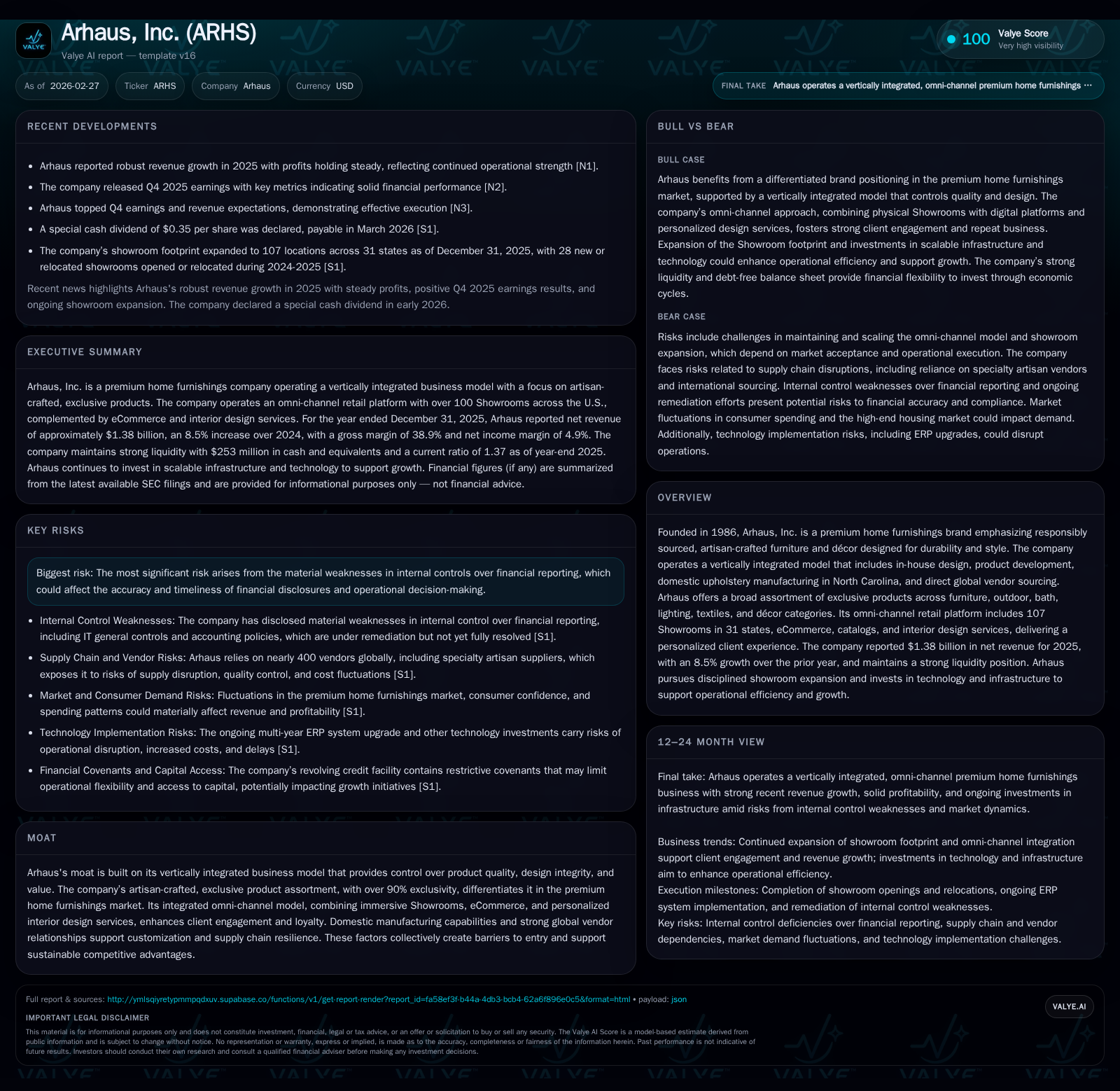
Founded in 1986, Arhaus has carved out a premium niche in the U.S. home furnishings market through its vertically integrated and omni-channel business model. The company grew net revenue to $1.38 billion in 2025, an 8.5% increase over 2024, supported by disciplined showroom openings and exclusive artisan-crafted products. Despite modest declines in margins and profits, Arhaus maintains strong liquidity and a debt-free balance sheet, positioning it for gradual expansion into underpenetrated markets with a large domestic sourcing base. Key risks include industry cyclicality, lease commitments, and internal control challenges.
Company Overview
Founded in 1986 by CEO John Reed and his father, Arhaus, Inc. is focused on premium home furnishings characterized by responsibly sourced materials and artisan craftsmanship designed for durability and style [S4]. The company operates a vertically integrated model encompassing internal design/product development teams, domestic upholstery manufacturing at its North Carolina facility (accounting for approximately 70% of upholstery merchandise receipts), and direct vendor relationships worldwide with nearly 400 global partners [S6][S14]. This integration allows tight quality control, product exclusivity exceeding 90%, extensive customization options, and supply chain resilience.
Arhaus presents its products through an integrated omni-channel retail platform that includes:
- Over 107 physical Showrooms strategically located across 31 states,
- An eCommerce channel functioning as a digital extension of the showroom experience,
- Print catalogs distributed seasonally,
- Personalized interior design services offered complimentary to clients [S4][S23].
The brand emphasizes "retail as theater"—creating immersive design-forward environments that foster emotional connection and inspire multi-room projects compatible with contemporary lifestyles.
Historical Financial Performance
Arhaus reversed a revenue dip recorded in fiscal year (FY) 2024 when net revenue fell by about -1.3%, growing back strongly at +8.5% in FY2025 to reach $1.38 billion [F1]. While gross margin declined moderately to 38.9% from prior years where it exceeded 39%, this reflects increased costs amid investments including showroom expansion and infrastructure enhancements [F1][N1]. Operating income climbed modestly by about +2.2% year-over-year reaching $88.9 million despite margin compression.
Net income dipped slightly -1.9% YOY to roughly $67 million amid increased operating expenses linked to growth initiatives [F1]. Operating cash flow (CFO) was solid but decreased about -7% YOY due primarily to working capital changes absorbing cash; nonetheless free cash flow remained positive at around $59 million after capital expenditures totaling nearly $78 million—a decrease from prior-year capex spend which topped $107 million [F1]. This capex decline signals more measured investment following aggressive prior expansions primarily focused on adding or relocating Showrooms.
Historical performance (annual)
| FY | Net ($mm) | CFO ($mm) | OpInc ($mm) | Capex ($mm) | Net YoY |
|---|---|---|---|---|---|
| 2025 | 67 | 137 | 89 | 78 | -1.9% |
| 2024 | 69 | 147 | 87 | 107 | |
| 2023 | 172 | 164 | 97 | ||
| 2022 | 137 | 74 | 185 | 53 | +547.0% |
Source: SEC companyfacts cache [F1].
Capital returns and efficiency (annual)
| FY | Div ($mm) | FCF ($mm) | ROE% |
|---|---|---|---|
| 2025 | 0 | 59 | 16.1 |
| 2024 | 70 | 40 | 19.9 |
| 2023 | 75 | ||
| 2022 | 22 | 65.2 |
Source: SEC companyfacts cache [F1].
Notes: FY = Fiscal Year; Rev = Net Revenue; OpInc = Operating Income; Net = Net Income; CFO = Operating Cash Flow; Capex = Capital Expenditures; Div = Dividends paid.
Business Model & Moat
Arhaus’s moat centers on its vertically integrated approach providing control over design integrity, quality assurance through domestic manufacturing capabilities (notably upholstery made at its North Carolina facility), and vendor relationships ensuring >90% product exclusivity from artisan partners worldwide [S6][S14][S21]. This integration supports high personalization capabilities across hundreds of fabric choices, leather grades, and bespoke silhouettes.
The company’s omni-channel model blends experiential Showrooms—ranging from large traditional formats averaging 17,100 sq ft to smaller Design Studios (5,700 sq ft) tailored for affluent second-home markets—with digital commerce platforms serving as seamless extensions thereof [S23][S26]. Complementing this are seasonal catalogs delineating lifestyle vignettes aligned with brand storytelling.
Interior design services enhance client loyalty through high-touch consultation driving higher average order values (AOVs) primarily via repeat multi-room projects; this professional trade channel represents an important growth driver beyond direct consumer sales [S4][S21].
Growth Drivers & Future Prospects
Arhaus plans continue showroom expansion carefully calibrated based on location-specific analysis of demographics, retail neighborhood affinity (favoring clustered luxury contemporaries), customer behavior patterns, and expected sales volumes per site—balancing larger Traditional Showrooms against targeted Design Studios or Lofts—the latter offering more curated assortments near affluent destinations or denser urban markets [S25][S26].
Market opportunity remains sizable given the fragmentation of the approximately $100 billion U.S premium home furnishings sector dominated by independent retailers lacking scale or integration advantages enjoyed by Arhaus [S14].
Growth will also be fueled by leveraging its proprietary artisan-crafted product pipeline refreshed regularly via global sourcing teams collaborating intimately with internal design groups ensuring style leadership alongside enduring quality standards [S21]. Enhancements in technology infrastructure underpin better inventory management, delivery logistics (recently brought largely in-house), eCommerce personalization tools, and data analytics enabling refined marketing targeting across direct mailings, digital media channels including social platforms reinforcing brand narrative continuity between physical/digital touchpoints [S11][S23].
Risks cap growth potential including macroeconomic headwinds especially affecting luxury housing trends which influence client spending patterns heavily correlated with equity market volatility; moreover supply chain disruptions or freight cost escalations could pressure margins due to dependency on third-party shipping carriers despite some vertical integration in distribution centers already underway [S20][S24][S16]. The significant leased real estate footprint entails fixed rent obligations which may constrain financial flexibility during downturns compared to exclusively online competitors [S17][S22]. Material weaknesses remain in internal controls over financial reporting posing reputational risk if not remediated promptly affecting investor confidence [S1].
Capital Allocation & Financial Health
Arhaus ended FY2025 with robust liquidity standing at approximately $253 million cash & equivalents alongside total current assets of around $621 million versus current liabilities near $453 million yielding a healthy current ratio of about 1.37—a conservative liquidity posture supporting ongoing investments without reliance on incremental debt given its debt-free balance sheet status except a revolving credit facility primarily used for working capital management [F1][S8].
The company’s approach favors reinvesting operating cash flows into growth initiatives like showroom rollouts and scalable infrastructure upgrades rather than returning substantial capital via dividends or share repurchases; dividend payments notably declined sharply from ~$70 million in FY2024 down to just $0.36 million in FY2025 reflecting retained capitalization priority amid expansion [F1]. This aligns with management’s articulated strategy emphasizing long-term sustainable value creation through measured expansion balanced against prudent capital stewardship avoiding excessive leverage exposure that might restrict strategic agility under market stress conditions [S21].
Return on equity calculated approximately at ~16% based on recent net income relative to equity base indicates reasonable profitability though down from previous years reflecting reinvestment phase dynamics rather than steady-state mature profitability levels typical for more established peers—but consistent with mid-growth boutique retailers investing heavily upfront around brick-and-mortar scaling efforts coupled with omni-channel platform enhancements [F1].
What To Watch Moving Forward (Analysis)
Key milestones will involve effectively executing showroom openings balanced against maintaining unit-level returns amid fluctuating macroeconomic factors influencing luxury discretionary spending particularly sensitive to housing sector dynamics and wage inflation pressures affecting labor costs within manufacturing/showroom operations.
Implementation milestones around ERP system upgrades intended to optimize inventory planning consistency across channels will bear watching as any delays or cost overruns could adversely impact gross margins or customer fulfillment timelines given elevated personalization/customization levels requiring complex scheduling across multiple vendors/domestic upholstery capacity constraints.
Client engagement metrics such as repeat purchase rates driven by interior designer-assisted projects versus new customer acquisition cost efficiency tracked on digital marketing campaigns will provide forward-looking signals on sustainable revenue growth trajectories supported by enhanced omnichannel integrations.
Finally remediation progress toward strengthening internal control frameworks over financial reporting remains material for transparency assurance purposes enhancing governance practices critical for investor relations especially post-public offering maturity stage ahead.[N3][N2]
Conclusion
Arhaus has established itself as a compelling premium lifestyle brand within the fragmented U.S home furnishings sector leveraging vertical integration combined with a thoughtful omni-channel retail experience enriched by artisan exclusivity that underpins differentiation versus competition.
The trajectory since IPO reflects steady top-line recovery accompanied by profitability moderation reflective of strategic reinvestment phases staffing new showroom openings while bolstering technology infrastructure integral for long-term scalability.
Risks inherent in macroeconomic sensitivity especially linked to luxury housing trends alongside operational complexities arising from lease-heavy physical retail footprint remain watch points but are mitigated by robust balance sheet reserves plus disciplined capital deployment coupled with unique product positioning.
Successful navigation of growth execution imperatives will dictate future shareholder value creation potential absent unforeseen systemic shocks impacting consumer confidence or supply chain fluidity.
This report summarizes publicly available information as of February 27, 2026, without providing investment advice or recommendations.
Disclaimer: This is research-only, informational analysis and not investment advice. It may include AI-generated interpretation and general industry context. Always verify important details using primary sources.

Comments