
Arcutis Biotherapeutics Doubles Revenue with Strategic Dermatology Focus but Faces Profitability Challenges
Arcutis’s innovative topical PDE4 inhibitor products have fueled rapid sales growth, though patent disputes and reimbursement issues cloud the path to profitability.
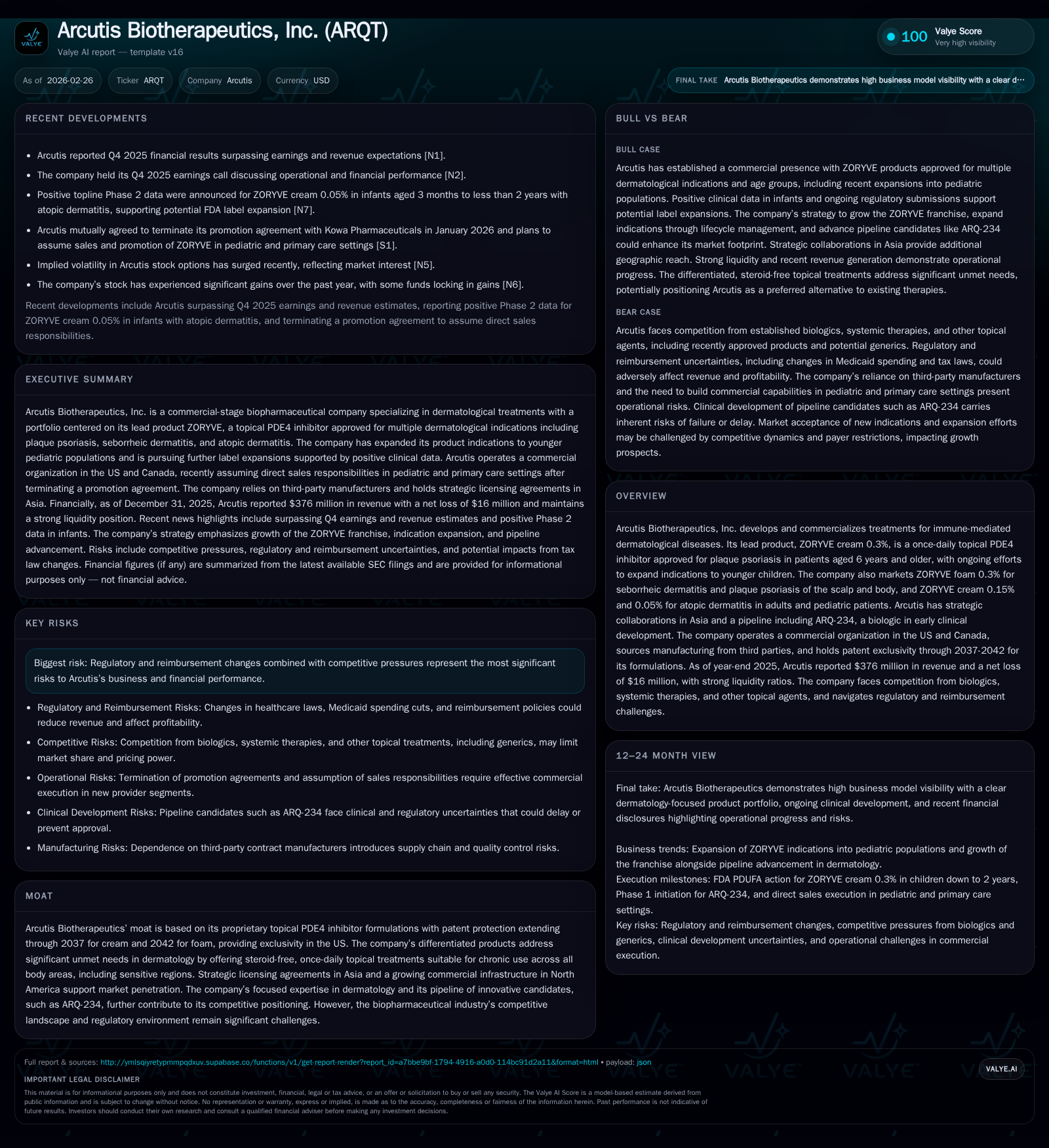
Arcutis Biotherapeutics reported a 91.3% revenue increase to $376 million in 2025, driven by the commercial expansion of its ZORYVE franchise targeting dermatological conditions. Despite improving operating results and a reduced net loss of $16.1 million, the company remains unprofitable with negative operating cash flow. Patent protections through 2037–2042 and ongoing litigation preserve exclusivity, while regulatory milestones including a June 29, 2026 PDUFA date for pediatric label expansion present key catalysts. Reimbursement challenges amid Medicaid funding cuts and competitive pressures persist. Capital allocation reflects continued investment in growth and R&D supported by a strong balance sheet.
Historical Performance Overview
Arcutis Biotherapeutics demonstrated strong revenue growth in fiscal year 2025, with total revenues increasing by 91.3% to $376 million from $197 million in fiscal year 2024 [F1]. This growth was driven primarily by the commercial rollout of its ZORYVE product line across multiple dermatological indications including plaque psoriasis, seborrheic dermatitis, and atopic dermatitis in the United States and Canada.
Operating income improved markedly but remained negative at approximately -$12.2 million compared to -$128.4 million in the prior fiscal year [F1]. This reduction of over 90% evidences emerging operational leverage as commercial scale increased. Net losses similarly narrowed to -$16.1 million versus -$140 million year-over-year.
Despite these improvements, operating cash flow remained negative at about -$5.6 million reflecting ongoing investments in commercialization infrastructure and research and development [F1]. Capital expenditures were modest at approximately $686,000 but increased relative to prior years.
Historical performance (annual)
| FY | Rev ($mm) | Net ($mm) | CFO ($mm) | OpInc ($mm) | Rev YoY | Net YoY |
|---|---|---|---|---|---|---|
| 2025 | 376 | -16 | -6 | -12 | +91.3% | +88.5% |
| 2024 | 197 | -140 | -112 | -128 | +46.6% | |
| 2023 | -262 | -247 | -241 | +15.8% | ||
| 2022 | -311 | -258 | -302 |
Source: SEC companyfacts cache [F1].
Capital returns and efficiency (annual)
| FY | FCF ($mm) | ROE% |
|---|---|---|
| 2025 | -6 | -8.5 |
| 2024 | -112 | -88.9 |
| 2023 | -247 | -295.6 |
| 2022 | -258 | -148.6 |
Source: SEC companyfacts cache [F1].
ZORYVE Franchise: Market Drivers
The core of Arcutis's commercial portfolio is the ZORYVE franchise—topical formulations containing roflumilast, a selective phosphodiesterase-4 (PDE4) inhibitor designed for once-daily application without corticosteroids [S1]. This steroid-free profile addresses concerns over long-term corticosteroid use especially in sensitive skin areas.
Initial FDA approval for ZORYVE cream targeted plaque psoriasis patients aged twelve years and older with launch commencing August 2022 [S1]. Pediatric label expansions followed: approval down to six years old occurred in October 2023; a supplemental New Drug Application seeking approval down to two years was accepted for filing in November 2025 with an FDA PDUFA action date scheduled for June 29, 2026 [N1][S1].
ZORYVE foam was approved by the FDA in December 2023 for seborrheic dermatitis patients aged nine years or older—the first new drug class approved in over two decades for this indication—with subsequent launches in the U.S. through early 2024 and Canada by December of that year [S1]. Additional foam approvals for plaque psoriasis of scalp and body followed in mid-2025 for patients twelve years and older with rapid commercial rollouts [S1].
Phase II data supporting use in infants with atopic dermatitis were reported recently reinforcing clinical rationale for pediatric expansions [N9]. Collectively these factors contribute to accelerating market adoption across multiple immune-mediated dermatological conditions.
Pipeline and Upcoming Regulatory Catalysts
A critical near-term catalyst is the FDA decision expected on June 29, 2026 regarding ZORYVE cream’s supplemental NDA seeking approval for use down to age two years old—potentially opening access to the youngest pediatric segment [N1][S1].
Beyond topicals, Arcutis is developing ARQ-234, an early-stage injectable biologic candidate targeting JAK inhibition pathways offering potential systemic immunomodulatory benefits [S1]. While still preclinical or early clinical stage, this candidate represents strategic pipeline diversification beyond topical therapies.
Monitoring clinical progress and regulatory outcomes will be important as future growth increasingly depends on successful pipeline execution alongside marketed product expansion.
Capital Allocation and Financial Position
Arcutis maintains a solid liquidity profile with cash and equivalents totaling approximately $42.9 million as of December 31, 2025 [F1]. The current ratio stands robustly at about 3.17x relative to current liabilities of approximately $130 million indicating short-term financial stability [F1]. Equity increased materially to nearly $189 million reflecting capital raises supporting R&D activities.
Free cash flow remains negative at roughly -$6.3 million (operating cash flow minus capital expenditures), consistent with ongoing investments typical of growth-stage biopharmaceutical companies [F1]. Return on equity is negative at about -8.5%, reflecting continued losses amid commercialization investments rather than mature profitability [F1].
No dividends or share repurchases were reported consistent with reinvestment priorities common among peers focused on pipeline advancement.
Patent Protection and Litigation Status
ZORYVE products benefit from patent protection extending through at least 2037 for cream formulations and potentially up to around 2042 for foam products based on Arcutis filings [S1][S18]. These patents cover active pharmaceutical ingredients as well as formulation technologies providing a competitive moat.
The company is engaged in patent infringement litigation against Padagis following submission of an Abbreviated New Drug Application seeking approval of generic versions of ZORYVE cream filed early in calendar year 2024 [S1][S26]. The litigation has resulted in agreed stays delaying generic entry beyond statutory timelines currently set to expire August 14, 2026 plus extensions during stay periods.
In Europe, Arcutis successfully defended its patents against oppositions filed by Teva Pharmaceutical Industries Ltd at the European Patent Office maintaining exclusivity rights internationally [S1].
These IP enforcement actions provide significant barriers against generic competition while lifecycle management efforts continue.
Reimbursement Environment and Pricing Risks
Market uptake is influenced by coverage decisions amid evolving healthcare cost containment initiatives particularly within U.S. government programs.[S2][S4][S7][S15] The "One Big Beautiful Bill Act" enacted July 2025 introduces substantial Medicaid funding reductions via work requirements and cost-sharing changes that may reduce eligible patient volumes impacting drug revenues under those programs.
Third-party payors impose formulary restrictions including rebate demands challenging pricing power.[S4][S5][S16] Proposed regulations under Medicare Part B requiring manufacturer rebates could add further pressure on net prices.[S7]
While no immediate adverse reimbursement effects have been disclosed as material in recent reporting,[N1] ongoing vigilance is necessary given potential impacts on revenue sustainability.
Geographic Expansion and Partnerships
Arcutis pursues geographic reach through strategic collaborations such as licensing agreements granting exclusive rights to Sato Pharma for Japan where local development and commercialization are managed externally while Arcutis retains oversight.[S21] Direct sales operations focus on North American markets supported by contract manufacturing organizations enabling flexible supply aligned with launch schedules.[S1][N1] Recent termination of agreements like Kowa's primary care promotion reflects internal resource realignment emphasizing core geographies post initial partner ramp phases.[S21] This model balances capital efficiency with scalability potential contingent on future pipeline success.
Risks Summary
Key risks include regulatory compliance complexities encompassing cGMP standards; cybersecurity risks related to sensitive clinical data management; reimbursement uncertainty amid evolving government policies; legal exposure due to patent litigation; competitive challenges from established biologics such as AbbVie’s Skyrizi or Bristol Myers Squibb’s Sotyktu; plus potential generic entrants post-patent expiry.[S4][S5][S6][S10][S18] Maintaining innovation momentum combined with disciplined capital allocation will be critical as Arcutis navigates these dynamics toward sustained growth.
Disclaimer: This analysis is based exclusively on publicly available information as of dates cited without extrapolation beyond stated facts herein. It is intended solely as an internal memo highlighting Arcutis Biotherapeutics’ historical performance drivers, strategic positioning, financial metrics, risks, and upcoming milestones within its dermatology-focused biopharmaceutical context.
Disclaimer: This is research-only, informational analysis and not investment advice. It may include AI-generated interpretation and general industry context. Always verify important details using primary sources.

Comments