
Ashland Inc. in 2026: A Comprehensive Review of Strategic Segments, Operational Risks, and Market Position
Ashland Inc. maintains a diversified specialty chemical portfolio with a global footprint focused on sustainability amid operational challenges.
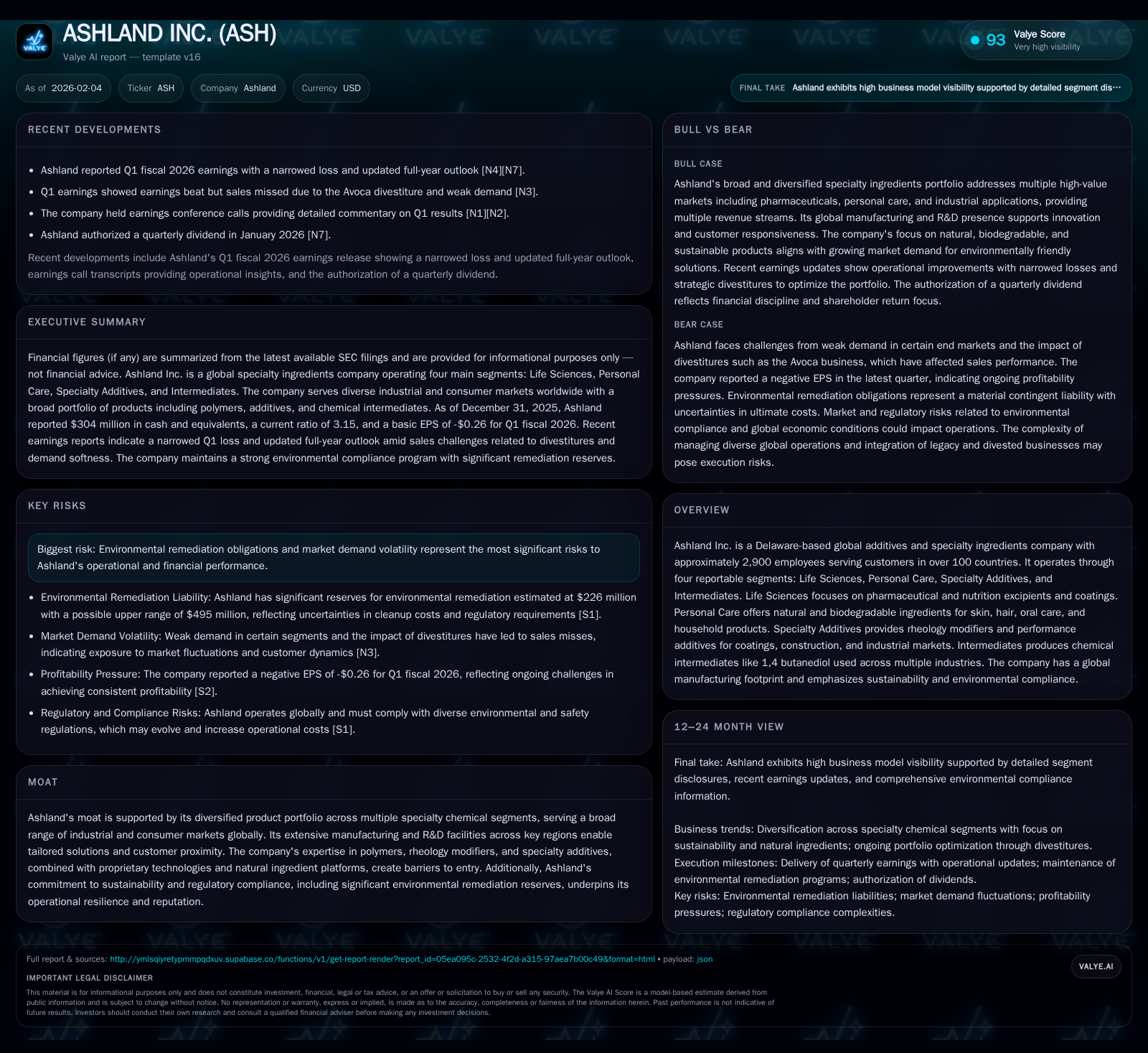
Ashland Inc., a global specialty additives and ingredients company with nearly 2,900 employees, operates across four distinct segments: Life Sciences, Personal Care, Specialty Additives, and Intermediates. Its broad product lineup serves diverse end markets from pharmaceuticals to construction materials and is underpinned by an emphasis on environmental compliance and innovation. Recent quarterly results show mixed demand influenced by divestitures and market softness while the company narrows its full-year outlook, reflecting underlying volatility. Key risks include environmental remediation liabilities and fluctuating market demand which could impact future growth and financial performance.
Company Overview
Ashland Inc. is a Delaware-based global specialty additives and ingredients firm employing approximately 2,900 people worldwide. It serves customers in more than 100 countries through an array of specialized chemical solutions catering to industrial and consumer markets alike. The company reports its operations through four principal segments: Life Sciences; Personal Care; Specialty Additives; and Intermediates. This segmentation reflects Ashland's strategic focus on diversified end-use markets ranging from pharmaceuticals to construction materials.
At its core, Ashland integrates sustainability considerations deeply within its manufacturing footprint that spans key geographies. Environmental compliance remains a stated priority in its operations alongside innovation in polymer science and additive technologies.
Operating Segments
Life Sciences
This segment primarily addresses pharmaceutical applications via excipients such as controlled release polymers, disintegrants, coatings, thickeners, solubilizers, and binders essential for drug formulation. Additionally, it offers nutritional excipients improving food texture and stability although it divested its nutraceutical business in August 2024—indicating recalibration towards core competencies. Key customers include pharmaceutical firms, food manufacturers, hospitals, and diagnostic centers.
Personal Care
Personal Care expands Ashland's reach into consumer-facing markets providing natural or nature-derived biodegradable ingredients for products including skin care, hair care, oral hygiene (toothpaste formulations), sun protection products, microbial protectants (preservatives), and household cleaning agents. This segment benefits from rising demand for sustainable ingredient solutions amid evolving consumer preferences favoring environmentally friendly products.
Specialty Additives
Serving largely industrial clientele such as architectural paint manufacturers, automotive firms, construction enterprises, electronics producers, textile mills, and energy sectors; Specialty Additives provide rheology modifiers (e.g., cellulosic thickeners), foam control agents, surfactants, pH neutralizers, advanced ceramics for catalytic converters, environmental filters as well as specialty chemicals for textile printing and welding alloys. These product lines improve functional attributes like workability and adhesion critical to manufacturing processes.
Intermediates
This segment produces chemical intermediates such as 1,4 butanediol (BDO) along with related derivatives like N-methylpyrrolidone which serve as foundational raw materials for numerous downstream industrial applications spanning polymers to solvents.
Financial Performance & Recent Developments
In the first quarter of fiscal 2026, Ashland reported earnings surpassing expectations despite revenues falling short primarily due to the Avoca divestiture coupled with weakening demand across certain end markets [N3][N6]. This contrasted performance highlights the near-term challenges from portfolio reshaping activities combined with macroeconomic headwinds affecting consumption patterns globally.
Liquidity remains robust with cash and equivalents totaling $304 million at the end of December 2025 alongside current assets at $1.15 billion against current liabilities of $366 million—providing a strong current ratio above 3.1 [F1]. This positions Ashland well to navigate operational pressures while investing in innovation.
Management subsequently narrowed the full-year guidance reflecting ongoing uncertainties yet emphasizes strategic priorities including optimizing asset utilization and enhancing product mix towards higher-margin offerings [N6].
Competitive Moat & Strengths
Ashland’s competitive advantage rests on several pillars:
- Diversified Product Portfolio: Spanning multiple chemical specialties reduces dependence on any single sector or market trend.
- Global Manufacturing & R&D Presence: Enables proximity to customers enabling customized solutions responsive to regional requirements.
- Proprietary Technologies: Expertise in polymers and rheology modifiers coupled with natural ingredient platforms confers entry barriers.
- Sustainability Focus: Commitment to environmental stewardship aligns with regulatory trends favoring greener chemistries securing license-to-operate.
- Reputation & Customer Relationships: Longstanding partnerships with leading formulators across pharmaceuticals and consumer products bolster resilience against competitive pressures.
Industry Context & Challenges (Analysis)
The specialty chemicals industry is characterized by cyclicality tied to broader economic conditions affecting industrial production volumes and consumer spending. Companies like Ashland must navigate rising raw material costs (notably petrochemical derivatives), regulatory complexity especially regarding chemical safety/environmental standards, and ever-evolving customer demands emphasizing performance combined with sustainability credentials.
Moreover, innovation cycles are accelerating wherein rapid adaptation of novel bio-based ingredients or smart additive technologies offers differentiation but requires substantial R&D investment.
Risk Factors Highlighted by Ashland
The company identifies several key risks relevant to its operational landscape [S1][S2]:
- Environmental Remediation Obligations: Historic operations have resulted in significant environmental cleanup responsibilities entailing financial reserves that may increase over time depending on regulatory changes or discoveries.
- Market Demand Volatility: Fluctuating demand especially in cyclical end markets like construction or automotive could lead to revenue swings impacting profitability.
- Acquisition Integration Risks: Failure to optimize acquired assets or realize anticipated synergies can impair growth targets—particularly relevant given past impairments noted in goodwill carrying values.
- Business Continuity Threats: Natural disasters or catastrophic events at production sites risk operational shutdowns affecting supply chains; insurance coverage might not fully mitigate such impacts.
- Cost Inflation & Supply Chain Disruptions: Energy price increases or logistics bottlenecks may elevate production costs compressing margins if not offset by pricing power.
Summary Perspective
Ashland occupies a distinctive niche within the specialty chemicals universe due to its multi-segment diversification spanning high-value life sciences ingredients through commodity-like intermediates while maintaining a progressive agenda centered on sustainability. Its global scale combined with proprietary technology platforms fosters competitive advantages difficult for new entrants to replicate easily.
However, management’s recent decision to narrow guidance amid sales softening underscores fragile demand dynamics possibly linked to macroeconomic headwinds or inventory adjustments from recent portfolio changes. Investors should remain cognizant that ongoing environmental liabilities together with integration complexities pose latent threats requiring vigilant capital allocation strategies going forward.
Liquidity cushions are adequate today but preserving operational agility will be crucial as external risks evolve rapidly including geopolitical tensions affecting supply chains or shifts in regulatory frameworks tightening chemical production norms internationally.
Disclaimer: This analysis is for informational purposes only based on publicly available data as of early 2026. It does not constitute investment advice or recommendations regarding Ashland Inc.’s securities or any other financial instruments. Readers should conduct their own due diligence before making any decisions.
Disclaimer: This is research-only, informational analysis and not investment advice. It may include AI-generated interpretation and general industry context. Always verify important details using primary sources.

Comments