
ASML Holding NV: Dominating Semiconductor Lithography Amid Operational Risks and Innovation Demands
ASML remains the linchpin in semiconductor equipment with unmatched EUV technology, navigating recent operational challenges and intensifying IP defense.
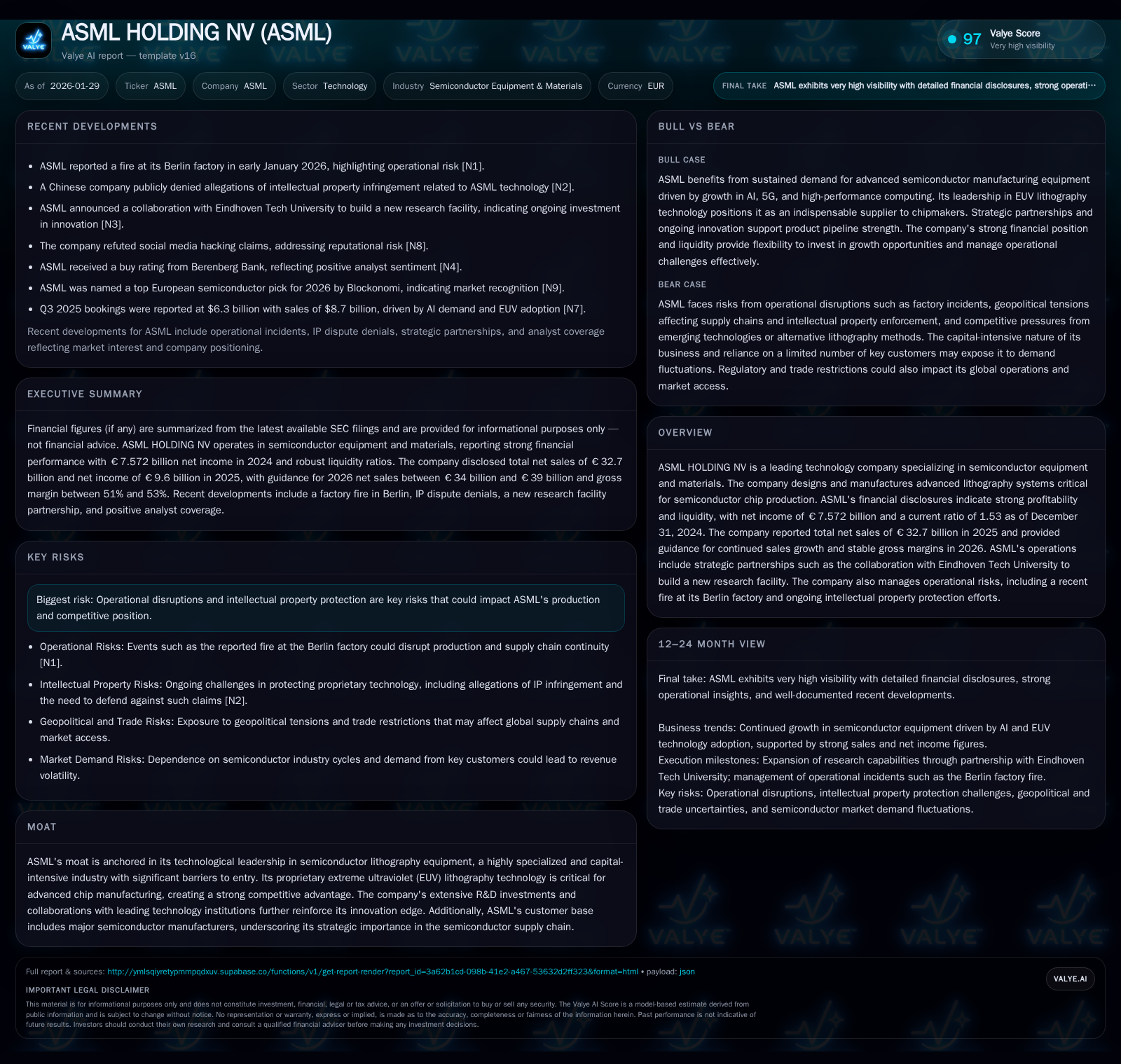
ASML Holding NV continues to consolidate its leadership in advanced semiconductor lithography, particularly with its proprietary EUV systems critical to chip manufacturing. Recent developments include a factory fire in Berlin and ongoing intellectual property disputes, underscoring operational and competitive risks. The company’s strong financial standing supports its sustained R&D investments and strategic collaborations like the new Eindhoven research facility. However, industry dynamics, including high capital intensity and geopolitical pressures, create complex challenges for ASML’s future growth trajectory.
What Changed Recently
ASML’s operational landscape has been marked by several notable developments in the past 45 days. In early January 2026, the company reported a fire incident at its Berlin manufacturing facility, a critical site for producing components of its lithography systems [N2]. While ASML did not disclose extensive damage details, such disruptions in a highly specialized manufacturing environment can temporarily impact production schedules and customer deliveries. Operational resilience and rapid recovery plans are therefore vital to mitigate potential downstream effects.
On the intellectual property front, ASML’s dominant market position has attracted scrutiny and legal challenges. A recent report highlighted a Chinese company denying allegations of IP infringement related to ASML’s advanced lithography technology [N1]. Given ASML’s technology is central to cutting-edge semiconductor fabrication, enforcement of IP rights remains a key strategic priority, especially amid rising geopolitical tensions and technology transfer concerns.
In a positive strategic move, ASML announced its collaboration with Eindhoven Tech University to build a new research facility [N3]. This initiative underscores ASML’s commitment to maintaining its innovation edge by fostering close ties with academic research and developing next-generation lithography technologies. This partnership is expected to enhance R&D productivity and accelerate technology commercialization over the medium term.
Financially, while no new SEC filings have been released in this period, prior disclosures indicate strong fundamentals, with €7.57 billion net income and a healthy liquidity position as of year-end 2024 [S1]. This financial strength underpins ASML’s capacity to invest aggressively in R&D and absorb operational shocks.
Business Model as a System
ASML operates at the apex of the semiconductor equipment value chain, supplying highly complex lithography machines that pattern integrated circuits during chip fabrication. Its business model balances high capital expenditure, extensive R&D investment, and proprietary technology development to generate outsized margins in a niche market.
The company’s revenue streams primarily come from sales of lithography systems, including its cutting-edge extreme ultraviolet (EUV) machines, and associated services such as system upgrades, maintenance, and parts. EUV technology, developed over decades with billions invested, is central to ASML’s differentiation and pricing power. These machines enable chipmakers to produce smaller, more powerful, and energy-efficient semiconductors, a critical enabler of modern electronics.
ASML’s operations require a tightly integrated supply chain and manufacturing system due to the complexity and precision required. The assembly of a single EUV machine involves tens of thousands of components sourced globally, necessitating careful supplier management and quality control. The company’s ability to orchestrate this system defines its delivery timelines and customer satisfaction.
Moreover, ASML’s customer base consists of a concentrated group of major semiconductor manufacturers, including the leading foundries and IDMs. This concentration results in long sales cycles with significant customer engagement, often involving co-development and customization. ASML also leverages strategic partnerships with research institutions, such as the Eindhoven Tech University collaboration, to sustain innovation and align technology roadmaps with customer needs.
Financially, ASML’s model generates strong operating leverage. High fixed costs associated with R&D and manufacturing infrastructure contrast with relatively limited sales volumes, as each lithography system can exceed $100 million in price. Services and upgrades contribute recurring revenue streams, smoothing cash flow. As of 2024, ASML reported a current ratio of 1.53, reflecting comfortable liquidity to support ongoing operations and investments [S1].
Industry Map & Competitive Battlefield
The semiconductor equipment industry is highly concentrated and specialized, with a few dominant players in discrete segments. Within lithography, ASML is unique in commercializing EUV technology at scale, which is essential for leading-edge nodes below 7 nanometers. Competitors in deep ultraviolet (DUV) lithography exist, such as Nikon and Canon, but these firms cannot match ASML’s EUV capabilities, which are critical for the most advanced chips.
The industry’s high barriers to entry stem from the immense R&D investment requirements, technological complexity, and long development cycles. ASML’s decades-long investment in EUV technology, supported by a global supply chain of specialized component suppliers, creates a formidable moat.
Geopolitics increasingly shapes competitive dynamics, with export controls limiting access to certain customers, particularly in China, and elevating the importance of IP protection. ASML’s enforcement of IP rights and compliance with export regulations influence its market access and partnerships.
Moreover, the semiconductor industry’s cyclical nature impacts equipment demand. Periods of chip inventory build-up or end-market weakness can delay capital spending by chipmakers, affecting ASML’s order intake. However, secular trends such as artificial intelligence, 5G, and automotive electrification drive sustained demand for advanced chips and, by extension, lithography systems.
Customer relationships are critical battlegrounds. ASML’s ability to co-develop technology and provide superior post-sale support strengthens its position. The company’s expanding service business enhances customer lock-in and revenue visibility.
Where the Economics Become Real
ASML’s unit economics are characterized by high upfront costs and long sales cycles balanced by high per-unit pricing and strong gross margins. A single EUV lithography system can cost upward of $150 million, reflecting the complexity and precision engineering involved.
The R&D expense intensity is a significant economic lever. ASML reportedly invests billions annually to refine EUV technology and develop next-generation lithography solutions. These investments are necessary to sustain technological leadership and defend against potential competitors.
Manufacturing bottlenecks, such as precision optics production and intricate assembly processes, constrain throughput. The recent fire at the Berlin factory highlights how localized disruptions can ripple through supply capabilities.
On the revenue side, the company benefits from a mix of system sales and recurring service contracts. Service revenues have higher gross margins and provide more predictable cash flow. This mix helps stabilize earnings amid volatility in new system orders.
Working capital management is another critical factor. Long production cycles and customized orders require ASML to manage inventory and receivables carefully. The 2024 current ratio of 1.53 suggests prudent liquidity management.
Pricing power remains robust given the lack of alternative suppliers for EUV systems and the strategic necessity of this technology for chipmakers. However, geopolitical constraints and customer pushback on pricing terms could introduce pressures.
Diligence Questions / Disconfirming Signals
- How significant was the impact of the Berlin factory fire on current production and customer deliveries? Are contingency plans sufficient to prevent future disruptions?
- What is the status and potential resolution timeline of ongoing IP disputes, particularly the alleged infringement claims by Chinese entities? Could litigation or regulatory actions impair market access?
- How is ASML navigating export restrictions and geopolitical tensions that limit sales to certain regions, notably China? Is revenue diversification adequate to offset these constraints?
- Does the company’s current R&D trajectory sufficiently address emerging lithography challenges, including the limits of EUV scaling and next-gen technology development?
- How sustainable are ASML’s pricing and margin levels given customer consolidation and potential pushback amid challenging macro conditions?
- To what extent can the service and upgrade business grow to provide steadier revenue streams and mitigate new system order cyclicality?
- Are there emerging competitors or technological innovations that could disrupt ASML’s market dominance in the medium term?
- How does ASML manage supply chain risks given the complexity and global dispersion of critical component suppliers?
Conclusion
ASML Holding NV operates within a uniquely challenging and strategically critical segment of the semiconductor industry. Its technological leadership, especially through EUV lithography, positions it as an indispensable partner for advanced chipmakers. Recent operational challenges and ongoing IP disputes illustrate the fragility of its highly complex manufacturing and competitive environment. The company’s robust financial position and strategic collaborations underline its capacity to invest in innovation and weather near-term disruptions. However, geopolitical tensions, supply chain vulnerabilities, and industry cyclicality remain pressing concerns that require continuous strategic vigilance.
This analysis is based on publicly available information as of January 2026. It does not constitute investment advice or a recommendation. Readers should conduct their own due diligence and consider their own risk tolerance before making any investment decisions.
Disclaimer: This is research-only, informational analysis and not investment advice. It may include AI-generated interpretation and general industry context. Always verify important details using primary sources.

Comments