
Aterian’s Strategic Shift Marks Exit from Core Consumer Brands Amid Liquidity Challenges
The company plans to sell its marquee brands for $18 million, relinquishing its primary revenue engines and pivoting toward an unproven post-sale strategy.
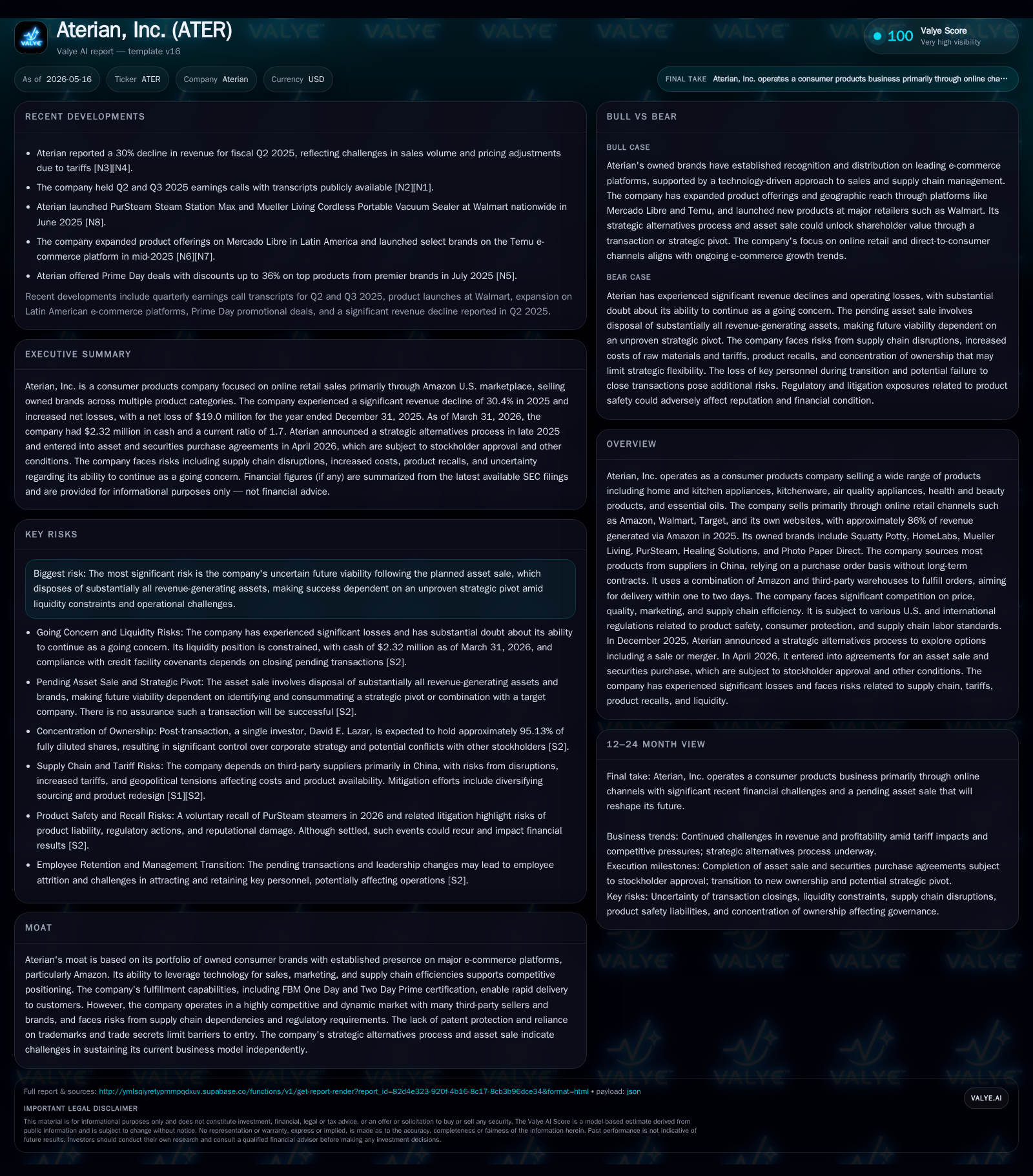
In its latest quarter, Aterian, Inc. formalized a definitive agreement to sell substantially all of its revenue-generating assets, including core brands such as Squatty Potty and PurSteam, for $18 million in cash. This move reflects the culmination of strategic alternatives initiated amid mounting financial pressures and market headwinds. The company’s revenues have historically depended heavily on Amazon-driven e-commerce sales and owned consumer brands primarily sourced from China; however, tariff inflation, macroeconomic softness, and escalating costs have compressed margins and eroded volumes. With this asset sale expected to close pending stockholder approval, Aterian faces a critical juncture where future viability hinges on executing a currently undefined post-investment pivot under significant liquidity constraints.
Recent Operating Update
On April 27, 2026, Aterian entered into an Asset Purchase Agreement with Trademark Global, LLC to sell certain marquee consumer brands—among them Squatty Potty, HomeLabs, Mueller Living, PurSteam, Healing Solutions, and Photo Paper Direct—for a cash purchase price of $18 million [S2][S3]. This sale represents substantially all the Company's revenue-generating assets. The tangible effect is a radical transformation away from its historical consumer product focus reliant on these brands sold primarily on Amazon.com. However, the allocated proceeds for some definite-lived brand intangible assets are lower than their carrying values, suggesting impairment risk [S2].
With stockholder approvals still required for closing and several key closing conditions—including contribution margin targets—the deal signals a near-term pivot away from existing operations. Failure to close could severely impair liquidity and threaten going-concern viability [S2].
Additionally, the strategic investment by David E. Lazar, expected to result in his controlling roughly 95% of fully diluted shares after conversion of preferred stock, consolidates decision-making power significantly within a single investor's hands [S2][S3].
Business Model
Historically, Aterian’s business has revolved around owning and marketing a portfolio of proprietary consumer product brands encompassing home and kitchen appliances, kitchenware, air quality devices, health & beauty products, and essential oils [S1]. The company sells principally through e-commerce channels—Amazon U.S. accounts for approximately 86% of revenues—with Walmart.com, Target.com, and direct websites forming smaller parts of the distribution mix. Customers pay retail prices for branded products fulfilled through fulfillment centers optimized for one- or two-day delivery [S1].
Revenue mechanics depend on unit volume (largely driven by online marketplace visibility), pricing strategies responsive to tariffs and competitive pressures, product mix shifts across seasonal categories (e.g., environmental appliances peak in summer; essential oils and kitchen appliances surge during holidays), as well as supply chain efficiency managing inventory costs [S1]. Pricing power is constrained given intense competition including third-party sellers often competing directly against Aterian-owned brands.
Margins are subject to fluctuation linked to tariff impacts—especially tariffs imposed on Chinese imports—and freight costs [S1][S20]. Inventory is typically purchased on a purchase order basis without long-term contracts leading to working capital volatility.
The company's technological assets have focused on automating sales insights and supply chain functions using proprietary technology shifted recently toward integrating third-party best-of-breed platforms instead of fully internally developed models [S1]. Intellectual property protection relies primarily on registered trademarks rather than patents.
Industry Structure and Competitive Position
Aterian operates within the fragmented and highly competitive direct-to-consumer e-commerce sector focused on small household goods. Competitors range from established branded manufacturers to countless third-party sellers leveraging online marketplaces' low barriers [S1]. The market is characterized by:
- High sensitivity to pricing due to commoditization.
- Customer reliance on ratings, reviews, and brand visibility algorithms.
- Rapid product life cycles needing continuous innovation or assortment refresh.
- Supply chain agility as a key differentiator amid global trade uncertainties.
Aterian’s moat historically has relied on its portfolio of owned consumer brands with established presence across major e-commerce platforms coupled with logistics capabilities certified for prime standard delivery times. In contrast to pure reseller models or private labels that lack brand equity or operational scale, Aterian's offerings command some differentiated customer loyalty but remain vulnerable due to:
- Limited patent protection.
- Dependence on trademarks susceptible to imitation.
- The presence of suppliers who also directly compete by selling their own branded products.
Growth Drivers
Prior to announcing strategic alternatives at the end of 2025 [S1], growth drivers included:
- Expanding product lines under owned brands targeting categories with seasonal demand spikes.
- Leveraging data-driven marketing automation for targeted customer acquisition across Amazon's platform.
- Supply chain efficiencies enabling rapid fulfillment enhancing customer satisfaction.
- Geographic sourcing diversification attempts beyond China to mitigate tariff risk.
However, these drivers have been countervailed strongly by macroeconomic headwinds such as softening discretionary spending due to elevated interest rates; tariff-driven cost increases reducing gross margins; increased competition pushing down prices; reduced open purchase orders signaling cautious inventory management; and operational restructuring involving workforce reductions lowering fixed costs but signaling internal challenges [S1][S22][S23][S24].
Risks and Watchpoints
Asset Sale Execution Risk: The pending asset sale is contingent upon stockholder approval and fulfillment of other closing conditions; failure jeopardizes liquidity and operating continuity [S2].
Post-Sale Viability: Once completed, Aterian will have disposed substantially all revenue-producing assets necessitating identification and success in executing a ‘‘post-investment transaction’’ or an unproven strategic pivot—a large unknown risking sustainability [S2].
Liquidity Constraints: As of March 31, 2026, cash was approximately $2.3 million against current liabilities nearing $12.5 million—a current ratio of 1.7—but persistent covenant compliance concerns prompt need for external capital or waivers under the MidCap Credit Facility amendments executed through early 2026 [F1][S7][S8].
High Leverage: Net debt approximates $26.4 million reflecting substantial financial leverage that limits flexibility amid uncertain earnings [F1].
Macroeconomic Sensitivity: Consumer discretionary spending softness related to geopolitical tensions (notably Middle East conflicts), inflationary pressures raising input costs via tariffs impacting mostly China-sourced products remains material [S14][S20].
Regulatory/Legal Challenges: February 2026 voluntary recall involving PurSteam steamers due to safety incidents triggered associated product liability risks including class action litigation settled recently but still weighing reputational impact [S18].
Competitive Pressure: Online marketplaces’ search algorithms favor high-performing sellers creating winner-take-most dynamics that pressure weaker players' visibility; dependence on Amazon substantially concentrates channel risk [S1].
What to Watch Next
- Closing of Asset Sale Transaction: Stockholder votes and regulatory approvals needed for completion; timing precision remains critical.
- Announcement/Details of Post-Pivot Strategy: How Aterian intends to generate value beyond divestiture of core brands.
- Liquidity/Covenant Compliance Metrics: Subsequent quarterly filings will reveal if refinancing or waivers are secured amid volatility.
- Market Reaction & Channel Partner Relationships: Maintaining Amazon/Walmart/Target partnerships during transition phase serves as bellwether for business stability.
- Legal Developments Related to Product Safety Litigation: Potential material settlements or regulatory actions could further affect prospects.
- Operational Updates on SKU Rationalization & Fixed Cost Reductions: Execution progress in pruning unprofitable product lines impacts cash flow profile.
Financial Profile (Q1 Fiscal Year Ended March 31, 2026)
Latest financial snapshot
_ *Total debt figure from latest available date (Sept 30), no updated figures released for Q1_
Disclaimer: This analysis is based exclusively on disclosed SEC filings as of mid-May 2026 along with Valye proprietary research data snapshots. It does not constitute investment advice or recommendation but rather an informed assessment framing recent developments relevant for industry observers and stakeholders evaluating Aterian’s strategic trajectory amid significant operational reorientation.
Disclaimer: This is research-only, informational analysis and not investment advice. It may include AI-generated interpretation and general industry context. Always verify important details using primary sources.

Comments