
Atlas Lithium Advances Mining Ambitions Despite Notable Losses
Atlas Lithium leverages its strategic lithium assets in Brazil's Lithium Valley while confronting persistent financial and operational challenges.
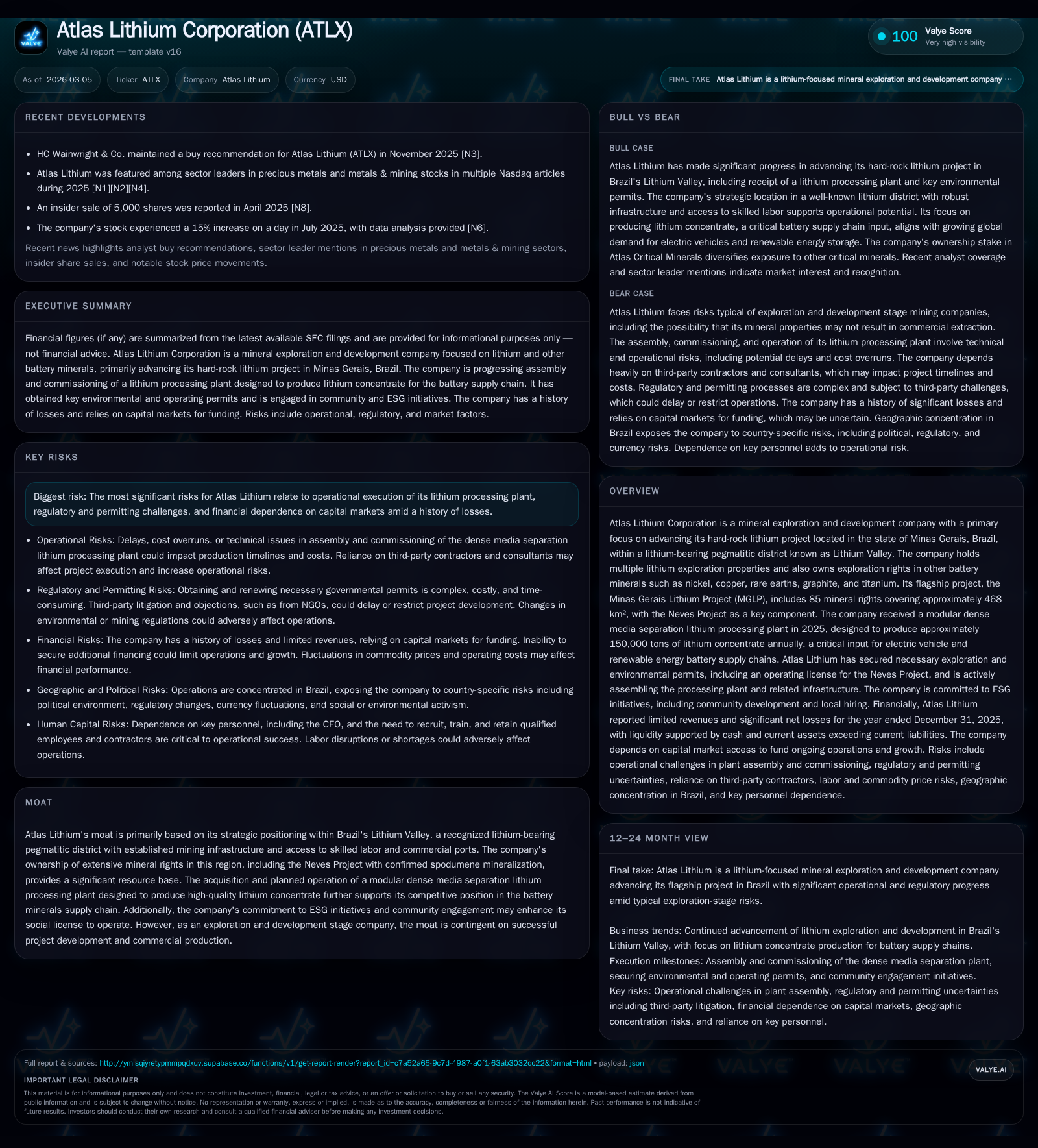
Atlas Lithium Corporation is focused on developing its hard-rock lithium project in Minas Gerais, Brazil, holding extensive mineral rights in a recognized lithium pegmatitic district. Despite commissioning a dense media separation plant designed to produce substantial lithium concentrate, the company continues to report significant net losses and negative cash flows typical of exploration-stage miners. Regulatory hurdles, community opposition, and dependence on capital markets compound operational risks. Key upcoming milestones include ramping plant operations and securing permits, which will determine prospects for transitioning toward positive cash flow and commercial production.
Historical Performance: Weighing Growth Against Persistent Losses
Atlas Lithium remains firmly an exploration and development stage company with financials reflecting ongoing investment rather than operational profitability. Revenue has grown from minimal $6,765 in both FY2022 and FY2023 to $667,131 in FY2024 but then contracted sharply to roughly $92,491 in FY2025 [F1]. The spike in 2024 likely related to milestone recognition or limited sales activity but was not sustained into 2025.
Operating income reflects deepening losses of -$5.5 million in FY2022 worsening to -$42.1 million FY2023 then improving slightly but still severe losses of -$43.9 million FY2024 and -$31.7 million FY2025—a meaningful 27.8% improvement flagged by corporate management [F1], signaling some cost control or operational efficiency gains.
Net income followed similar trends with sizeable annual losses totaling approximately -$28.1 million for FY2025 representing a 33.5% gain versus prior year net loss levels [F1]. Despite improved net loss percentages, the business remains unprofitable.
Cash flow from operations is consistently negative through this span (-$1.48m in FY2022 worsening to -$22.2m FY2025), indicative of heavy exploration spending [F1]. Capital expenditures also declined steeply year-over-year from $22.4m FY2024 to $6.1m FY2025 indicating slowed project capex after earlier build phases.
Historical performance (annual)
| FY | Rev ($) | Net ($mm) | CFO ($mm) | OpInc ($mm) | Rev YoY | Net YoY |
|---|---|---|---|---|---|---|
| 2025 | 92491 | -28 | -22 | -32 | -86.1% | +33.5% |
| 2024 | 667131 | -42 | -19 | -44 | +9761.5% | -3.6% |
| 2023 | 6765 | -41 | -6 | -42 | 0.0% | -780.8% |
| 2022 | 6765 | -5 | -1 | -6 |
Source: SEC companyfacts cache [F1].
Capital returns and efficiency (annual)
| FY | FCF ($mm) | ROE% |
|---|---|---|
| 2025 | -28 | -54.1 |
| 2024 | -41 | -198.7 |
| 2023 | -14 | -562.5 |
| 2022 | -272.8 |
Source: SEC companyfacts cache [F1].
This pattern typifies exploration firms where costs accumulate far ahead of realizing commercial-scale output or stable cash inflows.
Lithium Valley Footprint: Strategic Asset Positioning in Minas Gerais
Atlas Lithium’s flagship asset is the Minas Gerais Lithium Project (MGLP), comprising some 85 mineral rights covering about 468 km² situated within Brazil’s Eastern Brazilian Pegmatite Province (EBP) [S1],[S27]. This geologic province extends over roughly 850 kilometers and hosts lithium-bearing pegmatites containing spodumene — a lithium-rich pyroxene critical for battery grade concentrate production.
The Neves Project is a core part of MGLP representing concentrated spodumene mineralization with potential scalable deposits benefiting from established regional mining infrastructure including transport routes and access to commercial ports for export facilitation [S1],[S27]. Such geographic positioning confers a competitive moat anchored by:
- Extensive mineral rights securing lithium pegmatite bodies;
- Proximity to skilled local labor pools within mining communities;
- Recognition by state government designating this as "Lithium Valley" reflecting governmental support;
- Embedded infrastructure reducing capital intensity relative to more remote developments.
Mining sector vernacular stresses the importance of having large contiguous claims across pegmatitic districts due to their complex intrusions impacting deposit continuity; Atlas’ assemblage provides flexibility for staged development programs [S1],[S27].
Operational Progress: The DMS Plant and Project Developments
A pivotal milestone occurred during calendar year 2025 when Atlas commissioned a modular dense media separation (DMS) processing plant intended to process hard-rock ore into approximately 150 thousand tons per year of spodumene concentrate [S1],[S2]. The DMS method separates minerals based on density contrasts allowing production of battery-grade lithium feedstock.
Construction complexities typical for such plants involve assembly coordination amid supply chain latency for specialized equipment plus integration with mining extraction schedules [S1],[S2]. Mine-to-mill throughput ramp-up phases commonly affect initial productivity; delays or mechanical teething problems could depress short-term output below design capacity thus affecting economics [S1].
Execution risks are compounded by reliance on third-party contractors for critical services like drilling and construction with limited alternative providers locally available – an endemic challenge in niche battery minerals sectors [S13],[S16],[S17]. Nevertheless pilot runs have provided initial data supporting future volume scaling contingent upon sustained operations.
Navigating Regulatory and Community Challenges in Brazil
Brazil’s permitting framework demands complex multi-tier approvals encompassing environmental impact assessments alongside protected community consultations that can incur substantial timeline variability [S2],[S3],[S8].
In Atlas’ case notable regulatory scrutiny arose when NGO N’Golo filed legal actions contending insufficient consultation with the Girau community tied to permitting activities at Neves Project [S2],[S8]. Although the local community leadership expressly repudiated these claims citing thorough prior engagement involving anthropologists/social scientists [S8], pending civil litigation imposes reputational risks potentially delaying expansion applications.
Environmental regulations mandating adherence to air/water quality standards plus mine site remediation further elevate compliance spend risk profiles including possible contingency liabilities for historical environmental externalities unrelated directly to current exploration activities [S3],[S9]. The evolving regulatory regime typical in environmentally sensitive jurisdictions like Minas Gerais projects increasing enforcement rigor imposing cost escalators over time.
Financial Health: Capital Structure, Cash Flow, and Capital Raises
Atlas held approximately $35.9 million of cash & equivalents by end-2025 providing current liquidity bolstered by a strong current ratio around 2.56 due to modest levels of current liabilities ~ $14.8 million [F1]. Despite this cushion ongoing operations remain heavily reliant on continuous capital influx due to persistent operating losses (over $31 million in FY25) and negative free cash flow estimated at about -$28.3 million after capex [F1].
Recent equity raises included issuance of over ten million shares across At-the-Market programs and registered direct offerings during the year generating proceeds sufficient to support near-term operations as disclosed elsewhere [S4]. These transactions materially expand share count diluting existing stockholders while maintaining essential runway for project advancement.
Debt financing options remain limited given typical junior explorer risk profiles; any secured debt would impose covenants potentially constraining operational agility [S4],[S10]. Management explicitly states dependency on capital markets access as vital for sustaining development absent cash flow breakeven outcomes [S4],[S14].
Growth Catalysts and Constraints: Market and Execution Risks Ahead
Key growth drivers are predicated on successful scale-up of spodumene concentrate production concomitant with favorable market prices driven by sustained demand from electric vehicle (EV) battery supply chains subject to material supply shortfalls globally [S6],[S7]. Any acceleration toward steady-state commercial output underpins transition from loss-making exploration phase toward profitability potential.
Conversely notable constraints include:
- Price volatility impacting lithium spodumene concentrate revenues;
- Operational risks linked to labor disruptions or inefficiencies;
- Execution bottlenecks in plant commissioning;
- Potential delays stemming from protracted permitting processes;
- Competition from emerging non-lithium battery chemistry reducing future demand forecasts;
- Currency volatility affecting dollar-cost structure given Brazilian real denominated expenses;
- Geopolitical trade tensions which could complicate export operations [S19].
These factors combine to inject uncertainty around timing and magnitude of returns necessitating vigilant operational discipline alongside flexible financial management.
What to Watch: Project Milestones and Financing Needs
Absent explicit forward guidance from management disclosures calibrated monitoring should prioritize:
- Ramp-up progress reports on DMS plant throughput against nameplate capacity;
- Updates on pending permit renewals/expansion approvals especially addressing NGO litigation outcomes;
- Exploration drill results updated conversion metrics toward measured/resource estimates supporting mine planning;
- Quarterly liquidity trends juxtaposed with burn rates serving as indicators for imminent need for capital raising transactions;
- Any announcement regarding strategic partnerships or off-take contracts impacting long-term revenue visibility.
Successful navigation through these milestones will be critical inflection points toward reducing execution risk premiums inherently embedded within junior mining entities.
ESG Commitment and Its Role in Social License to Operate
Atlas Lithium emphasizes an ESG framework focusing on meaningful social engagement initiatives designed specifically for mining-sensitive locales within its project footprint [S12]. This includes partnering with technical schools offering training programs aligned with project labor requirements; charitable donations providing basic food supplies; sponsorships targeting cultural festivals strengthening community ties; nurturing children’s sports activities fostering goodwill.
Additionally prioritizing employment offers above-regional average wages coupled with proactive transparency around consultation processes supports mitigation against activist opposition common across extractive sectors in South America [S12]. These efforts not only fulfill regulatory prerequisites but cement longer-term acceptance emphasizing corporate responsibility integral for sustainable operations.
This analysis is based solely on information sourced from Atlas Lithium’s SEC filings and related materials as noted; it does not constitute investment advice.
Disclaimer: This is research-only, informational analysis and not investment advice. It may include AI-generated interpretation and general industry context. Always verify important details using primary sources.

Comments