
AtriCure Expands Clinical Footprint in Surgical AFib and LAA Management Amid Product Innovation
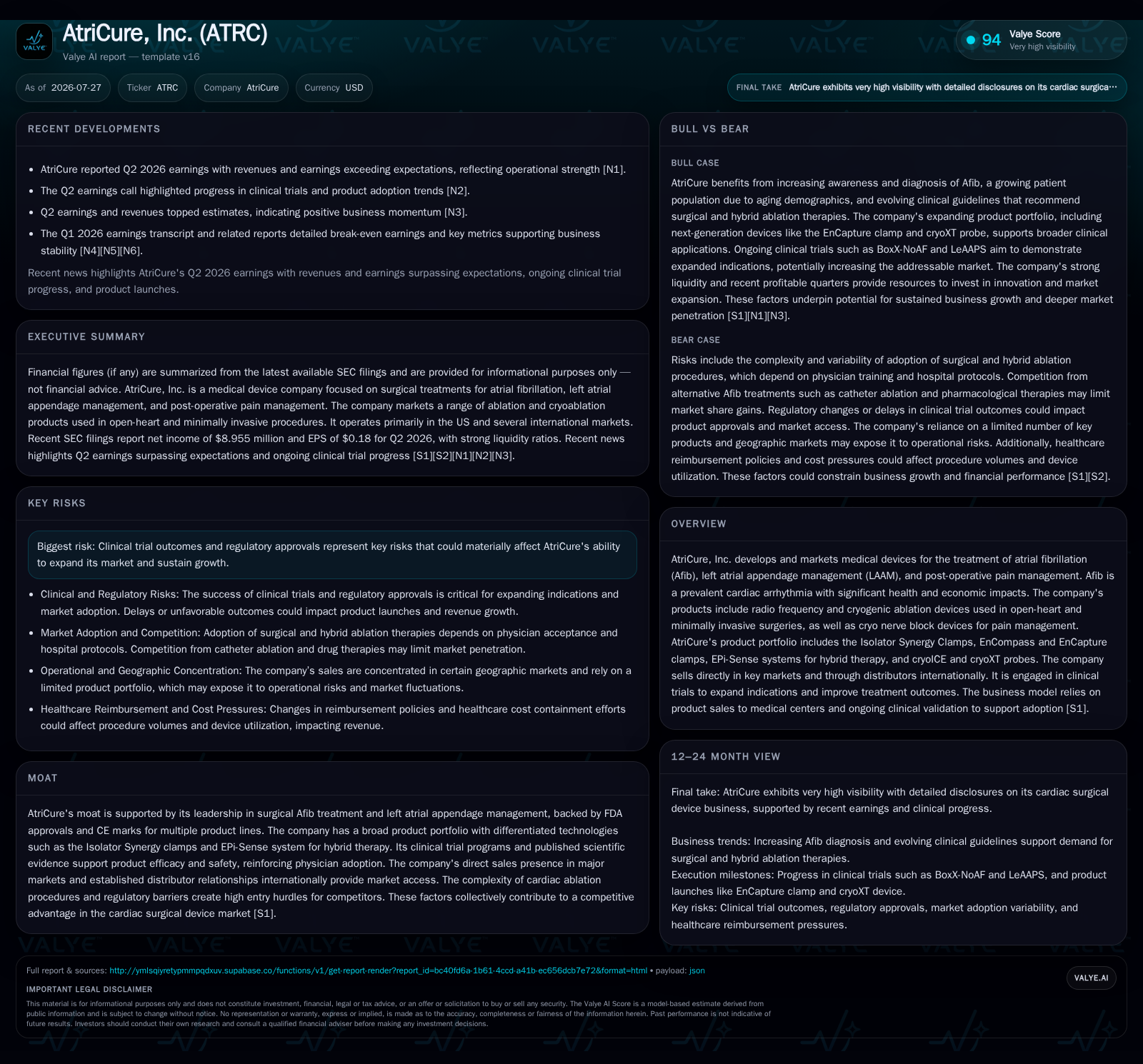
AtriCure’s Q2 2026 update highlights ongoing clinical trial progress, sustained product sales growth, and a strong financial position supporting innovation in cardiac surgical devices.
In its latest quarterly filing, AtriCure demonstrated continued operational momentum driven by growing adoption of its atrial fibrillation (Afib) and left atrial appendage management (LAAM) product portfolio. The company’s differentiated ablation and LAA exclusion devices maintain regulatory approval and clinical validation that support physician adoption in both open-heart and minimally invasive procedures. Ongoing clinical trials and a robust product pipeline underpin the firm’s strategic objective to expand indications and treatment options. Financially, AtriCure maintains a solid liquidity buffer with a current ratio above 4, enabling sustained R&D investment despite operating losses reported in recent years.
Recent Operating Update
In its Q2 2026 filing, AtriCure reported continued operational momentum driven by growing adoption of its cardiac surgical device portfolio focused on atrial fibrillation (Afib) treatment and left atrial appendage (LAA) management [S2]. The company’s revenue growth is supported by sustained sales of core products such as the FDA-approved Isolator Synergy clamps for radio frequency ablation and the EPi-Sense hybrid ablation system, which combines epicardial and endocardial approaches to treat persistent Afib subtypes [S1][S2]. The AtriClip family of LAA exclusion devices, including the recently introduced PRO-Mini system designed for minimally invasive procedures, continues to gain clinical traction with surgeons due to enhanced visualization and ease of use [S1][S18].
Clinical trial progress remains a key focus, with ongoing enrollment and data collection in pivotal studies like the BoxX-NoAF IDE trial evaluating concomitant ablation and LAA exclusion to reduce post-operative and clinical Afib incidence [S1]. These trials underpin regulatory submissions aimed at expanding indications and supporting reimbursement. The company’s direct sales teams in the U.S. and select developed markets, complemented by distributor networks internationally, continue to drive procedure volume growth and device utilization rates [S1][S2].
Business Model
AtriCure generates revenue primarily through the sale of specialized surgical devices and related consumables used in cardiac ablation and LAA management procedures. Its product portfolio includes radio frequency (RF) and cryogenic ablation systems utilized during open-heart surgeries addressing comorbid cardiac conditions, as well as standalone minimally invasive hybrid ablation therapies combining surgical and catheter-based electrophysiology interventions [S1]. The Isolator Synergy clamps enable precise lesion creation for durable electrical isolation, a critical factor in treating persistent Afib subtypes. The EPi-Sense system offers a hybrid ablation approach that integrates epicardial ablation with electrophysiologist-led endocardial catheter ablation, a differentiation supported by FDA Premarket Approval and clinical trial validation [S1][S19].
In the LAA management segment, the AtriClip platform—including the PRO-Mini device—provides surgeons with tools to exclude or occlude the left atrial appendage, a key stroke prevention strategy during concomitant or standalone procedures [S1][S18]. The PRO-Mini’s reduced size enhances surgeon visualization and access in minimally invasive surgeries, addressing a critical procedural challenge. Additionally, AtriCure’s cryo nerve block products, such as cryoICE cryoSPHERE and cryoXT probes, offer post-operative pain management solutions by temporarily freezing nerves to reduce recovery complications after cardiac, thoracic, or amputation surgeries [S1].
Revenue is derived mainly from hospital cardiac surgery departments purchasing capital equipment and recurring consumables required for each procedure. The company’s monetization strategy hinges on increasing procedure volumes driven by rising Afib diagnosis rates and growing physician adoption, supported by comprehensive training programs that include simulation-based modules to credential surgeons in complex hybrid therapies [S1][S19]. Physician proficiency is a critical operating variable as it directly impacts procedural success rates and patient outcomes.
Industry Structure and Competitive Position
The cardiac surgical medical device industry is characterized by stringent regulatory requirements, including FDA 510(k) clearances and Premarket Approvals (PMA), necessitating extensive clinical trials to demonstrate long-term safety and efficacy. This regulatory rigor fosters high barriers to entry and emphasizes the importance of clinical validation for physician trust and adoption. Procedural complexity in cardiac ablation and LAA management requires companies to cultivate deep relationships with cardiothoracic surgeons, electrophysiologists, and hospital systems.
AtriCure’s competitive positioning is anchored by a broad product portfolio that spans surgical ablation clamps, hybrid ablation systems, and LAA exclusion devices, all supported by robust clinical evidence from pivotal trials such as the CONVERGE IDE trial demonstrating hybrid therapy efficacy [S1][S19]. The company’s direct sales model in developed markets allows for pricing power and close customer engagement, while international distributor partnerships extend market reach amid diverse reimbursement landscapes [S1]. High switching costs arise from the need for specialized physician training and integration of proprietary procedural protocols within hospital cardiac surgery departments.
While peers such as Medtronic, Abbott Laboratories, and Boston Scientific compete broadly in electrophysiology and cardiac rhythm management, AtriCure’s focused specialization in surgical ablation and hybrid therapies enables a defensible niche leadership. Its ISO 13485 certification and quality management systems underscore compliance with global manufacturing standards critical for regulatory approvals and market access [S20].
Growth Drivers
Structural growth drivers favor AtriCure’s expansion prospects. The global prevalence of Afib, estimated at over 59 million individuals, continues to rise, driven by aging populations and improved diagnostic monitoring that increase treatment candidacy [S1]. The shift toward minimally invasive and hybrid ablation procedures, which combine surgical and catheter-based approaches, is gaining momentum due to superior clinical outcomes compared to catheter-only therapies, as validated in clinical trials [S19][S23].
Technological innovation remains central to growth, with product introductions like the PRO-Mini LAA Exclusion System addressing visualization and access challenges in minimally invasive surgeries, thereby broadening procedural applicability [S18]. Physician education initiatives leveraging simulation tools and hands-on training accelerate adoption by improving procedural proficiency and reducing learning curves [S1][S19].
International expansion through established distributor networks targets emerging markets in Asia-Pacific and Latin America, where Afib prevalence is increasing but access to advanced surgical therapies is limited [S1]. Additionally, evolving reimbursement policies that recognize the clinical and economic benefits of hybrid ablation therapies are expected to enhance hospital economics, driving higher procedure volumes and device utilization rates.
Risks and Constraints
AtriCure faces risks typical of medical device innovators operating in highly regulated environments. Negative or inconclusive clinical trial results could delay or restrict regulatory label expansions, limiting market growth opportunities [S12][S13]. Physician preference for alternative pharmacologic or catheter-only treatments may impede adoption if procedural complexity or reimbursement challenges persist.
Supply chain risks exist due to reliance on certain single-source components, although mitigated by inventory management and supplier audits aligned with regulatory standards [S20]. Competitive pressures from diversified cardiac device manufacturers offering integrated rhythm management platforms require continuous innovation to maintain differentiation.
Pricing pressures from hospital group purchasing organizations necessitate balancing competitive average selling prices (ASP) with margin preservation [S26]. Furthermore, evolving regulatory frameworks, particularly the EU Medical Device Regulation (MDR), impose additional compliance costs and potential time-to-market delays for new products
What to Watch Next
Key upcoming milestones include the completion of enrollment and interim data readouts from the BoxX-NoAF IDE trial assessing the impact of concomitant ablation and LAA exclusion on post-operative Afib rates. Positive outcomes would strengthen the clinical evidence base supporting regulatory submissions for expanded indications [S1]. Long-term follow-up data from the CONVERGE PAS trial will also provide critical validation of hybrid ablation therapy durability.
Commercial metrics such as procedure volume growth in direct sales territories and incremental gains through distributor channels will be important indicators of successful market penetration. Regulatory developments, including new FDA clearances or CE mark extensions for enhanced AtriClip platform iterations, will signal progress in minimally invasive procedure adoption.
Financially, monitoring gross margin trends driven by scale efficiencies and pricing dynamics will provide insight into operational leverage and the pathway toward sustained profitability amid ongoing R&D investments.
Financial Profile Discussion
As of June 30, 2026, AtriCure held approximately $168 million in cash and equivalents against current liabilities of about $82 million, resulting in a strong current ratio of 4.22, reflecting ample liquidity to support its innovation-driven R&D programs [F1][S2]. This liquidity position underpins the company’s ability to fund ongoing clinical trials and product development initiatives critical for expanding treatment indications.
The company reported operating losses of approximately $9.45 million for the year ended 2025, consistent with strategic prioritization of clinical and product innovation over near-term profitability, a common profile for specialty medtech firms targeting complex procedural markets [F1]. Capital expenditures focus on manufacturing capacity and R&D infrastructure aligned with anticipated demand growth.
Total debt stood near $53 million as of the last available data point, which, when offset against cash balances, results in a net cash position favorable for managing financial flexibility without immediate refinancing concerns [F1]. Working capital metrics indicate efficient inventory management consistent with medical device industry norms.
In summary, AtriCure’s financial health supports its strategic growth initiatives in the cardiac surgical device market, balancing investment in clinical validation and product innovation with operational discipline.
This analysis is intended purely as an informational industry review without any investment advice or research view.
Disclaimer: This is research-only, informational analysis and not investment advice. It may include AI-generated interpretation and general industry context. Always verify important details using primary sources.

Comments