
American Vanguard: Margin Squeeze, Operational Adjustments, and the Challenge of Restoring Profitability
Recent quarters have exposed American Vanguard to margin compression from falling sales volumes and higher input costs, resulting in deepening losses despite cost-cutting. The company’s liquidity position is mixed—current assets outpace liabilities, but cash is scarce. The path forward hinges on the company’s ability to stabilize gross margins and adapt its business mix amid volatile agricultural markets.
Operating expenses were reduced, but elevated interest costs exacerbated losses. The company’s future depends on restoring volume growth and margin, especially as weather and input volatility persist. [S2]
American Vanguard’s third quarter of 2026 underscores the company’s exposure to margin pressure and top-line volatility in the agricultural inputs sector. A sharp drop in sales volumes, compounded by higher freight and raw material costs, drove gross profit down 23% year-over-year—while even meaningful cost reductions could not prevent a $17.67 million net loss. American Vanguard’s ability to restore profitability will depend on navigating input volatility, managing interest expense, and reigniting growth—challenges that are amplified by the cyclical and weather-sensitive nature of its end markets. [S2]
Margin Compression and Losses Define the Latest Quarter
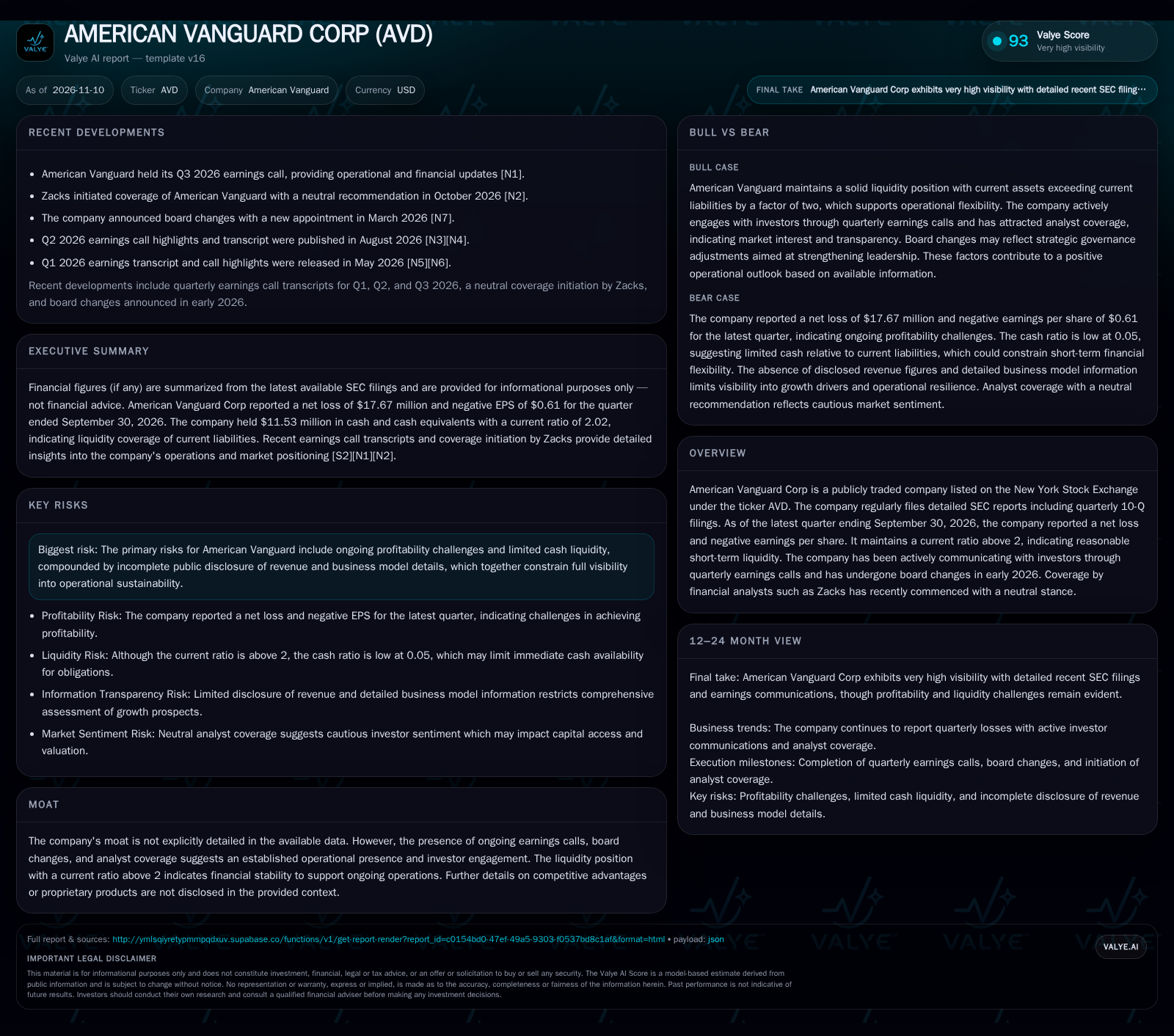
American Vanguard reported a $17.67 million net loss for Q3 2026, translating to a negative $0.61 in basic and diluted EPS [S2]. This deepened from a $12.36 million loss in the prior-year quarter, signaling worsening profitability. Gross profit fell 23% year-over-year, a decline attributed to lower sales volumes and rising freight and raw material costs, only partially offset by improved manufacturing performance. Despite reducing operating expenses both absolutely and as a percentage of sales, the company’s bottom line deteriorated further due to a nearly twofold increase in net interest expense compared to the prior year [S2]. The company reported cash and liquidity metrics for the period; these figures do not by themselves establish operating runway, investment capacity, financial flexibility, or financing capacity. [S2] Recent board changes and initiation of analyst coverage round out a period marked by operational and governance adjustments [N2] [N7].
The interplay between operational adjustments and financial outcomes highlights the complexity of managing agricultural input businesses amid external shocks. While cost-cutting measures can provide short-term relief, their effectiveness is often constrained by the rigidity of fixed costs and the timing mismatch between expense reductions and revenue declines. Moreover, the near doubling of net interest expense underscores the importance of capital structure management, as elevated leverage can exacerbate losses during downturns. Thus, a comprehensive approach that balances operational efficiency with prudent financial management is essential to stabilize performance in volatile environments.
Cost Structure, Volume Sensitivity, and the Operating Leverage Trap
American Vanguard’s business model, typical of agricultural chemical and input suppliers, is highly sensitive to both sales volume and input cost swings. Revenue is driven by the sale of crop protection products, soil fumigants, and specialty chemicals, often to distributors and large-scale growers. Pricing power is typically limited by commodity-like competition, while volumes are volatile due to weather, crop cycles, and regional demand shifts.
The company’s fixed cost base—spanning manufacturing, regulatory compliance, and R&D—creates pronounced operating leverage. When volumes fall, as in Q3 2026, gross profit drops sharply because fixed costs cannot be flexed down in real time. The 23% decline in gross profit, despite some manufacturing improvements, illustrates this dynamic [S2]. Variable costs such as freight and raw materials rose, further squeezing margins.
Operating leverage in agricultural inputs not only amplifies the impact of volume fluctuations but also limits the company’s agility in responding to rapid market changes. Fixed costs related to regulatory compliance and manufacturing capacity are often sunk or contractual, reducing flexibility. Consequently, management’s ability to forecast demand accurately and align production schedules becomes critical to minimize inventory build-up and avoid margin erosion. Additionally, the sensitivity to input cost inflation, such as raw materials and freight, necessitates effective procurement strategies and potential hedging mechanisms to mitigate volatility. Without these controls, margin compression is likely to persist even if volumes stabilize.
Commodity Exposure and the Absence of Durable Competitive Moats
American Vanguard operates in a fragmented and competitive agricultural inputs market, facing pressure from multinational agrochemical giants, regional specialists, and generic producers. Barriers to entry exist in regulatory approval, manufacturing scale, and distribution reach, but these are not insurmountable for well-capitalized competitors. The company’s lack of disclosed proprietary product advantages or long-term customer contracts suggests limited pricing power and low switching costs for buyers.
Competitive advantages in this sector often come from differentiated formulations, proprietary delivery systems, or strong distribution partnerships. In the absence of explicit evidence of such features, American Vanguard’s performance is likely to track broader industry trends—particularly weather-driven demand, input cost inflation, and regulatory shifts. The company’s recent board changes may be an attempt to strengthen governance or strategic direction, but there is no clear evidence of a shift toward a more defensible business model [N7].
In the absence of strong proprietary products or exclusive distribution networks, American Vanguard’s competitive position remains vulnerable to price competition and market share erosion. The agricultural inputs sector tends to reward companies that can innovate around formulation efficacy, application technology, or integrated service offerings that reduce switching costs for customers. Without clear differentiation, the company may face commoditization risks where price becomes the primary competitive lever. This dynamic can pressure margins further during periods of volume decline. Therefore, strategic investments in product development or partnerships that enhance value propositions could be pivotal in establishing more defensible market positioning over time.
Restoring Margin Through Volume Recovery and Cost Control
A favorable scenario for American Vanguard would see a rebound in sales volumes, driven by improved weather conditions, stabilization of input costs, or successful expansion in growth markets such as Ecuador. If the company can convert volume recovery into higher gross profit, while maintaining the recent discipline on operating expenses, it could return to profitability. Additional upside could come from new product launches, efficiency gains in manufacturing, or strategic partnerships that create stickier customer relationships.
Confirmation of this scenario would require sequential improvement in gross profit margin, a return to positive net income, and evidence of volume growth outpacing input cost inflation. Disclosures of new product wins, long-term customer contracts, or successful expansion into new geographies would further support the upside case. Conversely, continued gross margin compression or further increases in interest expense would challenge this scenario.
Navigating Volatility Without a Clear Catalyst for Turnaround
The most plausible near-term path is continued operational volatility, with profitability pressured by sluggish volumes and elevated input costs.
Incremental improvements in operating efficiency or modest volume gains may slow, but not reverse, the loss trajectory. Analyst coverage remains neutral, reflecting the market’s wait-and-see posture [N2]. Confirmation of this scenario would come from continued net losses, stable but unremarkable current ratios, and a lack of major new product or market breakthroughs. A shift to positive cash flow or margin expansion would falsify this base case.
Extended Losses and Liquidity Crunch in a Prolonged Downturn
A negative scenario unfolds if adverse weather, persistent input cost inflation, or weak end-market demand drive further sales declines. With high fixed costs and limited pricing power, deeper volume losses would likely result in larger operating and net losses.
Evidence supporting this scenario would include further sequential declines in gross profit, mounting net losses, deteriorating current and cash ratios, and negative operating cash flow. Announcements of asset sales, layoffs, or credit facility drawdowns would further corroborate downside risk.
Milestones and Metrics That Will Shape American Vanguard’s Trajectory
Gross profit margin trends, particularly sequential improvement or further compression, will indicate whether cost and volume pressures are being managed effectively.
Net income and EPS progression: a return to profitability or continued deepening of losses will be a direct signal of turnaround or distress.
Cash flow from operations, if disclosed, would clarify whether the business is generating sustainable liquidity or burning through reserves.
Interest expense trajectory: further increases would signal rising refinancing risk or worsening credit terms.
Sales volume and revenue trends by product line or geography, if disclosed, would help identify the company’s exposure to specific markets or weather events.
Disclosures on customer concentration, contract structure, or new product introductions would help test for emerging competitive advantages.
Management commentary on capital allocation, asset sales, or external funding needs would reveal the company’s approach to shoring up liquidity.
Board or governance changes, and any linked strategic shifts, could signal a change in operational direction or risk appetite.
Disclaimer: This is research-only, informational analysis and not investment advice. It may include AI-generated interpretation and general industry context. Always verify important details using primary sources.

Comments