
Awaysis Capital Advances Belize Resort Developments Amid Rising Liquidity and Execution Pressures
The company continues acquiring and developing residential resorts while managing mounting losses, secured debt maturities, and regulatory complexities across key markets.
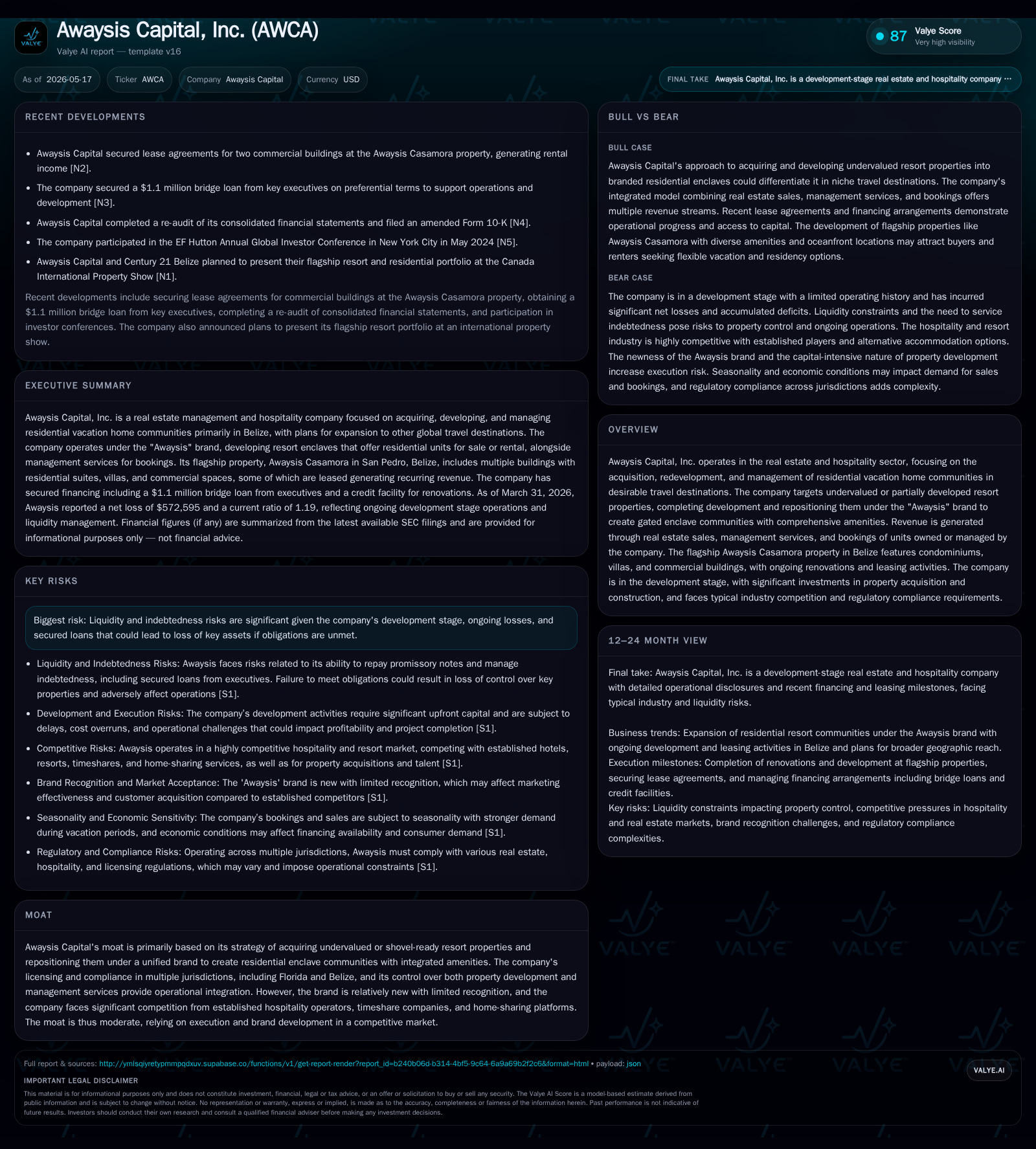
Awaysis Capital, Inc. continues focused development of residential vacation home communities primarily in Belize, leveraging acquisition and repositioning of undervalued resort properties under the Awaysis brand. Its latest quarterly disclosures show active capital deployment with incremental leasing activity but underscore persistent losses and meaningful liquidity risks tied to secured loans. The company's business model integrates real estate sales, management services, and bookings revenue within gated enclave communities designed for extended-stay travelers driven by evolving 'work from home' trends. Competitive pressures, regulatory complexity across jurisdictions, and execution risks related to development timelines and financing availability represent ongoing watchpoints. Growth depends on expanding the resort portfolio, improving occupancy and sales, and successfully managing capital structure amid a cyclical hospitality demand environment.
Recent Operating Update
Awaysis Capital's latest quarterly filing for the period ended March 31, 2026 [S2] delivers an incremental operating update aligned with its ongoing development stage trajectory. The company is actively advancing its flagship Awaysis Casamora property in Belize through continued renovations and stepped up leasing activity including a three-bedroom unit leased at $2,500 per month as well as two commercial spaces generating combined lease revenue of approximately $16,000 monthly since September 2024 [S6]. These moves signal early efforts at stabilizing cash flow through mixed-use asset leasing while awaiting unit sell-through or additional bookings revenue.
Additional context from a March 31, 2026 event filing [S3] indicates the company issued a modest $50,000 promissory note to board chairman Dr. Narendra Kini. This internal financing arrangement underscores the ongoing reliance on insider support as external capital remains constrained.
No material changes in risk factors were reported versus the November 2025 annual report [S2]. However, the continuing burden of operating losses (-$2.7 million reported as of June 30, 2025 [F1]) alongside significant liabilities paints a picture of a business balancing growth ambitions with pressing liquidity challenges.
Business Model
Awaysis Capital operates primarily in real estate development within the residential vacation home segment complemented by hospitality management services [S1]. The core strategic approach involves targeting undervalued and shovel-ready resort properties—especially those lacking completion or operational history—to reposition them under the "Awaysis" brand as gated enclave communities offering integrated amenities.
Units within these enclaves comprise condominiums, villas, single-family homes, and commercial spaces designed to facilitate comfortable extended stays suitable for evolving traveler behaviors influenced by remote work trends. The company either sells completed units directly to end buyers—often leveraging owner financing arrangements covering up to half the purchase price—or retains ownership to generate booking revenues from short- or long-term stays managed internally [S1], [S24].
Revenue streams thus primarily arise from three vectors:
- Real Estate Sales: Direct sale of finished residential units supports capital recovery necessary for expansion.
- Management Services: Including facility operations oversight for both owned resorts and third-party owned units under contractual arrangements.
- Bookings Income: Fees generated from managing unit reservations for transient or longer-term guests.
Importantly, customers include both direct buyers seeking vacation homes as well as travelers using managed accommodation services within the developed communities. The brand aims to build loyalty around the convenience of enclave living where residents can "live, work and play" without leaving the community [S24].
This vertically integrated model—control over land acquisition through construction/renovation plus guest management—is designed to optimize multiple monetization points within each asset cluster.
Industry Structure and Competitive Position
The residential vacation home niche occupies an intersection between real estate development and hospitality sectors characterized by a complex competitive landscape. Providers range from pure residential developers specializing in second-home markets to established resort operators offering fully serviced vacation experiences.
Awaysis Capital differentiates via its focus on repositioning underserved or partially completed resort properties in emerging travel destinations like Belize—a region with growing tourist inflows but less penetrated by well-capitalized operators. Regulatory compliance across multiple jurisdictions (including Florida licensing for real estate services and adherence to Belize tourism regulations) creates operational complexity but also barriers to entry [S5].
The competition includes timeshare firms with established distribution networks, branded hotel chains expanding into condo-hotel hybrid models, and peer-to-peer lodging platforms like Airbnb that offer flexible short-term rental options outside traditional resorts. While Awaysis does not yet have extensive brand recognition due to its recent entry into this market space (name change occurred in mid-2022) [S7], it seeks to build moat through unified branding and operational control across acquisition-to-hospitality lifecycles.
Operationally controlling both physical assets and booking management enhances switching costs for owners choosing Awaysis management services amid alternatives. However, scalability depends on successful new property additions outside Belize into other attractive global resort hubs identified in their strategic plan (Caribbean broader markets, parts of South America & Europe) [S1].
Growth Drivers
Several growth drivers underpin Awaysis Capital's path toward scale:
Property Acquisition & Development Pipeline: Continuing investments such as the recent Chial Reserve Assets acquisition (~$4.5M) augment the portfolio’s geographic footprint in Belize while supporting phased expansions around Awaysis Casamora [S26]. Ongoing rebranding efforts strive to weave these acquisitions tightly into the Awaysis network brand framework.
Residential Unit Sales Momentum: Facilitated by personalized marketing approaches targeting prospective buyers globally—including owner financing options—unit sales provide critical liquidity recycling for reinvestment [S6], [S24]. Unlocking additional phases hinges closely on initial sell-through success.
Hospitality Operation Scale: Increasing units held under company ownership translate into more inventory available for bookings revenue through integrated reservation systems tested at existing properties. Optimizing occupancy during peak vacation seasons aligns with expected seasonality patterns highlighted in earlier filings [S1].
Brand Ecosystem Expansion: Establishing Awaysis as a recognized lifestyle brand connected across multiple communities could drive cross-property customer retention advantages. Execution here will require enhanced marketing sophistication beyond localized real estate promotion.
Regulatory Compliance: Navigating distinctive laws governing hospitality licensing (Belize Tourism Board), real estate brokerage (Florida Real Estate Commission), plus securities law considerations relevant when selling timeshare-like interests [S25][S26], enables sustainable long-term operations.
Risks / Watchpoints / Growth Constraints
Despite growth prospects,Awaysis Capital faces pronounced risks:
Liquidity & Leverage Pressure: The balance sheet reflects tight liquidity with current assets approximating $13 million versus nearly $10.9 million current liabilities (current ratio ~1.19) as of March 31, 2026 [F1]. Total debt stood near $2.6 million at September 30, 2025 with upcoming maturities concentrated at late-2025 dates that could trigger refinancing risk or asset foreclosures if unmet [F1], [S9], [S18].
Development & Execution Risk: Renovation delays or unexpected cost escalations arising from supply chain disruptions may impair project timelines or margins substantially given large upfront capital commitments required for ground-up or value-add projects [S17].
Competitive Intensity & Brand Immaturity: Low brand awareness relative to entrenched hospitality groups challenges customer acquisition cost discipline and repeat business viability.
Cyclical Demand Exposure: Vacation unit sales are sensitive to generalized economic cycles affecting financing availability for buyers plus discretionary travel demand exposed to inflationary pressures or geopolitical shifts impacting inbound tourism flows [S27], [S19].
Regulatory Uncertainty: Potential securities law scrutiny regarding how unit sales with income-generating rental features are structured could impose compliance costs or legal risks if classification diverges from current assumptions despite prevailing guidance interpretations [S25], [S26].
Conflict of Interest Concerns: Related-party transactions involving key executives simultaneously acting as lenders or sellers may raise corporate governance issues affecting investor confidence.[S22]
What To Watch Next
Near-term milestones critical for tracking Awaysis' execution include:
- Completion of planned reverse stock split (1-for-20) targeted by end-2025 aimed at enhancing equity trading structure liquidity noted in annual filings [S20], [S13].
- Resolution of outstanding new appraisals revaluing key acquired assets such as Chial Reserve Assets which affect purchase price adjustments crucial for capital planning decisions [S26].
- Progress updates on planned development phases unlocking additional residential unit inventory critical for both sales revenue generation and portfolio diversification.
- Quarterly updates on leasing/sales velocity metrics particularly within Awaysis Casamora offering signals on improving operational cash generation capacity.
- Refinancing arrangements or capital raises addressing maturity concentrations within unsecured/promissory notes financed currently by insiders are important risk mitigants worth monitoring closely [S3][S18][S25].
- Regulatory developments especially clarifications related to rental program structures impacting how units are marketed/sold could alter business model economics materially.
Financial Snapshot Summary (as of Q1 FY2026)
Latest financial snapshot
| Metric | Value | Period |
|---|---|---|
| Current assets | $13mm | |
| 2026-03-31 | ||
| Current liabilities | $11mm | |
| 2026-03-31 | ||
| Current ratio | 1.19x | |
| 2026-03-31 |
Source: SEC companyfacts cache [F1].
This snapshot illustrates ongoing operational losses consistent with a development-stage entity actively deploying capital into growing its asset base while facing almost immediate debt amortization pressures.
Disclaimer: This analysis is provided solely for informational purposes based on publicly filed disclosures as of May 17, 2026. It does not constitute investment advice or an endorsement of any securities.
Disclaimer: This is research-only, informational analysis and not investment advice. It may include AI-generated interpretation and general industry context. Always verify important details using primary sources.

Comments