
American Express in 2025: Navigating Premium Strengths Amid Rising Engagement Costs and Intensifying Competition
American Express balances its renowned brand moat with operational cost challenges and evolving competitive dynamics in credit services.
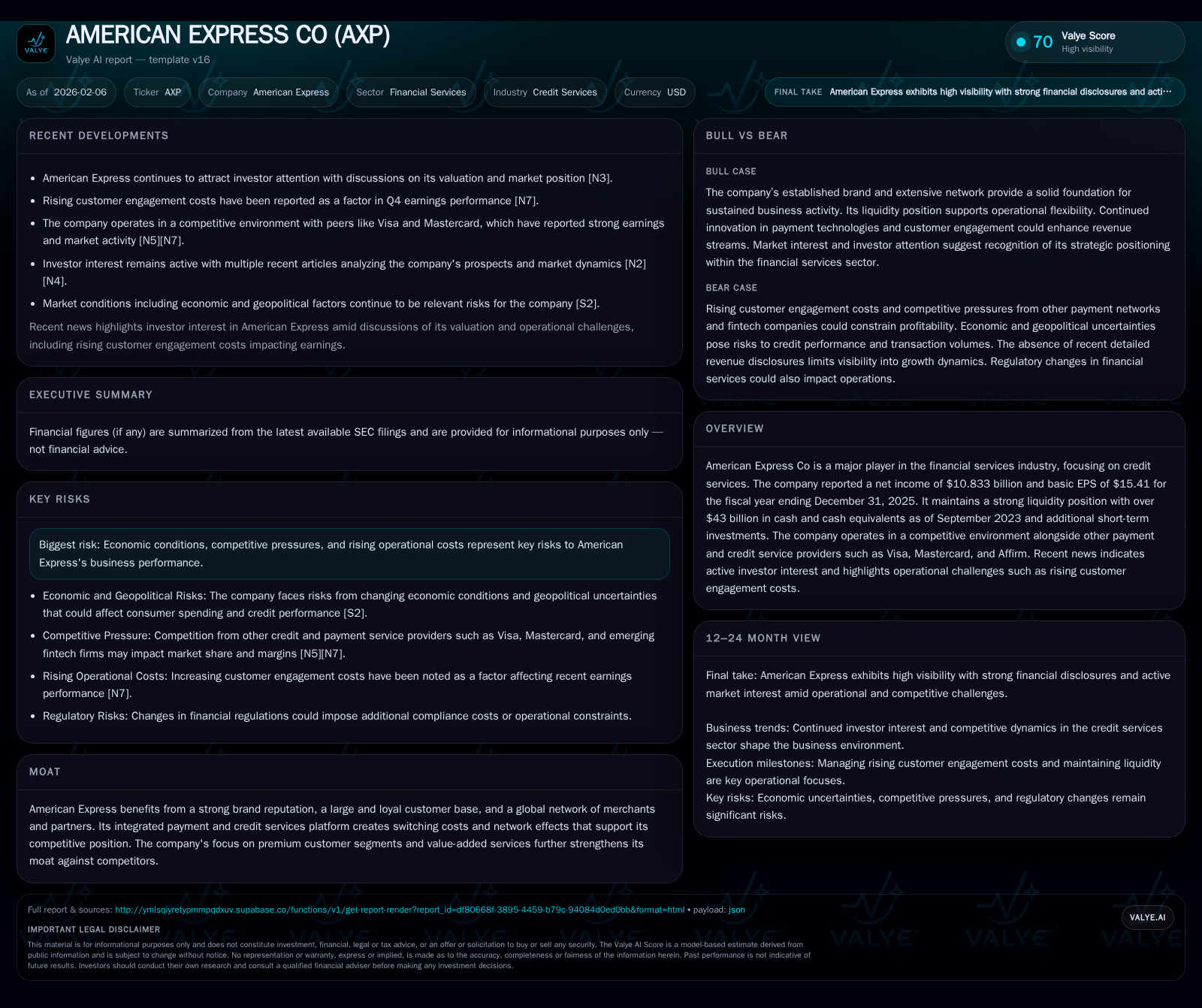
American Express Co maintains a formidable position in the financial services sector driven by its strong brand, loyal premium clientele, and expansive merchant network. The company reported a robust $10.8 billion net income for fiscal year 2025 alongside substantial cash reserves exceeding $43 billion, underscoring financial resilience. However, rising customer engagement costs are testing margins amid fierce rivalry from Visa, Mastercard, and newer entrants like Affirm. Strategic imperatives now focus on harnessing liquidity for innovation while managing cost pressures to preserve Amex's unique value proposition.
The Powerhouse Brand: Amex’s Moat and Market Position
American Express stands out distinctly within the credit services landscape through a deeply entrenched brand reputation that transcends mere payment convenience. Its network effect is not just about volume but quality—catering predominantly to premium customer segments that foster loyalty and generate elevated spending patterns [valye_report_excerpt]. This premium positioning creates formidable switching costs; customers embedded in Amex’s ecosystem find value in integrated credit offerings combined with rewards programs that are difficult to replicate elsewhere. Moreover, its global merchant acceptance and partnerships enhance this moat by embedding Amex into both consumer lifestyles and merchant operations alike, reinforcing recurrent usage and sustained engagement [S1].
Unlike Visa or Mastercard — which largely license their networks to banks — American Express functions as both issuer and network provider. This integration allows tighter control over customer experience, risk profiling, and product innovation. Consequently, Amex’s moat manifests through multifaceted dimensions: brand equity signaling trustworthiness; a loyalty-driven affluent clientele less sensitive to price; and an expansive international merchant base incentivized to maintain the partnership due to Amex cardholders’ purchasing power [valye_report_excerpt]. Such features collectively insulate it against commoditization pressures seen elsewhere in payment services.
Dissecting the 2025 Financials: From EPS to Cash Reserves
For fiscal year ending December 31, 2025, American Express reported a substantial net income of $10.833 billion paired with a basic earnings per share (EPS) of $15.41 — figures that broadly signal operational robustness amid industry headwinds [valye_report_excerpt][F1]. Revenue generation was supported by both cardmember spending growth and service fee expansion. Notably, these results arrived alongside healthy liquidity buffers; as of September 2023, the company held more than $43 billion in cash and cash equivalents complemented by additional short-term investments [valye_report_excerpt][F1].
This elevated liquidity firepower grants Amex latitude to pursue strategic investments or weather short-term volatility without jeopardizing its capital requirements or credit rating [S1]. It also provides capacity for incremental marketing initiatives or technology deployments responsive to competitive trends. Nevertheless, the profit margin story is nuanced — strong top-line growth contrasts with expanding operating costs driven notably by customer engagement expenses as detailed in recent earnings reports [N4]. The ability to reconcile robust earnings with these margin pressures will be critical going forward.
Customer Engagement Costs: The Rising Headwind
A conspicuous challenge surfaced during the fourth quarter of 2025 when American Express’s earnings lagged analyst estimates primarily due to rising customer engagement expenses [N4][N6]. These costs encompass marketing incentives, loyalty program funding, digital channel investments, and broader client relationship management activities intended to deepen customer interaction frequency and value extraction.
While such expenses support long-term revenue potential by cultivating stickiness within its premium user base, their escalation has placed short-term pressure on profitability metrics — highlighting a delicate balancing act between growth initiatives and cost discipline [N6]. It remains ambiguous if these higher engagement costs represent transitory spikes responding to competitive urgency or more structural shifts reflecting evolving consumer behavior demands requiring sustained outlays [S1]. The magnitude of these expenditures relative to incremental revenue gains will be a focal consideration for management strategy.
Contending with Competition: Visa, Mastercard, and Emerging Players
The competitive arena surrounding American Express is intensifying notably along two vectors: entrenched payment networks such as Visa and Mastercard continue leveraging scale advantages particularly in volume-driven markets; concurrently, emerging fintech challengers including Affirm and Bread Financial are aggressively capturing market share through innovative credit products tied to consumer financing experiences [N1][N2][N5][N14].
Visa recently demonstrated resilience by beating Q1 earnings expectations fueled by processing volumes despite isolated headwinds [N5], while Mastercard maintains bullish investor prospects despite cap constraints and competition-related pressures [N14]. On the other hand, Affirm’s growing gross merchandise volume signals momentum within installment lending spaces traditionally peripheral to Amex’s core offerings [N1]. Bread Financial’s solid quarterly performance similarly underscores increasing competition within flexible credit domains [N2]. These dynamics constrain pricing power for traditional card issuers including Amex.
Moreover, the merchant acceptance landscape subtly shifts toward wider interoperability demands as partners weigh transaction fees against consumer reach benefits—a scenario where Visa/Mastercard’s ubiquity poses advantages over Amex’s comparatively selective acceptance footprint [valye_report_excerpt]. Navigation of this complex competitive mosaic requires American Express not only to defend its core differentiators but also innovate relentlessly across product design and partnership models.
Segment Analysis: Premium Customer Focus and Merchant Network Strength
Central to American Express’s differentiated revenue resilience is its unwavering commitment to serving premium cardmembers supplemented by a curated merchant ecosystem offering exclusive value propositions. This segment focus enables higher average spend per user supported by tailored rewards programs emphasizing travel benefits, concierge services, lifestyle access, and financial tools uniquely aligned with affluent consumers’ expectations [valye_report_excerpt][S1].
Such segmentation creates virtuous revenue feedback loops: premium customers attract merchants seeking affluent shoppers willing to pay premium prices; merchants reciprocate through exclusive offers enhancing card usage frequency; enhanced card activity generates increased fee income for Amex while reinforcing loyalty barriers [valye_report_excerpt]. This ecosystem synergy underpins stable recurring revenues even amid broader macroeconomic uncertainties or shifts in mass-market credit usage patterns.
Furthermore, Amex’s investment in technology platforms strengthens its ability to personalize interactions—integrating data analytics with payment processing—to improve customer satisfaction levels while optimizing fraud prevention frameworks within this high-touch segment approach [S1]. This vertical integration of service quality plus network depth remains a notable competitive advantage.
Investor Sentiment and Market Reactions in Early 2026
Entering 2026, market participants display a cautiously upbeat stance on American Express characterized by heightened investor interest alongside tempered caution regarding operational cost trajectories [N9][N10][N11][N13]. Analysts dissecting the company often highlight confidence in brand durability tempered by skepticism around whether rising engagement spending might compress near-term margins. Discussions have tended toward balanced narratives rather than outright bullish or bearish extremes.
This nuanced sentiment reflects recognition of Amex’s legacy strengths counterbalanced against palpable challenges pervasive throughout credit services globally—chiefly inflationary pressures on marketing costs coupled with ever-more fragmented consumer credit preferences elicited by new fintech entrants [N9]. Investor dialogues emphasize monitoring Amex’s capacity for disciplined cost controls without sacrificing growth levers embodied in technology upgrades or partnership expansions.
Overall market movements mirror this balance; while some ETFs report inflows supportive of broad financial sector interest [N8], shares have experienced volatility in reaction to quarterly results underscoring the sensitivity of profitability metrics toward expense fluctuations [N7][N4].
Risks on the Horizon: Economic, Operational, and Competitive Factors
American Express’s SEC filings outline a spectrum of risks that frame near- and medium-term uncertainties surrounding its business model execution [S2][valye_report_excerpt]. Macroeconomic variables—including consumer discretionary spending trends affected by inflation rates or geopolitical developments—pose direct impacts on cardmember activity volumes and repayment behaviors.
Operationally, sustained increases in customer engagement costs could erode operating margins if not offset by commensurate revenue growth or efficiency gains. Additionally, technology investment risks exist both from rapid innovation cycles necessitating continual capex deployments as well as cybersecurity threats inherent in digital financial platforms [S2].
Competitive risks remain pronounced given industry concentration among dominant incumbents Visa/Mastercard while agile fintech startups continuously redefine market expectations around credit flexibility or digital experience customization. These factors collectively urge vigilance around pricing strategies, acceptance negotiations with merchants, and maintenance of service quality consistent with premium positioning.
Strategic Outlook: What’s Next for American Express?
Looking forward into 2026 and beyond, American Express appears poised at an inflection point requiring adept orchestration between leveraging its fortress-like liquidity position—over $43 billion available capital—and managing burgeoning operational expenditures highlighted most acutely through elevated engagement costs [valye_report_excerpt][N4][N6][N10]. Investment priorities likely include advancing platform technologies aimed at enhancing data-driven personalization capabilities as well as bolstering fraud detection systems aligning with premium client expectations.
Amid intensifying competition from both established card networks expanding value-added services and fintech innovators reimagining consumer lending vehicles, American Express must sustain enhancement of its differentiated product suite rooted in exclusive rewards frameworks coupled with superior service quality. Expanding merchant relationships selectively into new geographies or categories may help counterbalance acceptance limitations relative to rivals.
In summary, American Express's strategic stewardship depends on balancing innovation-led growth initiatives financed through robust cash flows with prudent control over increasingly material direct marketing and engagement expenditures. How effectively it navigates these dual imperatives will shape its trajectory within an evolving credit services industry still grappling with shifting consumer behaviors and regulatory landscapes.
Disclaimer: This analysis is provided for informational purposes only based on available data as of early 2026. It does not constitute investment advice or recommendations.
Disclaimer: This is research-only, informational analysis and not investment advice. It may include AI-generated interpretation and general industry context. Always verify important details using primary sources.

Comments