
Navigating Lease Disputes and Growth Challenges at ARK Restaurants Corp
ARK Restaurants Corp balances an iconic portfolio amid operational uncertainties tied to lease conflicts and competitive pressures.
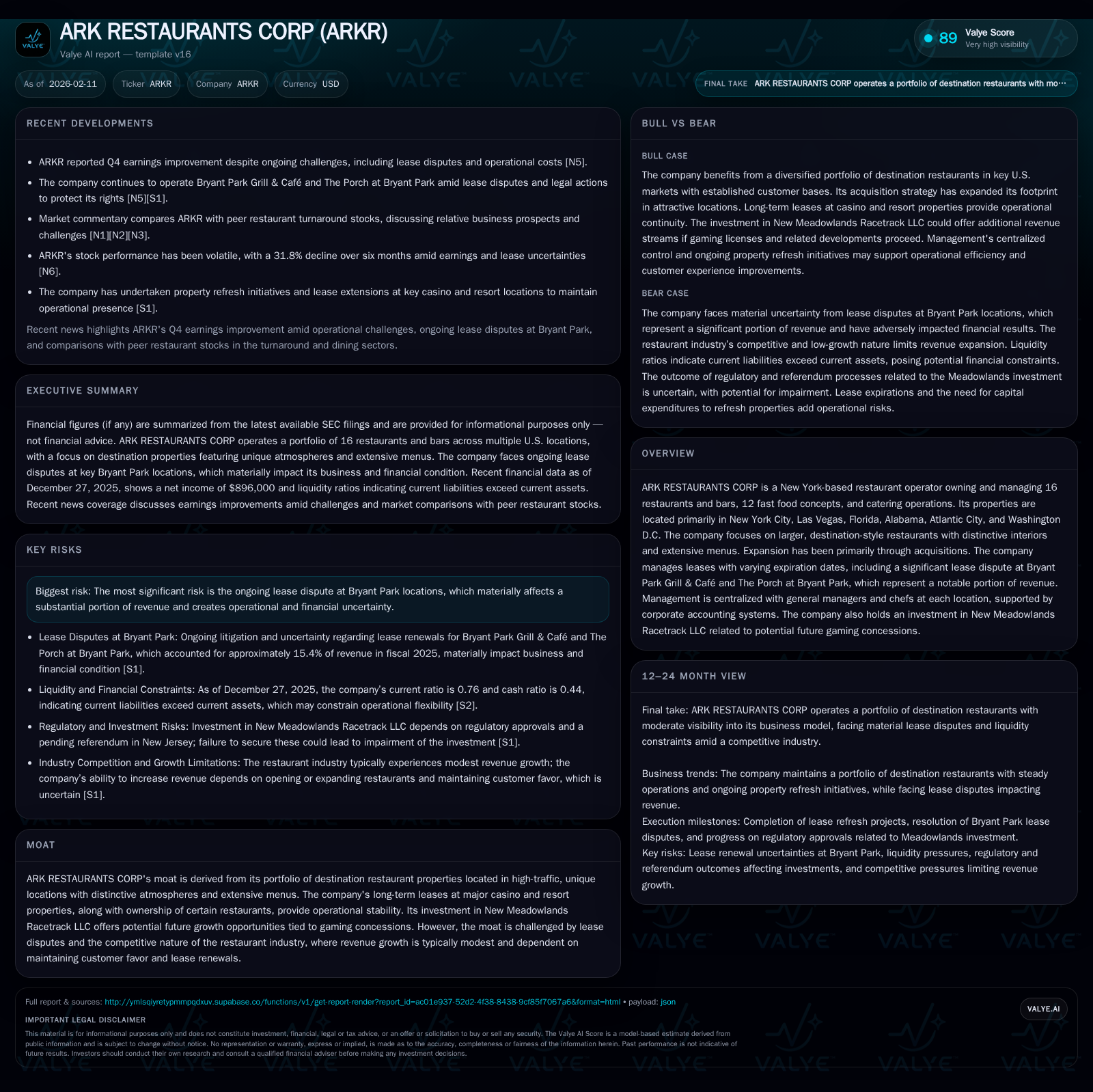
ARK Restaurants Corp operates a diverse collection of destination-style restaurants across major U.S. leisure markets, with a focus on unique atmospheres and extensive menus. The company is engaged in a pivotal lease dispute involving its Bryant Park Grill locations, which represent a meaningful revenue concentration and create near-term operational uncertainty. Expanding primarily through acquisitions, ARK faces the challenge of integrating disparate brands while managing tight liquidity metrics. Its strategic investment in New Meadowlands Racetrack offers potential upside beyond dining. However, the competitive landscape and lease-related risks underscore questions around the sustainability of ARK’s moat and growth prospects.
The Culinary Footprint: Mapping ARK's Destination Brands
ARK Restaurants Corp presents a portfolio deeply rooted in destination dining experiences that transcend mere meal service. Anchored by 16 restaurants and bars alongside 12 fast-food outlets and catering operations, its footprint spans several key leisure corridors—the bustling streets of New York City, the glitz of Las Vegas, the gaming hubs of Atlantic City, various coastal sites in Florida, as well as select Alabama Gulf Coast locales [S1].
These properties prioritize distinctiveness: expansive menus that cover a broad culinary gamut complemented by theatrical interiors featuring dramatic open spaces, vivid wall treatments, and glass exteriors designed to captivate patrons. This architectural flair aligns with ARK’s strategy to cultivate venues not merely for dining but as event destinations where ambiance is as much an attraction as the food.
Recent acquisitions—like The Rustic Inn (Dania Beach), Shuckers (Jensen Beach), two Original Oyster Houses in Alabama, JB's on the Beach, and Blue Moon Fish Company—reflect a consistent pursuit of well-established local brands that enhance ARK's regional reach on the East Coast [S1]. Broad thematic differences exist among properties; however, branding replicates only across limited pairs such as Broadway Burger Bar or Original Oyster House outlets. Operationally, locations run full-week schedules emphasizing dinner service as the primary sales driver.
Lease Dispute at Bryant Park: Revenue Impact and Legal Standoff
One cannot overstate the drama enveloping ARK’s Bryant Park Grill & Café and The Porch at Bryant Park—two cornerstone properties whose leases expired between March and April 2025 [S1]. The Landlord, a private non-profit operating Bryant Park under city agreements, invited proposals (RFPs) for these high-profile leases during mid-2023. While ARK responded promptly, the Landlord publicly acknowledged selecting an alternative operator for both venues by Q2 2025.
Despite this announcement, no definitive lease agreements have secured mandatory approvals from New York’s Department of Parks & Recreation or the Public Library—both essential gatekeepers for such arrangements [S1]. Consequently, ARK continues operating under holdover conditions while pursuing legal channels aiming to uphold their right of first lease renewal through external advisors.
This standoff places considerable financial strain given that Bryant Park properties represent a sizable portion of ARK’s revenue base. The looming threat of losing these assets introduces material uncertainty impacting cash flow predictability and strategic planning—forcing management into a defensive posture balancing litigation costs with operational continuity [S1][S2].
Expansion by Acquisition: Growth Strategy Under the Microscope
ARK’s growth narrative eschews organic new openings in favor of acquiring proven restaurant concepts in complementary markets [S1]. This approach provides immediate cash flow contributions from established brand loyalty and mitigates some risks inherent to greenfield developments.
Notable acquisitions over the past decade have concentrated in Florida’s coastal markets and Alabama’s Gulf region—areas benefiting from steady tourism influxes—and align with ARK’s penchant for casual yet vibrant dining experiences. Such consolidation enables cross-location operational synergies but also invites integration challenges related to brand coherence and unified supply chain management.
However, market saturation poses a visible ceiling; these regions already host numerous competitors vying for discretionary dining spend. Furthermore, acquisition-driven scale may plateau absent fresh concept innovation or broader geographic expansion beyond existing zones.
Financial Health Check: Profitability, Liquidity, and Balance Sheet
A deeper dive into ARK's financials reveals nuanced strengths blended with notable vulnerabilities [F1]. Net income clocks in marginally positive at $896k as of December 2025 year-end—a figure signaling profitability but highlighting thin operational margins.
Liquidity emerges as a more pressing concern: current assets total approximately $15.98 million against current liabilities nearing $20.93 million, yielding a subpar current ratio around 0.76 that stresses short-term funding capability [F1]. Cash reserves of $9.14 million provide some cushion; however, working capital remains tight.
This financial profile suggests management must carefully navigate cash flow allocations amidst ongoing lease negotiations and integration expenses from acquisitions without triggering liquidity crises or resorting aggressively to external debt.
Competitive Landscape: How Does ARK Stack Against Industry Peers?
ARK sits within a fiercely competitive sector characterized by modest margin profiles and cyclical consumer spending tendencies. Recent comparative analyses showcase peers such as RAVE Restaurants (RAVE), Brindisi Dining Limited (BDL), and Nathan’s Famous (NATH) as noteworthy benchmarks [N1][N2][N3][N4].
Analyst commentary frequently highlights how RAVE benefits from diversified franchise platforms while BDL leans heavily on scalable concepts within robust demographic clusters. Nathan’s brings strong brand recognition rooted in quick-service menu staples.
Against this backdrop, ARK's distinctiveness lies in its destination venue emphasis; yet relative to these peers it contends with elevated operational uncertainties stemming largely from its faltering control over Bryant Park leases. Comparatively tighter margins and weaker liquidity ratios further temper investor enthusiasm about resilience versus some competitors enjoying steadier earnings trends.
Management and Operations: Centralized Control Versus Local Autonomy
ARK employs a dual-layered management model blending corporate centralized functions with empowered local teams [S1]. Financial reporting infrastructure—including accounting systems—is consolidated at headquarters ensuring standardized controls. Conversely, individual restaurants rely extensively on their general managers alongside head chefs who curate daily operations maintaining venue-specific atmospheres.
Such decentralization fosters tailored customer experiences vital to sustaining distinctiveness across disparate properties—where ambiance varies wildly from casual beachside eateries to upscale theatrical interiors.
However, this model implicates operational risks around maintaining consistent execution standards without overly diluting brand identity through too much localization—a balance management must vigilantly maintain.
Hidden Gems and Future Upside: The Meadowlands Racetrack Investment
Beyond core restaurant operations lies an intriguing speculative asset: ARK’s stake in New Meadowlands Racetrack LLC connected to prospective gaming concessions [S1].
While current revenues derive prominently from dining venues, this minority investment hints at potential diversification opportunities conditioned upon regulatory approvals within New Jersey's evolving gambling framework.
If realized fully over time, gaming concessions could augment top-line growth offering less cyclicality relative to restaurant sales sensitive to shifting consumer habits—a prospect injecting cautious optimism into ARK’s longer-term trajectory.
Moat Under Pressure: Evaluating Sustainability Amid Industry Headwinds
ARK's moat ostensibly springs from its portfolio configuration: large-format destination venues embedded in high-footfall urban parks or casino resorts fortified by long-term leases [S1]. These factors historically provided reliable revenue baselines insulated somewhat from transient economic shocks.
Yet the emerging lease disputes at Bryant Park impair this foundational stability severely while intensifying lawsuit-related financial exposure [S1]. Compounded by vigorous competition for consumer attention among casual dining formats nationwide underscores that growth will not be facile.
Moreover, dependence on lease renewals underscores risks attached to location-based operating models exposed to landlord discretion beyond company control—a vulnerability hard to hedge against without ownership stake or favorable contract terms.
In sum, while differentiated interiors and established geography confer advantages difficult for new entrants to replicate quickly, sustaining these advantages demands deft navigation through real estate negotiations coupled with consistent quality execution under evolving market conditions.
This analysis integrates multiple data points around ARK Restaurants Corp drawn predominantly from recent SEC filings augmented by industry commentary. All factual information reflects publicly disclosed filings or cited news sources as of early 2026; any forward-looking implications are presented strictly within analytical context without direct forecasts or investment recommendations.
Disclaimer: This is research-only, informational analysis and not investment advice. It may include AI-generated interpretation and general industry context. Always verify important details using primary sources.

Comments