
Electromed’s SmartVest: Innovating Airway Clearance Therapy with a Strong Clinical and Strategic Moat
Electromed’s proprietary pulmonary therapy device offers comfort-driven innovation amid evolving respiratory care needs.
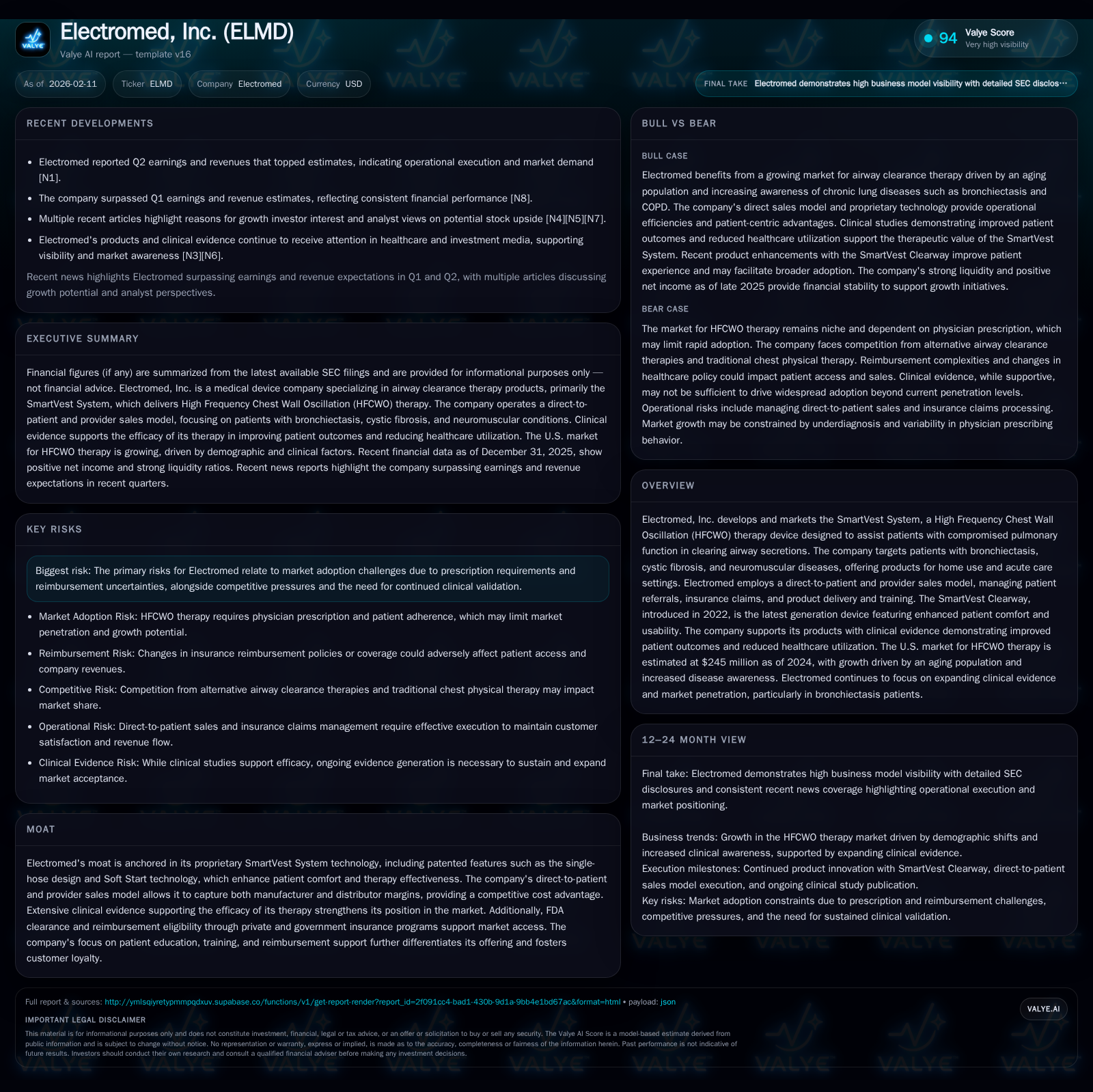
Electromed, Inc. has carved a distinctive position in the pulmonary therapy space through its SmartVest System—a patented, patient-friendly high frequency chest wall oscillation (HFCWO) device designed to improve airway clearance for patients with chronic respiratory diseases. By employing a direct-to-patient business model that streamlines referral and reimbursement processes, the company captures value beyond traditional distribution channels. Its moat is fortified by patented technology features that enhance comfort and adherence, supported by robust clinical data validating efficacy and health economic benefits. While recent financial results indicate growth resilience, Electromed must navigate challenges including prescription-driven market access and reimbursement uncertainties to sustain momentum in an expanding demographic market.
Breathing New Life into Airway Clearance: How SmartVest Is Reshaping Respiratory Therapy
Imagine living each day tethered to the constant struggle for breath — a reality for millions with compromised pulmonary function due to conditions such as cystic fibrosis, bronchiectasis, or neuromuscular diseases. The inability to effectively clear mucus from airways not only aggravates breathing difficulties but predisposes these individuals to recurrent infections requiring costly hospital interventions. Electromed’s SmartVest System emerged out of the pressing need to empower patients with more effective, convenient pulmonary care at home.
The SmartVest System delivers High Frequency Chest Wall Oscillation (HFCWO) therapy through a three-component design: a programmable air pulse generator, a wearable garment fitted over the chest, and a connecting hose. This system generates controlled oscillations that mobilize airway secretions gently yet effectively. Key technology differentiators include a patented single-hose design which minimizes tubing bulkiness and enhances wearability – a significant improvement over earlier two-hose systems known for being cumbersome during daily use [S1]. Additionally, the incorporation of Soft Start technology enables gradual ramp-up of oscillation intensity, markedly increasing patient comfort and adherence.
Crucially, SmartVest democratizes airway clearance by allowing patients to self-administer therapy without caregiver assistance. This independence reduces reliance on in-home healthcare providers and cuts associated costs while maintaining clinical equivalence with traditional chest physical therapy (CPT) often performed by trained therapists [S1]. This innovation is far more than convenience; it directly addresses quality-of-life impairments central to the respiratory disease experience.
Direct-to-Patient Model: Cutting Traditional Channels to Capture Value and Control Outcomes
Electromed diverges sharply from conventional medtech distribution strategies by embracing a vertically integrated direct-to-patient and provider sales model. Rather than relying on intermediary home medical equipment (HME) distributors who absorb margins and fragment accountability, Electromed manages the entire customer journey—from clinician referrals through insurance claim processing to delivery and patient training [S1].
This control over end-to-end operational processes yields multiple advantages. First, it allows the company to capture both manufacturing profits and distributor markups historically lost downstream. Second, managing insurance claims internally enables smoother reimbursement navigation tailored specifically for each customer’s coverage situations—an obstacle-laden terrain in durable medical equipment markets [S1]. Third, direct engagement facilitates extensive patient education programs ensuring proper device use adherence, optimizing clinical outcomes.
This model aligns incentives tightly between Electromed’s clinical teams, reimbursement specialists, and patients themselves. Unlike fragmented channel structures where misaligned interests can degrade service quality or slow response times, Electromed maintains responsibility—and opportunity—for superior customer outcomes throughout treatment lifecycles.
The Patent-Backed Moat: What Makes SmartVest’s Technology Difficult to Replicate
At the heart of Electromed’s competitive edge lies a suite of patents safeguarding key SmartVest innovations designed explicitly for enhanced patient experience. The single-hose design stands out as a cornerstone patent — simplifying garment connectivity while reducing obstruction during movement or sleep compared to legacy dual-hose configurations [S1].
Complementing this is the patented Soft Start technology which mitigates sudden pressure spikes at therapy initiation. These subtle yet impactful engineering enhancements translate into measurable improvements in comfort metrics reported across patient populations—a vital determinant of long-term usage adherence.
Such proprietary technological barriers are nontrivial for new entrants seeking viable alternatives in this niche therapeutic segment. The integrated combination of garment ergonomics with customizable airflow patterns creates an ecosystem challenging to reverse engineer without infringing on established intellectual property [S1]. Moreover, regulatory clearances anchored on these innovations further extend temporal competitive protection.
Clinical Proof in Pulmonary Care: Evidence That Bolsters Market Adoption and Payer Confidence
Electromed's claims about the SmartVest System's efficacy rest on substantial clinical research demonstrating that HFCWO matching traditional CPT achieves similar airway clearance results with added benefits of self-management [S1]. These findings underpin payer confidence given that interventions reducing exacerbations mitigate expensive hospital admissions.
One pivotal aspect identified in studies is the reduction in respiratory infections owing to consistent secretion clearance — thereby lowering antibiotic dependency and emergency visits [S1]. Furthermore, the self-administration feature diminishes caregiver burden offering psychosocial advantages alongside cost-effectiveness.
These evidence-based outcomes have been critical in securing both FDA clearance for multiple iterations of SmartVest devices (including the latest SmartVest Clearway launched in 2022) as well as facilitating insurance reimbursement pathways across Medicare/Medicaid and commercial payers [S1]. The availability of documented clinical benefit remains a potent tool against coverage denials common in specialized durable medical equipment fields.
Financial Resilience: Key Metrics Supporting Electromed’s Growth Outlook
From a financial perspective, Electromed demonstrates solid operational health underscored by recent quarterly performance surpassing analyst expectations [N1]. For fiscal year ending December 31, 2025, revenues reached approximately $16.3 million evidencing modest expansion relative to prior periods [F1]. Net income registered at $2.76 million reinforcing profitability trends within this medtech niche [F1].
Liquidity profiles provide additional comfort with cash and equivalents totaling nearly $13.8 million complemented by current assets surpassing current liabilities nearly fivefold—current ratio measured at 4.86—reflecting prudent balance sheet management [F1]. This cash runway supports ongoing product development efforts, marketing outreach, and reimbursement support activities essential for scaling patient adoption.
Operating under a small-cap framework necessitates tight capital efficiency; Electromed’s ability to leverage its integrated business model maximizes margin retention mitigating dilution risk relative to sector peers dependent on fragmented supply chains [N1][F1][S2].
Risks on the Horizon: Prescription Barriers, Payor Uncertainties, and Emerging Competition
Despite its compelling profile, Electromed faces notable headwinds intrinsic to its business environment. The requirement for physician prescriptions restricts open-market penetration—necessitating continual alignment with clinicians who act as gatekeepers for patient referrals [S1]. Any changes in prescribing patterns or clinic-level preferences introduce variability in revenue pipelines.
Reimbursement environments remain dynamic; evolving payer policies could alter eligibility standards or coverage amounts particularly in governmental programs sensitive to cost containment priorities [S2]. While current data supports maintained access levels owing to clinical evidence integration, ongoing real-world outcome tracking will be pivotal in defending reimbursement status amidst mounting scrutiny.
Competitive threats loom not only from alternative airway clearance therapies but also emerging digital health platforms attempting remote respiratory monitoring or adjunctive approaches [S1]. Preserving technological leadership via patent enforcement alongside continuous innovation will be vital over medium term horizons.
Looking Ahead: Market Expansion Drivers in an Aging Population and Evolving Treatment Landscape
The backdrop supporting Electromed’s long-term growth includes demographic trends signaling increased prevalence of chronic respiratory conditions among aging populations. As lung function naturally declines with age—and incidence rates for bronchiectasis rise—the addressable market for effective outpatient airway clearance therapies expands commensurately [valye_report_excerpt].
Moreover, shifts favoring home-based care solutions post-pandemic underscore heightened acceptance of self-administered medical technologies reducing hospitalization risks while improving quality of life [valye_report_excerpt]. The estimated $245 million U.S. HFCWO market continues gradual growth driven by these factors coupled with increasing clinician awareness around airway management innovations.
Electromed's positioning—with its robust technological foundation backed by clinical validation—situates it well within this evolving paradigm emphasizing patient-centered care frameworks that prioritize convenience alongside efficacy.
Investor Takeaways: Balancing Innovative Strengths with Adoption Challenges
Electromed epitomizes a specialized medtech innovator combining technical ingenuity with an astute business model designed for value capture across the care continuum. Its patent-backed SmartVest System addresses clear unmet needs among pulmonary disease sufferers delivering clinically validated benefits directly accessible through streamlined referral-to-delivery workflows.
Financially resilient at a small-cap scale with healthy cash reserves supporting continued R&D efforts, Electromed appears prepared for steady progress leveraging demographic tailwinds fueling demand for effective airway clearance therapies. Nonetheless, prescription requirements pose natural adoption ceilings limiting near-term volume acceleration; moreover reimbursement landscapes require attentive stewardship given policy fluxes prevalent in durable medical equipment reimbursement spaces.
Success hinges on sustained education initiatives reinforcing clinical stakeholder buy-in combined with driving incremental innovation atop existing patented frameworks ensuring differentiation amid rising competition pressures. Viewed through this prism—the company recounts a compelling growth narrative framed tightly around patient-centric innovation intertwined with operational rigor rather than simplistic volume gambits.
Disclaimer: This analysis is informational only based on public filings and news as of February 2026; it does not constitute investment advice or recommendations.
Disclaimer: This is research-only, informational analysis and not investment advice. It may include AI-generated interpretation and general industry context. Always verify important details using primary sources.

Comments