
Aramark's Strategic Realignment and Resilience Amid Inflationary and Macroeconomic Challenges
Aramark pivots post-spin-off to focus on food and facilities services, confronting operational pressures while leveraging sector diversification.
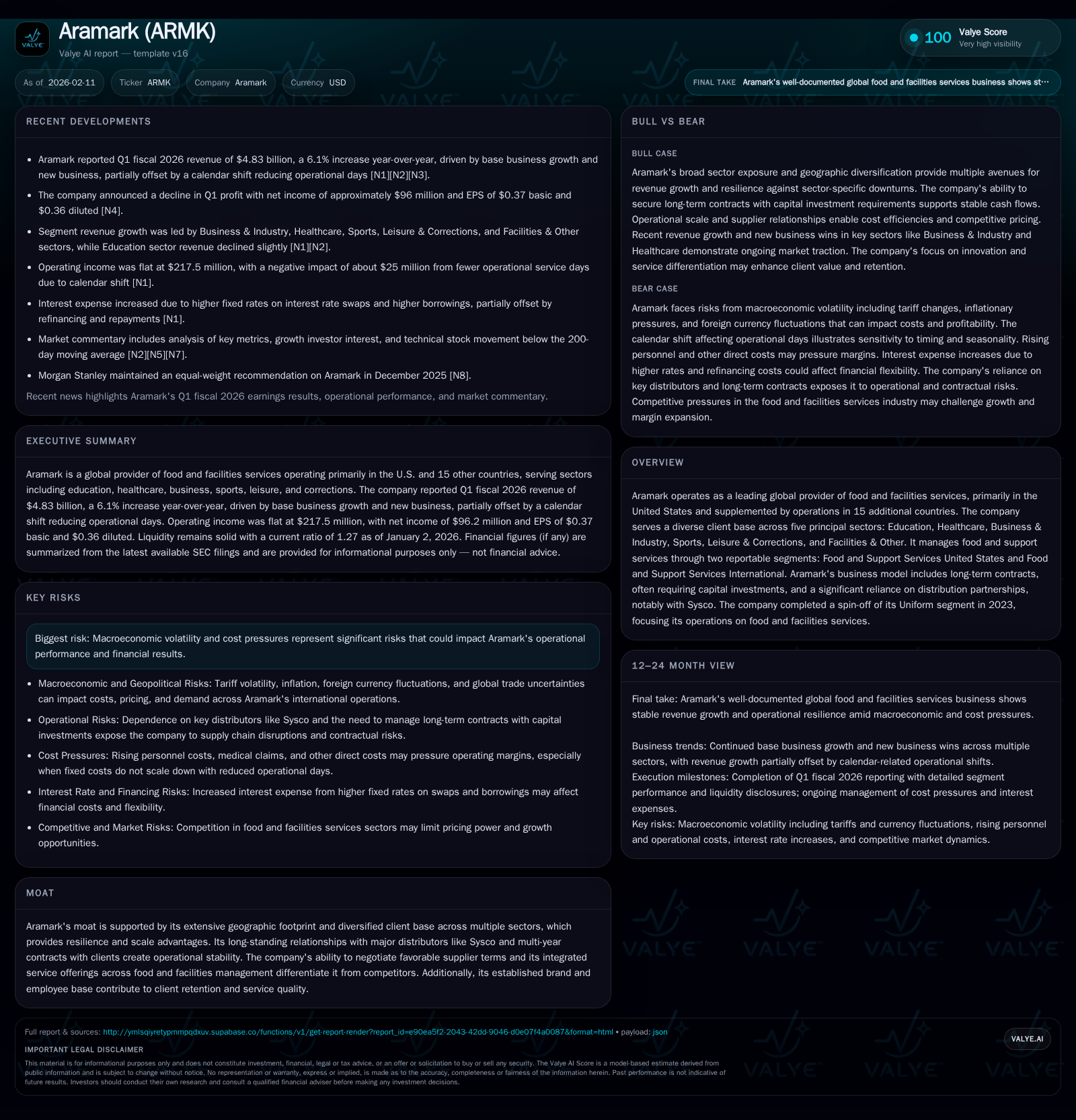
Following its 2023 spin-off of the Uniform segment, Aramark has sharpened its operational focus exclusively on food and support services across a broad global footprint. Despite encountering margin pressure from inflation and macroeconomic volatility during Q1 FY2026, the company continues to benefit from long-term contracts, diversified client sectors, and strategic supply chain partnerships. While revenues exceeded expectations, profitability faced headwinds, underscoring the challenge of balancing growth and cost control in a complex operating environment.
From Uniforms to Core: The Post-Spin-Off Identity of Aramark
The strategic divestiture of Aramark's Uniform segment on September 30, 2023 marked a pivotal moment in the company's evolution. By spinning off Vestis Corporation as an independent entity via a tax-free distribution to shareholders [S1], Aramark crystallized its business model to concentrate exclusively on food and facilities services — areas where it holds top-tier competitive positions globally. This restructuring not only simplified the corporate structure but also allowed management to dedicate resources towards scaling core operations that span institutional food service and integrated facilities management.
The historical financials for the Uniform division are now presented as discontinued operations [S1], enhancing transparency into the ongoing business performance solely within food and support services. This focus benefits Aramark by enabling more precise strategic investments and operational initiatives targeted at its principal client sectors.
Segment Deep Dive: US vs. International Operations and Sector Breakdown
Aramark operates through two primary reportable segments: Food and Support Services United States (FSS United States) and Food and Support Services International (FSS International) [S1]. The U.S. segment comprises approximately 71% of total revenues ($13.2 billion in FY2025), reflecting deep penetration across major domestic markets. The international segment contributes close to $5.3 billion or nearly 29% of revenue, providing exposure to diverse geographic markets spanning 15 countries.
Client sectors broadly encompass Education, Healthcare, Business & Industry, Sports & Leisure including corrections, plus Facilities & Other specialized services [S1]. Education (K-12 schools and higher education institutions) alongside Healthcare form the backbone with stable, captive client bases delivering predictable volume streams year-round. Meanwhile, Sports & Leisure inject seasonality with demand spikes around events but less consistency. This diversification helps stabilize revenues across market cycles.
No single client exceeds 2% of overall revenue outside government agencies collectively [S1], highlighting a diversified customer base which mitigates dependency risk.
Partnerships & Supply Chain: The Sysco Relationship Amid Inflation
A cornerstone of Aramark’s operational moat remains its longstanding distributor relationships, most notably with Sysco. Such partnerships provide scale leverage essential for negotiating supplier terms amid the inflationary challenges impacting commodity inputs like food ingredients and packaging materials [valye_report_excerpt; S2].
This collaboration is crucial as supply chain disruptions continue globally alongside tariff-induced volatility. Sysco facilitates streamlined logistics and pricing stability enabling Aramark to maintain product availability while implementing tiered pricing strategies tailored across varied service sectors [S2].
Moreover, integrated procurement capabilities allow Aramark not only to reduce input cost escalation impacts but also ensure quality standards necessary for multi-client operations spanning healthcare compliance requirements through leisure venue demands.
Financial Resilience Under Pressure: Earnings Review and Key Metrics
Q1 FY2026 earnings presented a mixed picture. Revenue surpassed analysts’ consensus — underlining robust demand retention — while net income declined markedly to $96 million compared with prior periods [N3; N6; F1]. Margin compression was attributed primarily to elevated inflationary cost inputs compounded by wage inflation amid tight labor markets [N1; S2].
Despite these pressures, liquidity indicators remain solid with cash & equivalents totaling approximately $440 million at quarter-end against current liabilities near $2.9 billion yielding a current ratio around 1.27 [F1]. Working capital management proved critical during historically seasonal Q1 periods characterized by reduced activity in sports/leisure sectors offset partially by steadier educational volumes [S2].
Corporate overheads held relatively stable excluding one-time items reflecting disciplined expense controls balanced against ongoing investment for contract fulfillment.
Navigating Macro Risks: Inflation, Currency Volatility, and Cost Challenges
The broader economic backdrop is laden with uncertainty stemming from tariff policy shifts impacting raw material costs globally alongside fluctuating foreign exchange rates inherent in a multi-country footprint [S2; valye_report_excerpt]. Recent quarters saw heightened volatility especially in currencies affecting purchasing power parity across non-U.S markets.
Tariff unpredictability necessitates agility through dynamic pricing models passed onto clients where contracts permit. Interest rate exposures are actively managed employing swaps ensuring financing cost stability despite rising benchmark rates [S2].
Although cost pressures compress margins short term, management highlights proactive actions including supply chain initiatives focused on efficiency enhancements plus continuous evaluation of pricing frameworks aligned with inflation trends.
Growth Opportunities in Education, Healthcare, and Leisure Sectors
Aramark's entrenched presence across education and healthcare sectors anchors recurring revenue opportunities fueled by large-scale contracts often extending multiple years or more [valye_report_excerpt; S1]. These “captive customer bases” generate consistent foot traffic encompassing students in schools/universities plus patients in senior care facilities ensuring steady dining service volumes.
Meanwhile, the leisure sector offers growth potential albeit with higher volatility given dependence on event schedules within sports venues and entertainment complexes [S2]. Expansion efforts leverage cross-selling integrated facility services enhancing value proposition.
Strategic emphasis on tailoring service portfolios according to sector-specific needs enhances customer retention prospects amid competitive landscapes fostering incremental market share gains domestically and internationally.
Capital Structure and Cash Flow: Assessing Liquidity and Investment
The balance sheet exhibits resilience underpinned by healthy liquidity cushions supporting capital outlays linked to contract fulfillment obligations requiring upfront investments in physical plant operations or technology upgrades [F1; S2]. The $440 million cash position relative to near-term liabilities affords operational flexibility during cyclical downturns.
Seasonal cash flow patterns reflect customary Q1 usage attributed partly to incentive payouts contrasted by robust inflows seen towards year-end coinciding with academic cycles in higher education sectors [S2]. Financing arrangements include risk-mitigated instruments buffering interest fluctuations ensuring sustainable servicing capacity.
These financial fundamentals enhance capability for selective acquisitions or reinvestment programs prioritizing long-term value creation aligned with core competencies.
Market Sentiment and Share Price Dynamics Since the Spin-off
Post spin-off investor sentiment has been cautious amidst earnings variability evidenced by a recent break below technical supports such as the 200-day moving average—a notable signal reviewed extensively in market commentary over recent weeks [N8; N5].
Volatility leading into quarterly results reflected concerns regarding margin pressures juxtaposed against resilient revenue generation potential [N7]. Media narratives highlighted both growth prospects tied to sector diversity alongside macroeconomic headwinds tempering enthusiasm.
Investor appetite appears calibrated toward monitoring execution discipline moving forward especially managing inflation impact while sustaining organic expansion domestically balanced against international dynamics.
Looking Ahead: Strategic Priorities and Risk Mitigation
Management’s latest commentary underscores commitment toward navigating persistent inflation/cost challenges via enhanced operational efficiencies coupled with leveraging scale advantages inherent in serving thousands of clients globally [N1; valye_report_excerpt].
Focus remains firmly planted on fortifying client relationships through service excellence while pursuing prudent pricing adjustments aligned with contractual frameworks accommodating economic shifts.
Risk mitigation embraces continued hedging for interest rates combined with agile supply chain strategies structured to absorb tariff shocks wherever possible without sacrificing service quality or market competitiveness.
As fiscal conditions evolve, careful balancing between sustaining growth momentum in stable sectors like education/healthcare versus opportunistic expansion within leisure arenas will shape medium-term trajectory.
This analysis is based on information publicly available as of early February 2026 including SEC filings and market reports but does not incorporate non-public data. Forward-looking statements referenced should be considered within disclosed risk factors without inferring guarantees about future results or performance.
Disclaimer: This is research-only, informational analysis and not investment advice. It may include AI-generated interpretation and general industry context. Always verify important details using primary sources.

Comments