
Booz Allen Hamilton Advances With AI and Government Contract Strategy
Recent quarterly updates highlight Booz Allen’s growing AI integration alongside resilient government contract execution amid regulatory scrutiny.
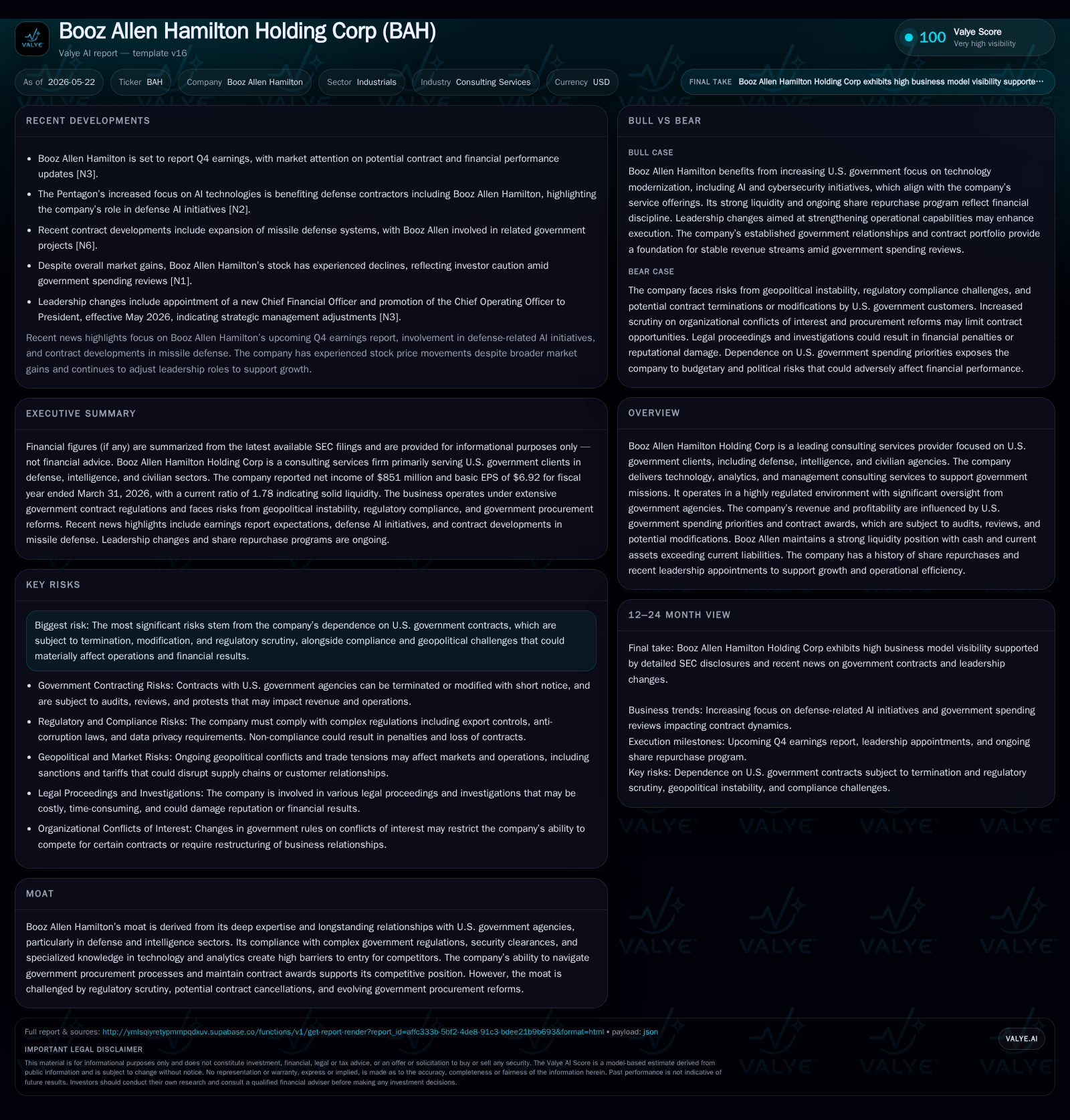
In its latest quarter ending December 2025, Booz Allen Hamilton reinforced its position as a premier consulting partner for U.S. government agencies, reporting stable contract backlog and ongoing share repurchases. The firm is increasingly embedding AI technologies across its service lines to meet evolving defense and intelligence demands. While its deep government ties and compliance expertise underpin a durable competitive moat, Booz Allen faces risks from audit exposures, cybersecurity threats, and geopolitical uncertainties. Its liquidity remains strong with a current ratio near 1.78, supporting operational resilience as it pursues growth in technology-driven consulting services.
Latest Quarterly Operating Update Highlights
Booz Allen Hamilton's quarter ended December 31, 2025, disclosed in the January 2026 10-Q [S2], presents a steady operational foundation. The company reported no material changes in risk factors or internal controls over financial reporting during the quarter. Share repurchases remained active with over 1.3 million shares purchased at average prices between $86 and $101 per share across the quarter [S2]. Importantly, ongoing contract backlog levels provide revenue visibility with both funded and unfunded components underpinning the firm's pipeline. Management reaffirmed fiscal year guidance despite a modest contract cancellation by the U.S. Treasury expected to impact less than 1% of revenue through March 2027 [S20]. These factors collectively affirm Booz Allen's steady state as a trusted government consulting partner.
Business Model Overview: Navigating Government Consulting and Tech Integration
Booz Allen generates revenue primarily through providing technology-enabled consulting services to U.S. government clients spanning defense, intelligence, and civilian agencies [S1]. Contracts primarily take the form of time-and-materials and cost-reimbursable-plus-fee agreements where revenue recognition follows the transfer of control of services rendered. Variable consideration often hinges on award fees tied to milestone or performance-based criteria [S1]. This model offers a blend of predictability from backlog while allowing upside through incentives.
Service offerings extend across management consulting, systems integration, cybersecurity solutions, advanced analytics, and increasingly AI-powered capabilities [S1]. Booz Allen differentiates itself through deep technical expertise combined with the ability to comply rigorously with contracting rules governing classified or sensitive environments. By supporting mission-critical operations involving classified data and complex IT infrastructure under strict regulatory oversight, the firm embeds significant switching costs creating client retention durability.
Competitive Moat and Industry Positioning Within U.S. Government Services
The company’s competitive moat centers on longstanding relationships with top-tier U.S. government agencies coupled with necessary security clearances enabling access to classified contracts [S1]. Navigating federal procurement cycles requires not only technical capability but proven compliance with strict regulatory frameworks—areas where Booz Allen demonstrates leadership relative to peers.
The hurdle for new entrants remains high due to security clearance requirements, specialized talent pools familiar with government mission imperatives, and the intricacies of bidding on complex defense contracts [S1][S3]. However, this moat is balanced against regulatory scrutiny risks; ongoing audits by bodies such as the Defense Contract Audit Agency (DCAA) add pressure to maintain impeccable financial and operational controls.
AI Adoption and Technology Innovation as Growth Catalysts
Reflecting broader defense sector trends highlighted in recent industry news [N9], Booz Allen has escalated investments in artificial intelligence encompassing agentic systems capable of autonomous decision-making as well as adversarial AI technologies designed to enhance threat detection capabilities [S1]. The company's disclosures emphasize substantial resource allocation to AI technology development and governance framework implementation given the sensitive nature of these applications.
This push aligns strategically with Pentagon initiatives prioritizing AI-enhanced cyber defense and battlefield analytics. Embedding AI not only enriches service offerings but also drives improved margins through higher-value contract awards tied to cutting-edge technology deployment—a competitive differentiator within digital transformation efforts in government services [N11].
Regulatory Environment and Contract Compliance Risks
The highly regulated nature of Booz Allen's business exposes it to continuous audit cycles focused on procurement integrity, labor time reporting accuracy, cybersecurity compliance, and other contractual obligations [S1][S2]. Failure or delays in addressing audit findings could adversely affect revenue recognition especially linked to variable incentive fees.
Cybersecurity threats pose an elevated risk given the firm's role in managing classified information systems vulnerable to advanced persistent threats including those augmented by malicious AI actors [S1]. Breaches could have material reputational impacts potentially restricting future contract eligibility or incurring remediation costs. As such, governance around AI deployment extends beyond innovation to encompass risk mitigation protocols.
Geopolitical and Security Risk Factors Affecting Business Stability
Global conflict dynamics including ongoing crises in Eastern Europe and Middle East directly influence U.S. defense priorities that drive demand for Booz Allen's services [S1]. Heightened military engagements typically elevate funding for intelligence support analytic services where Booz Allen is positioned.
However, geopolitical unpredictability also introduces volatility into project scopes or export controls which can constrain opportunity sets or delay procurement processes impacting near-term revenue growth trajectories.
Outlook and Key Execution Milestones To Watch
Key near-to-mid term indicators include updates on backlog composition reflecting awarded contracts particularly those emphasizing AI-enabled solutions [S2][S3]. Progress on resolving any outstanding audit reviews will be important for minimizing clawbacks or contract modifications affecting variable fee income.
Monitoring leadership transitions such as recent appointments reported effective May 2026 signal management focus on growth areas including civil sector expansion while maintaining operational discipline [S25][S26]. Continued activity under the share repurchase program highlights confidence in free cash flow generation sustaining capital return strategies.
Summary Financial Profile
Booz Allen finished fiscal year ended March 31, 2026 with operating income approximately $1.03 billion and net income around $851 million indicating robust profitability supported by diversified federal client base and premium technological offerings [F1][S3]. The balance sheet remains liquid with cash & equivalents near $728 million against current liabilities of about $1.66 billion yielding a current ratio around 1.78—comfortably above critical thresholds facilitating working capital needs [F1]. Net debt is estimated at roughly $1.65 billion underscoring manageable leverage levels consistent with investment-grade profiles.
Overall financials underpin operational resilience allowing continued investment into transformative technologies such as AI while absorbing sector-specific headwinds associated with contract cycle complexities.
This analysis synthesizes Booz Allen Hamilton’s latest quarterly disclosures with its strategic positioning within government consulting emphasizing AI integration as a key growth vector amid complex regulatory requirements. It reflects purely factual reporting derived from SEC filings and does not constitute any investment advice or research view.
Disclaimer: This is research-only, informational analysis and not investment advice. It may include AI-generated interpretation and general industry context. Always verify important details using primary sources.

Comments