
BancFirst Posts 11% Net Income Growth Backed by Local Market Strength and Acquisitions
Oklahoma-focused BancFirst offsets regulatory fee pressures and economic risks with diversified income streams, controlled costs, and robust liquidity in 2025.
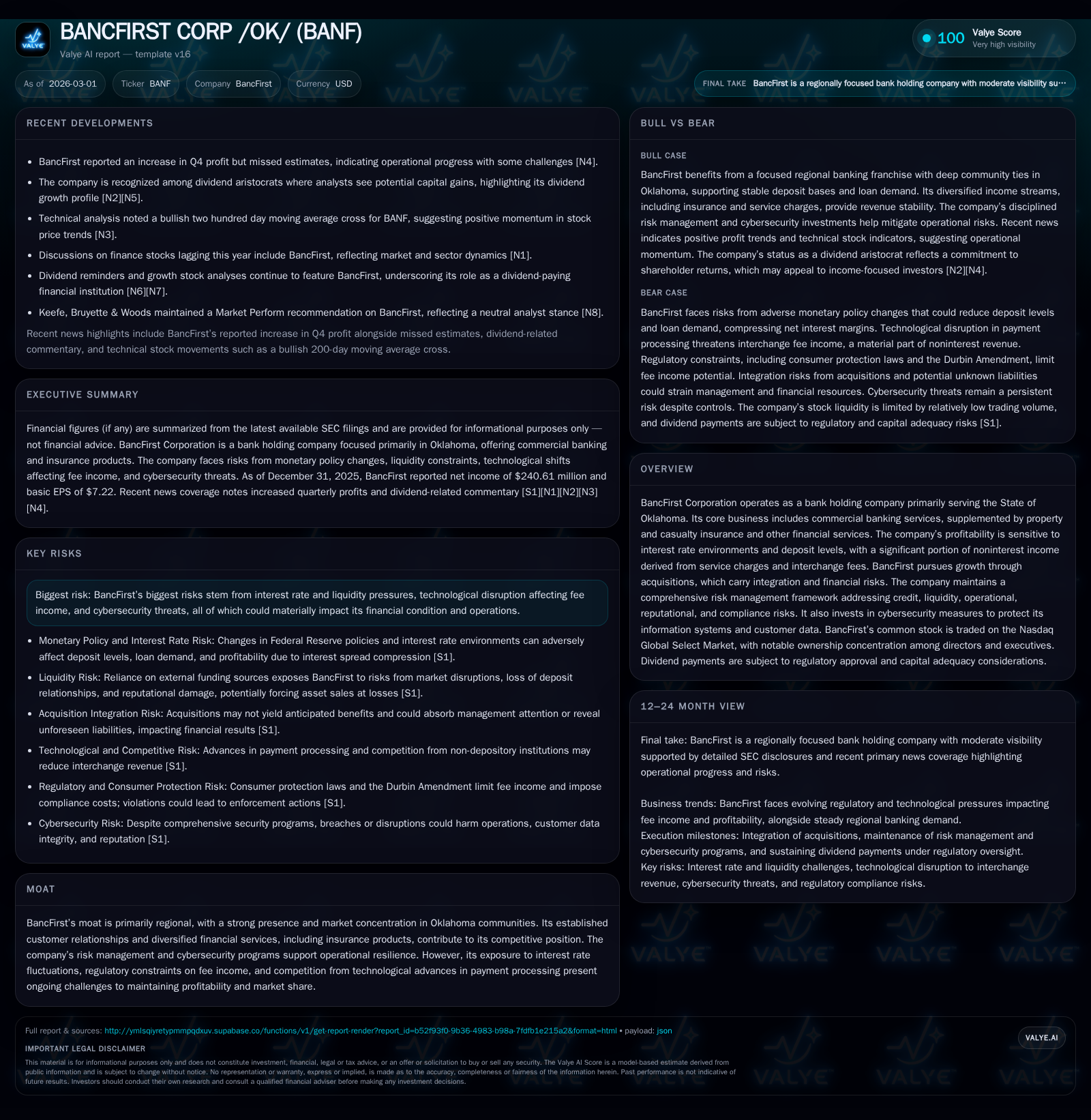
BancFirst Corporation, a bank holding company focused on Oklahoma, has delivered consistent net income growth driven by an expanding loan portfolio and controlled operating costs. Its regional moat is supported by deep community ties and diversified noninterest income streams, including insurance services. However, future growth faces constraints from regulatory limitations on interchange fees, interest rate volatility, and technological disruption in payment processing. The bank’s capital base and liquidity remain solid, with prudent acquisition activity adding scale but introducing integration risks. Monitoring regulatory developments, especially around consumer fees and the Durbin Amendment, alongside economic conditions in Oklahoma's energy sector, will be key to assessing BancFirst's medium-term trajectory.
BancFirst Overview and Market Position
BancFirst Corporation primarily serves communities within Oklahoma as a regional bank holding company. It offers commercial banking services accompanied by property and casualty insurance along with other financial products [S1][S5]. This localized focus confers a moat rooted in established customer relationships bolstered by diversified services that extend beyond traditional banking. The company trades on Nasdaq Global Select Market under ticker BANF [S3].
Historical Performance
BancFirst’s financial results demonstrate steady growth across recent years supported by effective operational management and strategic acquisitions [F1]. Key financial highlights for the last four fiscal years are summarized below:
Historical performance (annual)
| FY | Net ($mm) | CFO ($mm) | Capex ($mm) | Net YoY |
|---|---|---|---|---|
| 2025 | 241 | 285 | 48 | +11.2% |
| 2024 | 216 | 261 | 37 | +1.8% |
| 2023 | 212 | 233 | 23 | +10.0% |
| 2022 | 193 | 226 | 20 |
Source: SEC companyfacts cache [F1].
Capital returns and efficiency (annual)
| FY | Buybacks ($mm) | FCF ($mm) | ROE% |
|---|---|---|---|
| 2025 | 2 | 237 | 13.0 |
| 2024 | 2 | 225 | 13.3 |
| 2023 | 2 | 211 | 14.8 |
| 2022 | 12 | 206 | 15.4 |
Source: SEC companyfacts cache [F1].
Net income expanded approximately 11.2% from $216 million in FY24 to $241 million in FY25 [F1]. Operating cash flow increased by over 9%, supporting strong free cash flow estimated at roughly $237 million after capital expenditures in FY25 [F1]. Capital investments nearly doubled between FY23 and FY25 as BancFirst enhanced infrastructure and technology platforms [F1].
Equity growth reflects retained earnings combined with conservative capital management strategies. The trailing return on equity (ROE) of about 13% indicates efficient use of shareholder capital [F1]. The buyback program remains modest relative to equity expansion.
Growth Drivers and Constraints
Growth Drivers
- Organic Expansion and Acquisitions: BancFirst pursues growth through expanding its core Oklahoma markets alongside targeted acquisitions of smaller banks or financial entities aimed at increasing scale and market share [S1][S9].
- Diversified Revenue Streams: Besides commercial banking services BancFirst generates noninterest income from property & casualty insurance products and service charges which help stabilize revenue [S5].
- Digital Banking Initiatives: Investments in digital platforms seek to enhance customer engagement and support future growth.
Growth Constraints
- Interest Rate Sensitivity: Earnings depend heavily on net interest margin influenced by Federal Reserve policies affecting loan and deposit rates; prolonged low or volatile rates can compress margins [S1][S13][S18].
- Regulatory Pressure on Fee Income: Debit card interchange fees comprise a material portion of noninterest income but face caps under the Durbin Amendment; recent Federal Reserve proposals could reduce permissible fees further [S4][S14][S22]. Consumer protection laws may also constrain overdraft and NSF fees which represented approximately 15.8% of noninterest income in recent periods [S4][S5][S22].
- Technological Disruption: Emerging fintech solutions and payment innovations threaten traditional fee-based revenues necessitating ongoing investments [S22].
- Regional Economic Concentration: The company's loan portfolio is concentrated primarily in Oklahoma with significant exposure to commercial real estate (
71%) and energy sectors (6%), making it sensitive to local economic cycles and commodity price volatility [S12][S25][S26]. - Acquisition Risks: Integration challenges or unforeseen liabilities associated with acquisitions may affect near-term results [S1][S9].
- Cybersecurity Threats: Increasing cyber risks require continuous investment in security controls amid evolving threats [S16][S24].
Future Expectations and Milestones
While explicit forward guidance is limited in filings up to early 2026 [S3], BancFirst emphasizes monitoring regulatory developments such as enhanced CFPB rules on consumer data transparency anticipated post-2024 [S11] alongside Federal Reserve proposals impacting debit interchange fees [S1][S4]. Executive changes in accounting leadership indicate ongoing governance enhancements [S3].
Monetary policy shifts will continue influencing deposit costs and loan demand dynamics [S18], while successful execution of acquisitions without disrupting operations remains critical.
Emerging technologies including artificial intelligence present nascent opportunities coupled with compliance challenges affecting operational risk profiles going forward [S15].
Capital Allocation and Returns
BancFirst delivered an approximate ROE of 13% for FY25 reflecting disciplined capital management balanced between dividend payments subject to Federal Reserve oversight and reinvestment into business operations [F1][S16].
Operating cash flows support capital expenditures mainly directed toward technology upgrades while free cash flow remains robust after these investments [F1]. Stock repurchases have been minimal relative to equity growth suggesting retained earnings principally fund balance sheet strength.
Liquidity risks arise from the inherent banking model mismatch between short-term deposits funding longer-term loans; while policies maintain adequate buffers there remains vulnerability during market disruptions or depositor withdrawals that could necessitate asset sales or regulatory intervention if prolonged [S6][S8][S14][S17][S19].
Industry Context and Risk Management Commitment
Community banks like BancFirst face mounting compliance costs due to expanding consumer protection laws enforced by the CFPB which impact overdraft fee revenues—a meaningful component of BancFirst’s noninterest income [S4][S11]. Moreover technological advances enable fintech competitors to capture transaction flows reducing traditional interchange revenue pools.
Interest rate cycles remain a dominant factor for profitability; spread compression during dovish phases erodes margins while rising rates increase funding costs potentially dampening credit demand. BancFirst’s concentration in Oklahoma ties credit performance closely to local economic conditions notably oil/gas price fluctuations distinguishing it from more diversified peers.
The company invests consistently in cybersecurity controls addressing privacy mandates under GLB Act provisions plus third-party vendor risks essential for reliable digital operations [S16][S24]. An enterprise risk-management framework governs credit underwriting standards tailored for environmental liabilities prominent in real estate lending sectors [S14].
Conclusion
BancFirst navigates a complex environment anchored by a strong regional presence complemented by diversified revenue streams spanning banking plus insurance services. Historical performance reflects disciplined management maintaining solid profitability growth feeding equity expansion alongside prudent capital reinvestment.
Key near-term challenges include regulatory pressures constraining fee-based revenues particularly from debit interchange fees and overdraft charges coupled with interest rate uncertainty and acquisition execution risks.
Strategic vigilance around evolving consumer protection regulations offset against entrenched customer relationships positions BancFirst as resilient yet challenged. Digital transformation efforts remain critical not only for growth but survival against fintech competition.
Stakeholders should monitor pending regulatory reforms affecting transaction fees as well as macroeconomic dynamics specific to Oklahoma’s energy sector as bellwethers for credit quality trajectories influencing earnings durability.
This analysis is based solely on disclosed information up to March 2026 without providing investment advice or price forecasts.
Disclaimer: This is research-only, informational analysis and not investment advice. It may include AI-generated interpretation and general industry context. Always verify important details using primary sources.

Comments