
Navigating Bark’s Profitability and Market Challenges Amid Pet Product Sector Shifts
Bark, Inc. continues to leverage brand loyalty in pet subscriptions while addressing operational losses, supply disruptions, and macroeconomic headwinds.
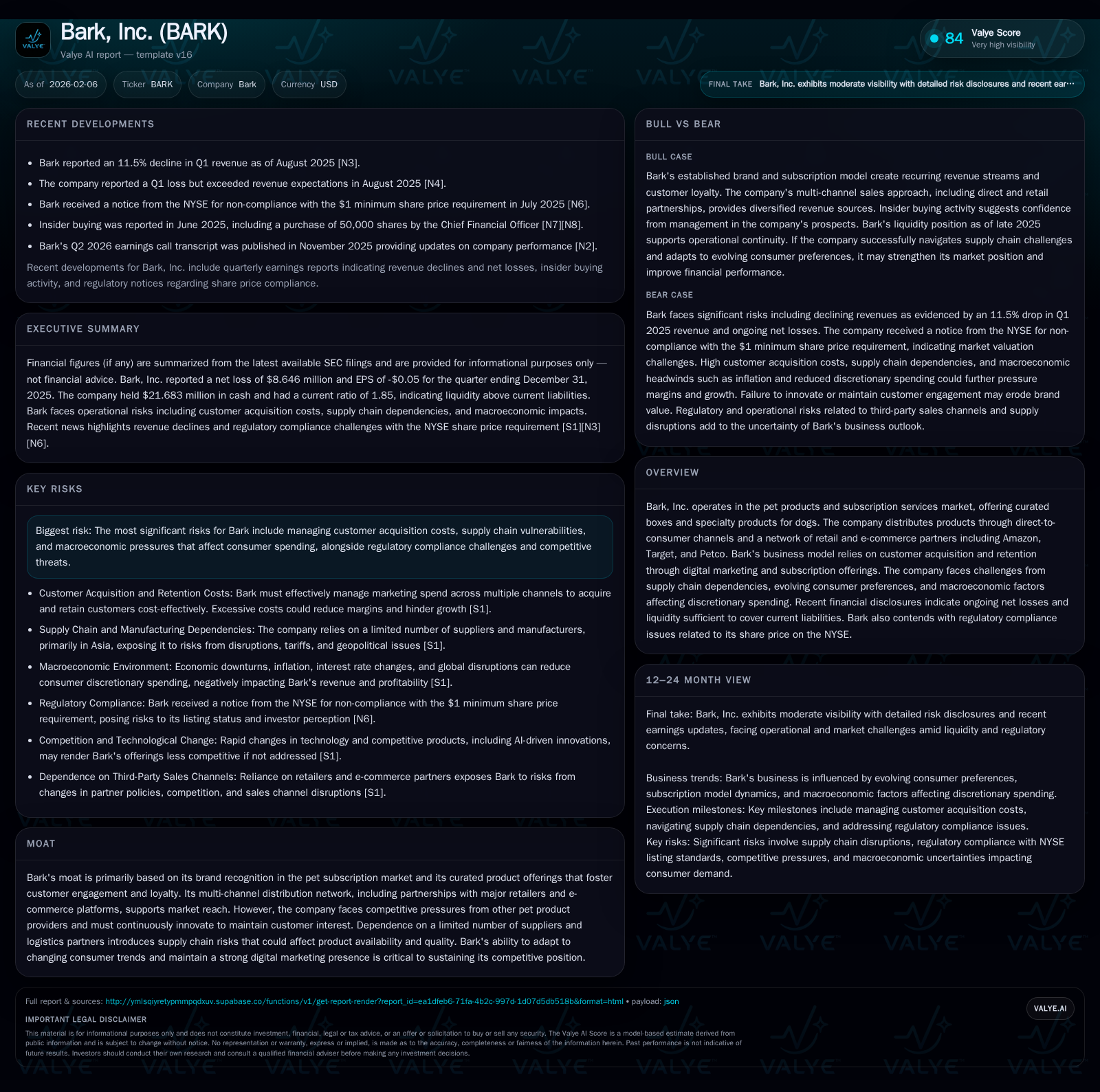
Bark, Inc. has cultivated a strong identity in the evolving pet subscription market, underpinned by recognizable brand and curated offerings. Financially, the company still operates at a loss, with recent quarterly results reflecting a net income deficit of $8.6 million but retaining a solid current liquidity position. Bark faces layered risks spanning supply chain dependencies, elevated customer acquisition costs, shifting consumer preferences influenced by economic pressures, and regulatory challenges associated with its public listing status. A strategic focus on optimizing marketing ROI, mitigating operational vulnerabilities, and deepening multi-channel partnerships will be imperative as Bark charts its path toward sustainable profitability.
From Puppy Love to Profit Challenges: Bark's Brand in Focus
In the intimate world of dog ownership, affection runs deep—a fact Bark, Inc. has harnessed expertly through its curated subscription boxes and specialty products for dogs. This emotionally charged connection between owners and their pets underpins Bark’s brand strength, distinguishing it in a burgeoning yet competitive niche within the pet care ecosystem. The company's appeal hinges on delivering tailored experiences that blend convenience with discovery, fostering loyalty through recurring subscription engagement.
However, this moat is not impervious. Bark operates within a dynamic landscape where direct-to-consumer innovation meets entrenched retail incumbents and myriad specialty competitors. Its partnerships with retail giants—Amazon, Target, Petco—amplify reach but demand constant innovation to maintain relevance across both digital storefronts and brick-and-mortar shelves. Given these factors, Bark’s brand equity is critical but must be actively defended against competitor advances as consumer attention fragmentation intensifies.
Peeling Back the Numbers: Financial Health and Liquidity Insights
A detailed look at Bark's financials reveals the dual narrative of brand promise intertwined with persistent operational headwinds. As of December 31, 2025, the company reported a net loss of $8.64 million [F1], illustrating ongoing challenges in achieving profitability despite notable sales initiatives. Yet liquidity appears adequate for near-term obligations with cash and equivalents standing at $21.68 million against current liabilities totaling $74.35 million—yielding a current ratio around 1.85 [F1].
This buffer suggests Bark retains sufficient short-term financial flexibility to execute strategic investments without immediate solvency concerns. Nonetheless, extending runway toward positive operating income will demand disciplined expense management coupled with revenue acceleration—both of which hinge on customer acquisition efficiency and supply chain reliability.
Wagging Through Risks: Supply Chain and Consumer Trends
Bark's exposure to supply chain disruptions reflects a broader industry-wide vulnerability shaped by geopolitical tariffs, labor shortages, and fluctuating shipping rates [S2]. Tariff uncertainties exacerbate input cost volatility; coupled with dependencies on select suppliers for specialty pet products, Bark must carefully navigate these pressures to avoid inventory gaps or quality dilution.
Consumer spending behaviors add complexity; discretionary outlays on premium pet products ebb amid inflationary pressures and economic instability [S2]. Shifts toward value-conscious purchasing can suppress average order values or subscriber counts unless product offerings align tightly with emerging customer priorities.
Marketing Momentum or Monetary Drain? Customer Acquisition Costs Under the Microscope
Customer acquisition remains the financial fulcrum between growth aspirations and margin compression for Bark. The company has committed significant marketing capital to secure new subscribers while attempting to sustain renewals—a delicate balance vital for subscription model health [S2]. Precise allocation across advertising platforms requires constant calibration as digital ad costs fluctuate alongside campaign performance.
Inefficient spend contributes materially to net losses recorded in recent quarters; thus Bark’s ability to refine targeting algorithms and enhance lifetime value metrics through product innovation or personalized engagement strategies constitutes a critical inflection point.
Distribution Dynamics: How Retail Partnerships Shape Bark’s Reach
Distribution forms the backbone of Bark’s go-to-market strategy with omnichannel presence through Amazon, Target, and Petco [F1]. This network facilitates broad consumer touchpoints beyond direct digital channels while leveraging established logistics frameworks.
Yet reliance on prominent retail partners introduces concentration risk—from contractual terms to operational dependencies—that could amplify disruption impact if any single channel falters. Concurrently, scaling fulfillment operations in a cost-effective manner remains essential amid heightened e-commerce expectations for speed and reliability.
Regulatory Red Flags and Public Market Pressures
Bark’s status as an NYSE-listed entity brings attendant regulatory scrutiny tied to share price dynamics [F1][S2]. Compliance challenges may constrain strategic flexibility or elevate administrative burdens during periods of heightened market volatility.
Investor sentiment potentially influenced by stock performance can affect capital raising options crucial for funding growth or restructuring initiatives — compounding internal operational challenges.
Looking Forward: Strategic Imperatives for Sustainable Growth
Synthesizing these insights points toward several pivotal strategic priorities that Bark must address to transition toward durable profitability:
- Technology Integration: Developing a unified platform that harmonizes customer data, order fulfillment, and subscription management to reduce friction and improve scalability [S2].
- Operational Scale-Up: Expanding supplier relationships prudently alongside infrastructural investments to enhance supply chain resilience.
- Cost Rationalization: Refining marketing spend through analytics-driven decisions while optimizing fulfillment costs without sacrificing service quality.
- Talent Retention: Maintaining skilled teams capable of innovating across product development, marketing effectiveness, technology infrastructure.
- Platform Unification: Migration of existing customers onto streamlined user experiences encouraging higher retention rates [S2].
These initiatives reflect pragmatic pathways grounded in disclosed risk factors rather than speculative expansions—aligned tightly with current macroeconomic realities and competitive landscapes.
This analysis is based solely on publicly available information as of February 2026 and does not constitute investment advice.
Disclaimer: This is research-only, informational analysis and not investment advice. It may include AI-generated interpretation and general industry context. Always verify important details using primary sources.

Comments