
BlackBerry Ltd’s Transformation into a Leading Automotive Software Infrastructure Provider
BlackBerry is pivoting from legacy hardware roots toward a specialized software infrastructure business, anchored by its QNX platform and strategic automotive partnerships.
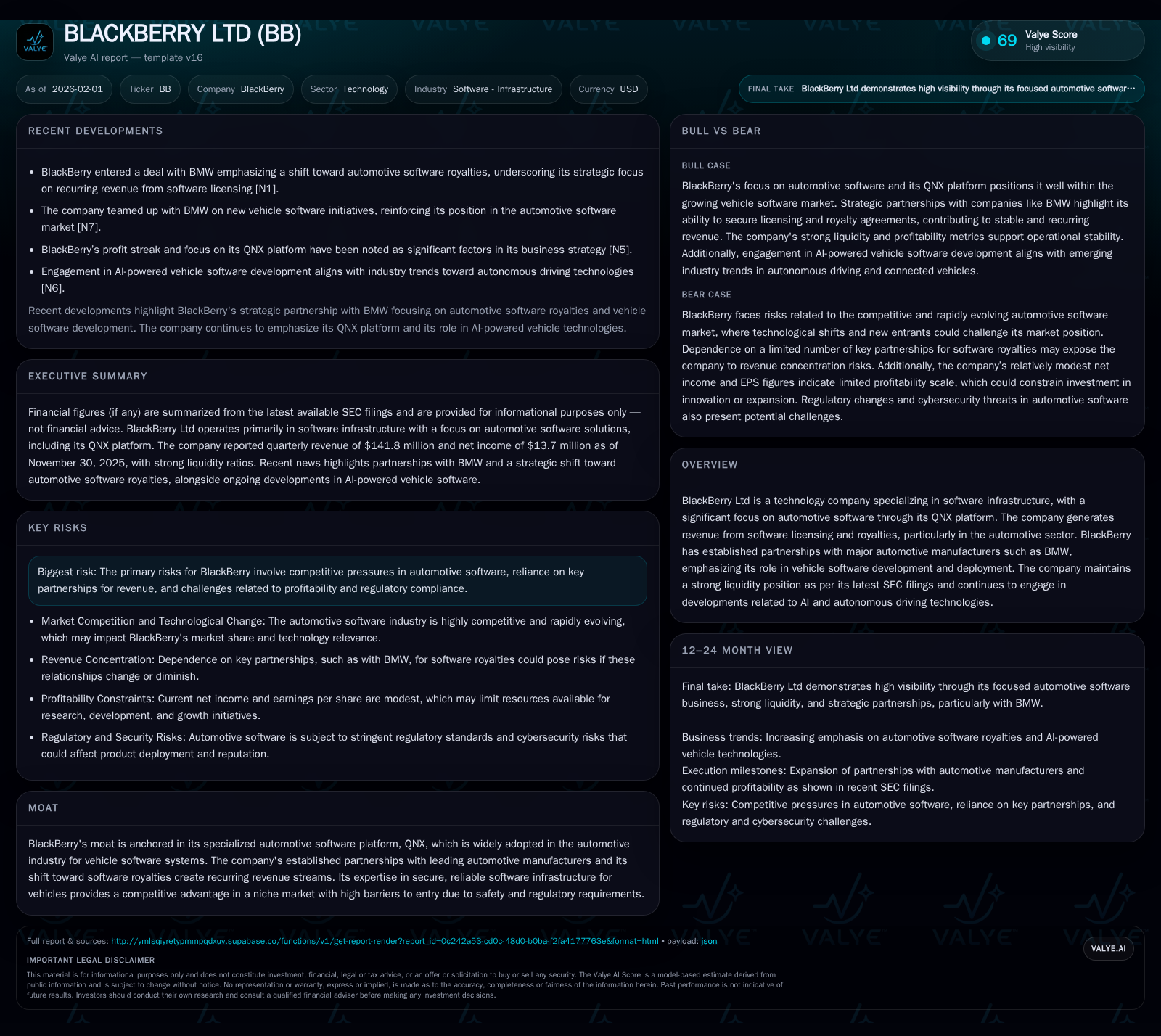
BlackBerry Ltd has solidified its transition from smartphone hardware to software infrastructure, with a focus on automotive systems through its QNX platform. Recent deals, notably with BMW, underscore a shift toward recurring software royalties in the expanding vehicle software market. The company maintains a strong liquidity position, while facing competitive and regulatory challenges inherent in automotive software development. BlackBerry’s moat derives from its entrenched relationships and safety-critical software expertise, positioning it as a niche player in a complex and fragmented industry.
What Changed Recently
In early 2026, BlackBerry Ltd announced a notable expansion of its automotive software business through a new agreement with BMW. This deal highlights BlackBerry’s strategic pivot toward generating software royalties from automotive manufacturers, moving beyond traditional licensing models to a more recurring revenue approach [N4][N5]. The partnership underscores BlackBerry’s focus on its QNX platform, which remains a widely adopted vehicle software foundation. Concurrently, market commentary has recognized BlackBerry’s growing profit streak linked to this shift, suggesting potential for improved financial performance driven by software infrastructure rather than legacy hardware [N8].
This period also coincides with broader industry interest in AI-powered automotive technologies, as exemplified by Elon Musk’s recent statements on AI-driven autonomous vehicles that do not require hardware upgrades [N9]. While not directly linked to BlackBerry, the technological backdrop intensifies competitive dynamics around software platforms like QNX, which need to support evolving autonomous and connected vehicle requirements.
Business Model as a System
BlackBerry’s business model is centered on its QNX software platform, a real-time operating system (RTOS) that powers critical vehicle systems. The company generates revenue primarily through software licensing fees and royalties tied to the deployment of QNX in vehicles manufactured by original equipment manufacturers (OEMs) such as BMW [N4]. This software infrastructure is embedded deeply within automotive electronic control units (ECUs), infotainment systems, and increasingly in advanced driver-assistance systems (ADAS).
The software licensing model is complemented by maintenance and support services, although licensing and royalties form the bulk of revenue. BlackBerry’s model benefits from a high degree of recurring revenue, as OEMs typically integrate QNX software across multiple vehicle platforms and generations. This creates revenue visibility and operating leverage once initial development costs are absorbed.
The company’s financials, based on the latest SEC filings, show revenue of approximately $142 million for the quarter ending November 2025, with net income of $13.7 million, indicating modest but positive profitability [S3]. Current assets significantly outweigh current liabilities, with a current ratio of 2.14, supported by $270 million in cash and equivalents, providing liquidity to invest in growth initiatives and cushion against cyclical volatility.
Underlying the business model is BlackBerry’s expertise in secure, reliable software development for safety-critical applications. The automotive industry’s stringent regulatory environment and functional safety standards (ISO 26262) create high barriers to entry, reinforcing the durability of BlackBerry’s competitive positioning.
Industry Map & Competitive Battlefield
BlackBerry operates within the automotive software infrastructure industry, a niche segment of the broader automotive technology ecosystem. The competitive landscape comprises legacy RTOS providers, large semiconductor companies with integrated software solutions, and emerging software platform entrants backed by tech giants.
Key competitors include companies like Green Hills Software, Wind River (acquired by Intel), and QNX’s former sibling platforms within the embedded systems space. Additionally, Tier 1 automotive suppliers such as Continental and Bosch are developing proprietary software stacks, while newer entrants like Tesla and Waymo focus on in-house software development for autonomous driving.
A critical competitive advantage for BlackBerry lies in its entrenched OEM relationships and the safety certifications of QNX. Automotive manufacturers are highly risk-averse regarding software platforms due to safety implications, making certified and proven platforms like QNX preferred choices. However, the rise of AI and autonomous driving introduces new competitive pressures, as OEMs explore integrating AI frameworks that may require more flexible or cloud-connected software architectures.
The industry is also shaped by a shift from one-time licensing toward software-as-a-service or royalty-based models, reflecting the increasing software content in vehicles. BlackBerry’s recent deal with BMW exemplifies this trend, as automakers seek to align costs with vehicle sales and ongoing software updates.
Where the Economics Become Real
At the unit level, BlackBerry’s economics depend on the per-vehicle licensing fees and royalties associated with QNX deployment. While specific pricing is not publicly disclosed, the software licensing model typically involves upfront fees for platform integration and ongoing royalties tied to each vehicle shipped with QNX software.
The recurring royalty model enhances revenue predictability and margins, as development costs are amortized over large vehicle volumes and software updates. Profitability hinges on maintaining high OEM adoption rates and expanding into new vehicle segments, such as electric vehicles (EVs) and autonomous platforms.
Cost drivers include ongoing R&D investment to keep QNX compliant with evolving safety standards and capabilities, along with sales and support costs to maintain OEM partnerships. BlackBerry’s liquidity position, with over $270 million in cash and a current ratio above 2.0, provides a buffer to fund these investments without immediate financing pressure [S3].
Potential bottlenecks include the pace of OEM adoption for new software features, the complexity of certifying software updates in safety-critical environments, and competition that may pressure licensing fees. Additionally, BlackBerry must balance the need for innovation (e.g., AI integration) with the conservative automotive development cycles.
Diligence Questions / Disconfirming Signals
How scalable is the QNX platform to support emerging AI and autonomous vehicle software demands? Does BlackBerry have a clear roadmap for integrating AI capabilities while maintaining safety certifications?
What is the concentration risk related to key OEM partners such as BMW? How diversified is BlackBerry’s automotive customer base, and what portion of revenue depends on a handful of contracts?
How sustainable and sticky are the recurring royalty streams? Are there contractual protections or minimum commitments that ensure revenue visibility?
What are the implications of evolving regulatory standards on BlackBerry’s development costs and time-to-market?
How exposed is BlackBerry to competitive pressures from larger technology firms entering automotive software, potentially leveraging cloud or AI technology stacks?
Given modest current profitability, what leverage exists for margin expansion as software revenues grow? What is the company's path to healthier operating margins?
Are there any risks from legacy businesses or hardware dependencies that could distract management or consume capital?
How does BlackBerry manage intellectual property and cybersecurity risks, considering the increasing threat landscape in connected vehicles?
This analysis synthesizes publicly available news and financial disclosures to provide an overview of BlackBerry Ltd’s strategic positioning and operational context. It does not constitute investment advice and reflects information as of February 2026. Future developments and undisclosed information could materially affect the company’s prospects.
Disclaimer: This is research-only, informational analysis and not investment advice. It may include AI-generated interpretation and general industry context. Always verify important details using primary sources.

Comments