
BigBear.ai Holdings Inc: Navigating AI Innovation in Defense and Regulated Sectors
BigBear.ai evolves through targeted acquisitions and strategic partnerships to deliver AI-driven solutions tailored for government and commercial clients operating under stringent security requirements.
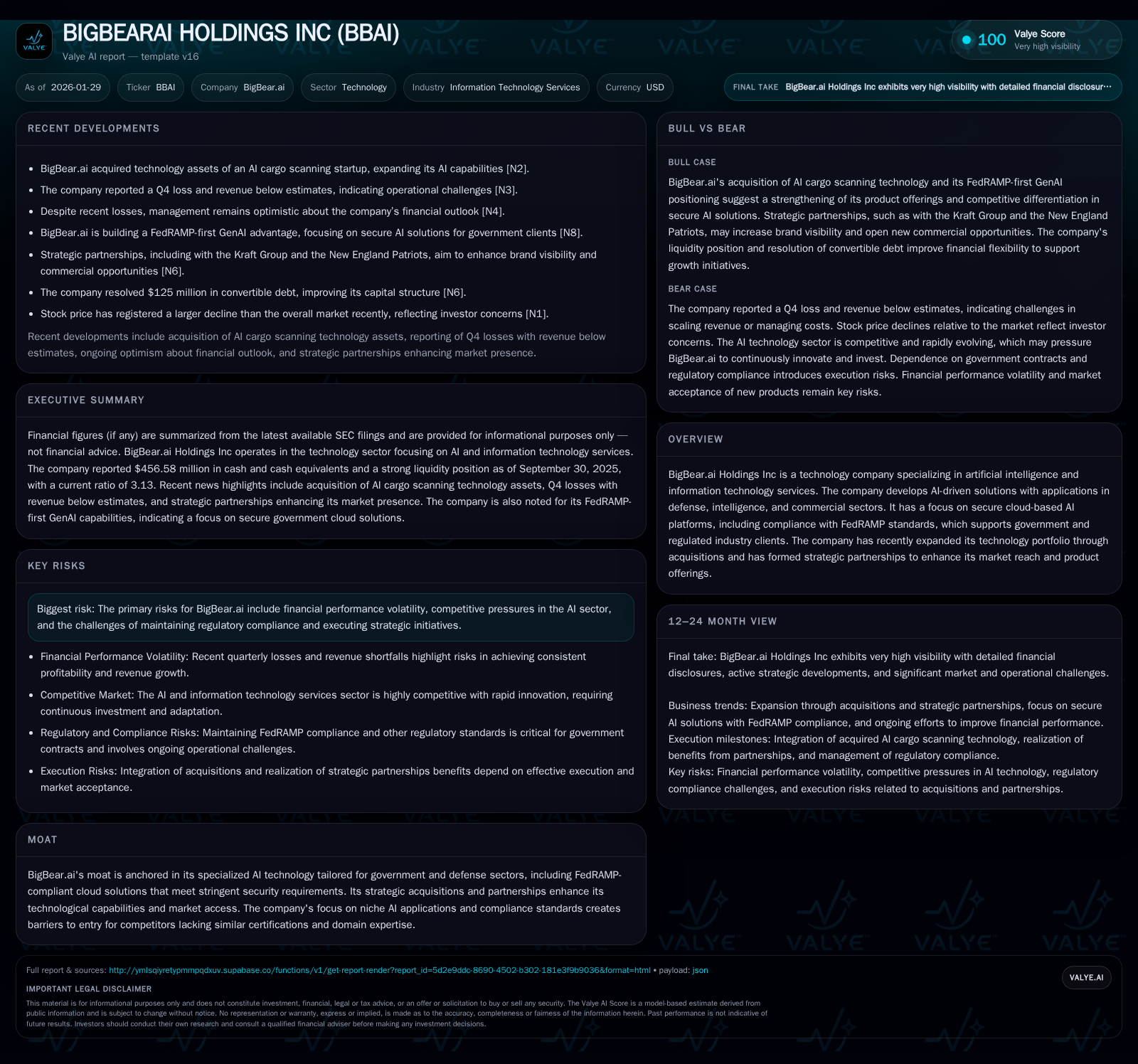
BigBear.ai Holdings Inc operates at the intersection of AI technology and government-grade security compliance, focusing on defense, intelligence, and regulated commercial sectors. Recent acquisitions and partnerships aim to broaden its technology portfolio and market reach amid a challenging revenue environment. The company’s competitive moat centers on FedRAMP-compliant cloud platforms, specialized AI applications, and domain expertise that create significant barriers to entry. However, financial volatility, competitive pressures, and regulatory complexities remain key considerations.
What Changed Recently
BigBear.ai Holdings Inc has navigated a mixed quarter ending Q4 2025, reporting a net loss that missed revenue expectations, signaling operational pressures despite a strong cash position [N1]. On January 29, 2026, BigBear.ai announced the acquisition of AI technology assets from a startup specializing in cargo scanning, a move intended to broaden its commercial AI capabilities beyond the core defense and intelligence domains [N5]. Concurrently, the company disclosed a strategic partnership with the Kraft Group, a diversified holding company, aiming to accelerate market penetration and leverage AI solutions across new verticals [N3]. These developments underscore an active corporate strategy focused on inorganic growth and ecosystem expansion.
However, market reaction has been cautious, with shares falling more than the broader market on the back of earnings news and ongoing legal scrutiny from investor lawsuits regarding public disclosures [N4][N14]. Analysts remain divided on the company’s near-term outlook, reflecting uncertainty over revenue ramp and profitability trajectories [N6][N10].
Business Model as a System
BigBear.ai operates a technology-driven business model centered on developing and delivering artificial intelligence software platforms predominantly to U.S. government agencies and commercial clients operating in highly regulated environments [S1]. The company’s core product suite includes AI-powered data analytics, predictive modeling, cyber defense, and autonomous decision-making tools, all deployed on secure cloud infrastructure that complies with FedRAMP standards—an essential certification for servicing federal contracts [S1].
Revenue is generated through a mix of fixed-price and cost-plus government contracts, subscription-based cloud services, and professional services related to AI system integration and customization. The sales cycle is typically long and complex, influenced by federal procurement processes and regulatory compliance hurdles. Customers span defense, intelligence, homeland security, and regulated commercial sectors such as critical infrastructure and transportation.
BigBear.ai’s operational system integrates proprietary AI algorithms with cloud deployment optimized for security and scalability. The company invests heavily in R&D to maintain technological differentiation and pursues acquisitions to fill capability gaps or access new markets, as illustrated by the recent cargo scanning tech acquisition [N5]. This acquisition complements its existing portfolio by adding specialized AI applications for cargo and logistics, potentially opening commercial avenues beyond government contracts.
Industry Map & Competitive Battlefield
The AI technology landscape serving government and regulated industries is intensely competitive and comprises large defense contractors (e.g., Lockheed Martin, Raytheon), established IT services firms (e.g., Palantir Technologies, Booz Allen Hamilton), and emerging AI platform providers. BigBear.ai’s competitive differentiation lies in its FedRAMP-compliant cloud AI platforms and domain-specific AI expertise tailored for defense and intelligence missions.
FedRAMP compliance acts as a significant market barrier, as many AI startups lack the resources or expertise to achieve this certification, which is mandatory for federal cloud service providers. This compliance enables BigBear.ai to bid on a wide array of government contracts and positions it favorably against non-compliant competitors [N11].
The company’s partnerships, such as with the Kraft Group, suggest a strategic intent to diversify beyond entrenched government segments into regulated commercial sectors where AI adoption is growing but security compliance remains critical [N3]. However, this expansion pits BigBear.ai against commercial AI vendors who may have faster innovation cycles but less certification rigor.
Industry trends include rising government budgets for AI and cybersecurity, growing demand for explainable AI in defense applications, and an increasing emphasis on AI ethics and data privacy. These factors favor companies that can demonstrate trustworthiness and compliance, areas where BigBear.ai aims to excel.
Where the Economics Become Real
BigBear.ai’s unit economics are shaped by contract structure, platform scalability, and customer concentration. Government contracts often involve long sales cycles, upfront investments in compliance and customization, and delayed revenue recognition, which can pressure near-term cash flow despite eventual profitability.
The company’s cloud AI platforms offer recurring revenue potential through subscriptions and usage fees, which if scaled, can improve gross margins substantially compared to professional services. However, the pace of cloud adoption in government and regulated sectors tends to be slower due to security reviews and integration complexities.
Cost structure includes significant R&D expenses to sustain technological leadership, SG&A related to federal sales and compliance, and integration costs from acquisitions. The acquisition of AI cargo scanning assets adds incremental technology development and potential new commercial revenues, though integration risks remain.
Financially, BigBear.ai held $457 million in cash and equivalents as of September 2025, coupled with a strong current ratio of 3.13, indicating solid liquidity to fund ongoing operations and strategic initiatives [S12]. Yet, the recent Q4 loss and revenue miss reflect challenges in scaling contract wins and converting pipeline into recognized revenue [N1].
Margins and cash flow will ultimately depend on the company’s ability to balance investment in growth and compliance with operational efficiency, particularly as it expands into commercial markets that may have different procurement dynamics.
Diligence Questions / Disconfirming Signals
- How effectively is BigBear.ai integrating recent acquisitions, particularly the cargo scanning technology, both culturally and technically? Are there signs of execution delays or cost overruns?
- What is the visibility and health of the government contract pipeline, especially given the company's Q4 revenue miss? Are contract awards accelerating or facing headwinds?
- Can BigBear.ai sustain its FedRAMP compliance and other security certifications at scale, especially as it expands cloud-based offerings?
- How differentiated are the company’s AI algorithms and platforms compared to larger incumbents and emerging AI startups without FedRAMP constraints?
- To what extent does customer concentration pose a risk, and how diversified is the revenue base across defense, intelligence, and commercial sectors?
- What are the implications of the ongoing investor legal investigations on management focus, capital allocation, and disclosure practices [N14]?
- How does the partnership with the Kraft Group translate into concrete commercial opportunities? Is this a pathway to meaningful revenue diversification or primarily a strategic collaboration?
- What are the unit economics for commercial clients compared to government contracts? Are margins and sales cycles materially different?
- Does the company have sufficient R&D spend to maintain technological leadership, and how is this balanced against financial discipline?
BigBear.ai operates within a complex ecosystem where AI innovation meets stringent regulatory and security demands. Its focus on FedRAMP-compliant platforms and specialized AI solutions positions it as a niche player with differentiated capabilities. Yet, the path to sustainable growth is nuanced, requiring successful integration of acquisitions, execution against government contracts, and credible commercial expansion. Investors and stakeholders would be well served to monitor the company’s operational execution, contract wins, and regulatory compliance rigor, alongside evolving market dynamics.
This analysis is based solely on publicly available information as of January 29, 2026, and does not constitute investment advice.
Disclaimer: This is research-only, informational analysis and not investment advice. It may include AI-generated interpretation and general industry context. Always verify important details using primary sources.

Comments