
BigBear.ai’s Mission-Focused AI Growth Encounters Profitability and Backlog Challenges
BigBear.ai Holdings targets national security and trade sectors with specialized AI but faces ongoing losses despite expanding liquidity.
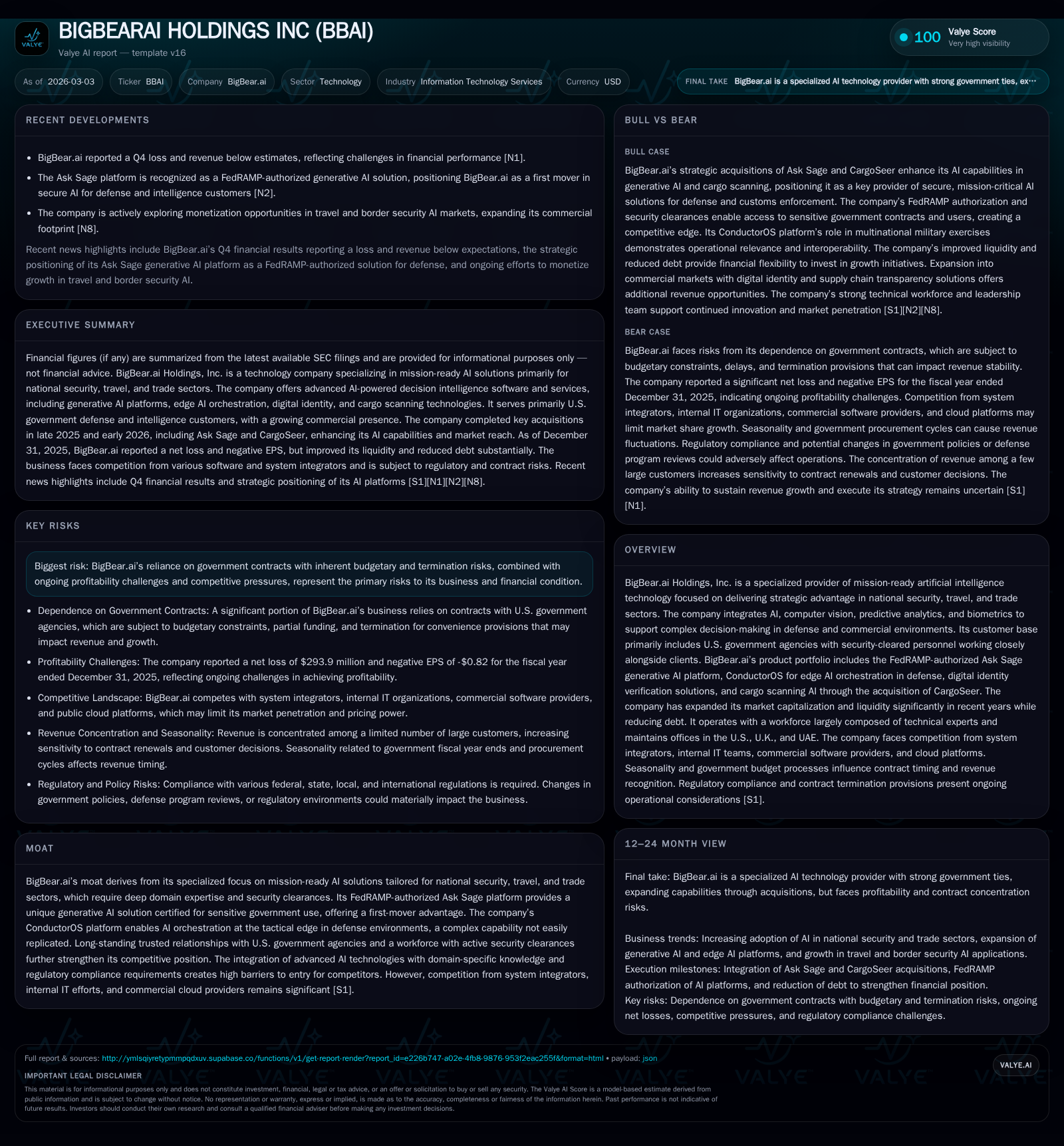
BigBear.ai Holdings Inc. operates a niche artificial intelligence platform aimed primarily at U.S. government national security, travel, and trade customers, leveraging avionics-grade edge AI and generative models like its FedRAMP-authorized Ask Sage. While revenues grow through acquisitions such as Ask Sage, the company has sustained sizeable net losses and negative operating cash flow over recent years, indicating persistent challenges in achieving profitability. Its 2025 backlog shows marked decline, underscoring risks from contract funding and customer concentration. Substantial liquidity raised via ATM programs underpins operations and debt management, but future growth depends on converting unfunded backlog amidst competitive and regulatory pressures.
Business Overview
BigBear.ai Holdings Inc. specializes in mission-ready artificial intelligence solutions focused on national security, trade facilitation, and travel sectors — industries that depend on highly secure, rapid decision-making technologies. The company’s product suite integrates edge AI orchestration (ConductorOS), predictive analytics, computer vision capabilities, biometrics identity verification systems, and a FedRAMP-authorized generative AI platform named Ask Sage. These offerings are primarily targeted at U.S. government customers with active security clearances and select commercial partners involved in complex operational environments.
Founded originally to serve defense needs, BigBear.ai has expanded its technological footprint to span supply chain security and digital identity verification by complementary acquisitions such as Ask Sage (generative AI) and CargoSeer (cargo scanning AI). This expansion aligns with the U.S. government's strategic AI acceleration initiatives prioritizing rapid military deployment of innovative technologies alongside civilian applications [S1, S20].
Historical Performance
Financially, BigBear.ai’s results reveal a consistent pattern of operating losses that have deepened through 2025. The company reported an operating loss of approximately -$214 million for the full year ended December 31, 2025 — down roughly 60% compared to a -$133 million loss in 2024 [F1]. Net losses hovered near -$294 million across both years [F1], indicating stable but significant profitability challenges despite revenue growth driven partly by acquisitions.
Operating cash flow remains negative: -$42 million in 2025 against -$38 million in prior year periods [F1]. Capital expenditures are minimal (~$0.5 million), consistent with BigBear.ai’s software-centric business model; however this leads to continued free cash flow deficits exceeding $42 million annually [F1].
Liquidity improved markedly due to multiple equity issuance programs producing $637 million in gross proceeds through ATM offerings completed during 2025 [S1, S4]. This influx elevated end-of-year available liquidity (cash plus investments) to about $462 million from just over $50 million at the end of 2024 [F1][S4], providing important runway for operational needs and debt servicing.
Historical performance (annual)
| FY | Net ($mm) | CFO ($mm) | OpInc ($mm) | Capex ($) | Net YoY |
|---|---|---|---|---|---|
| 2025 | -294 | -42 | -214 | 525000 | +0.6% |
| 2024 | -296 | -38 | -133 | 484000 | -389.6% |
| 2023 | -60 | -18 | -39 | 2000 | +50.4% |
| 2022 | -122 | -49 | -111 | 769000 |
Source: SEC companyfacts cache [F1].
Capital returns and efficiency (annual)
| FY | Buybacks ($mm) | FCF ($mm) | ROE% |
|---|---|---|---|
| 2025 | -42 | -48.0 | |
| 2024 | 0 | -39 | 7957.6 |
| 2023 | 0 | -18 | 89.7 |
| 2022 | 101 | -50 | 321.3 |
Source: SEC companyfacts cache [F1].
Backlog Trends and Revenue Concentration
BigBear.ai’s backlog as of December 31, 2025 stands at approximately $248 million — a substantial contraction from $418 million a year earlier [S9][F1]. This decline largely reflects material reductions in priced unexercised contract options alongside decreases in unfunded backlog segments [S13]. Given governmental budgets remain subject to appropriation risk and potential termination provisions inherent in many contracts [S7], this backlog adjustment signals uncertainty around near-term revenue visibility.
Revenue concentration is acute: a few large U.S. government entities accounted for over half of total revenue during the year ended December 31, 2025 [S16][S18]. Contractual terms generally permit these customers significant latitude including unilateral termination clauses allowing cancellation with limited penalty exposure to BigBear.ai — increasing volatility risk.
Growth Prospects
Growth catalysts pivot on further integrating acquired platforms such as Ask Sage — which extends offerings into multi-modal generative AI applicable across federal agencies — alongside leveraging CargoSeer’s cargo scanning technology for customs enforcement missions worldwide [S1][S20]. Additionally, national policy directives emphasizing technological superiority through AI investments underpin anticipated demand for BigBear.ai solutions within defense-associated domains.
Expansion into travel security and trade risk management markets could provide incremental commercial opportunities although competition is vigorous from incumbent system integrators as well as internal IT teams executing comparable projects in-house [S22][N12]. The company’s ability to deepen existing customer relationships will be critical amid contracting sales cycles often influenced by government funding cycles and regulatory compliance requirements.
Outlook & Key Milestones
The company aims to execute exercisable contract options while managing risks associated with funding uncertainties presented by federal appropriations processes—especially evident during continuing resolutions or shutdowns [S13][N1][N4]. Management highlights multiple ATM facilities supporting potential share issuances totaling $637 million gross for the fiscal year ended December 31, 2025 as evidence of financial flexibility.
Investors should monitor:
- Conversion or renewal rates on priced unexercised options within backlog,
- Timing for revenues linked to recently acquired assets,
- Integration progress of Ask Sage products,
- Government contract award announcements related to national security AI deployments,
- Quarterly financial trends especially operating cash flow improvements or deterioration.
Returns & Capital Allocation
Returns remain subdued with an approximate negative return on equity near -48%, given net losses relative to positive equity of $612 million as of late-2025 following capital raises [F1]. The company does not pay dividends nor conduct share repurchases recently; prior share buybacks ceased after FY22 when nearly $101 million was deployed [F1].
Liquidity sources rely overwhelmingly on capital raises rather than operating cash flow generation given persistent negative free cash flows exceeding tens of millions annually [F1][S6]. The capital structure includes convertible notes extending maturity profiles into late-decade horizons along with covenants mandating minimum liquidity thresholds (~$15 million monthly minimum) to preserve compliance and avoid defaults [S4][S6][S12][S19].
This approach maintains a buffer against unexpected operational expenses or project funding gaps amid cyclical government procurement environments.
Competitive Position & Risks
BigBear.ai differentiates through advanced mission-specific AI applications—particularly its FedRAMP-certified Ask Sage platform—and embedded edge orchestration capabilities tailored for tactical defense customers [S22]. Workforce security-cleared status grants privileged access enabling close client collaboration rarely matched by generalist competitors.
Challenges include intense competition from major systems integrators adept at bespoke solutions or broader IT suites. Additionally, clients’ internal teams increasingly attempt custom-builds before outsourcing decisions reduce contract win rates or margins on awarded deals [S15][S28].
Key risks include significant dependence on government contracts prone to variable funding levels coupled with short notice termination clauses limiting guaranteed revenue streams; evolving compliance landscapes governing data privacy/security obligations; legal contingencies typical within government contractor realms; goodwill impairments linked to acquisition valuations; plus the unpredictability surrounding adoption rates of novel AI products within conservative bureaucracies [S8][S10][N1][N10].
Conclusion
Despite promise embedded in focused mission-driven AI capabilities aided by recent strategic acquisitions like Ask Sage and CargoSeer, BigBear.ai grapples with enduring profitability obstacles alongside volatile visibility on its sizable yet shrinking contract backlog heavily concentrated among a handful of government customers. Its strong liquidity position fueled by multiple equity raises provides operational resilience but is not yet complemented by positive cash generation or net earnings.
Future performance will hinge crucially on effective monetization of expanded product lines amid tightening federal budgets; navigating competitive tendering cycles while maintaining trusted partnerships; minimizing goodwill impairments; adhering robustly to escalating regulatory scrutiny; and transitioning toward scalable operating leverage sufficient to bend loss trends downward.
This analysis is based solely on disclosed public financial statements and filings without predictive forecasts or investment recommendations.
Disclaimer: This is research-only, informational analysis and not investment advice. It may include AI-generated interpretation and general industry context. Always verify important details using primary sources.

Comments