
Bread Financial Holdings Inc.: Navigating Credit Services Amid Regulatory and Market Dynamics
Bread Financial Holdings operates a credit services platform anchored in credit card and loan receivables management within a regulated banking framework.
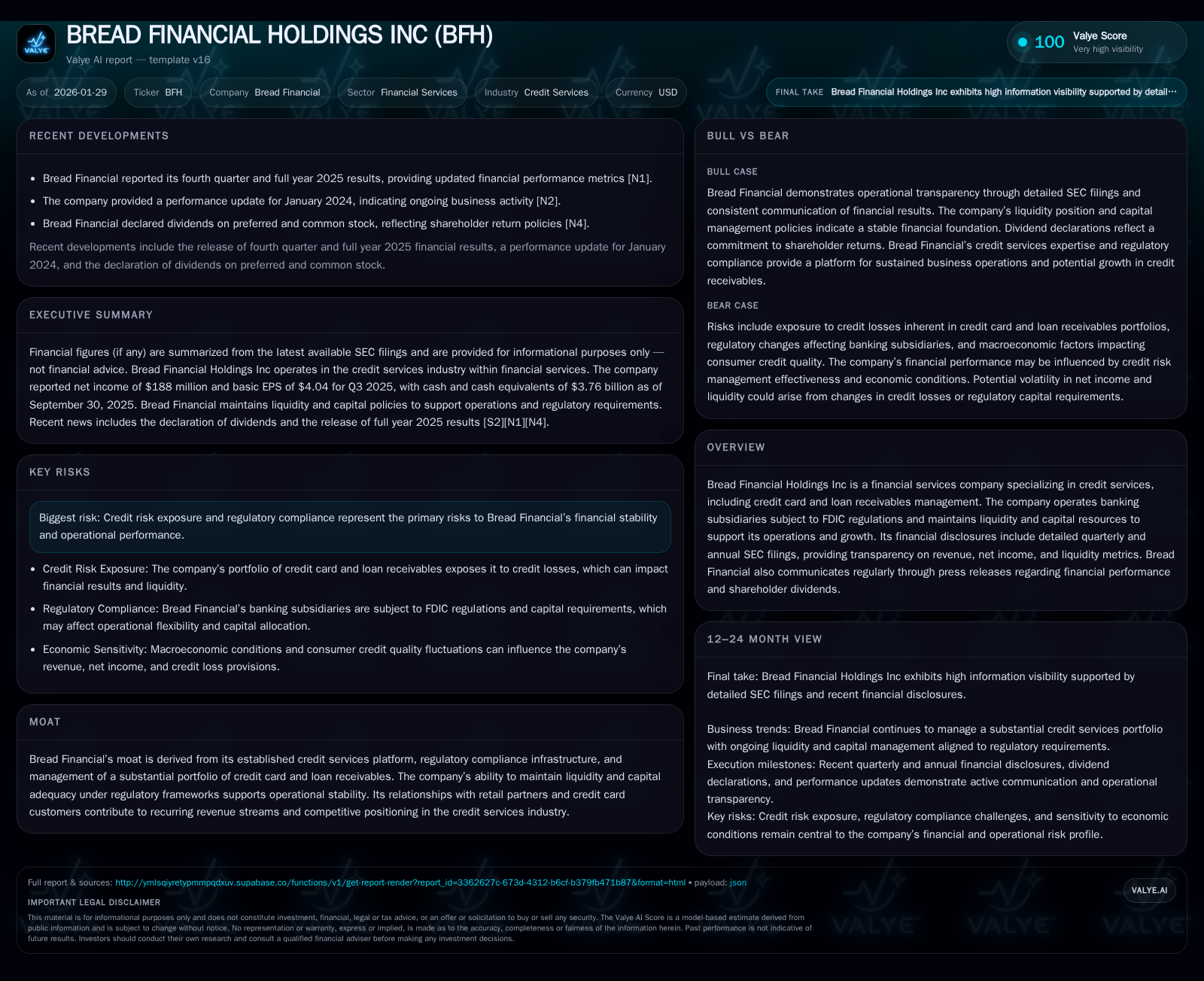
Bread Financial Holdings (BFH) reported solid fourth quarter and full year 2025 results, maintaining dividend payments and liquidity levels. The company’s business model centers on leveraging credit card and loan receivables through its banking subsidiaries, which operate under FDIC supervision, supporting stable recurring revenue streams. However, regulatory changes, especially around credit card fee structures, and credit risk exposure remain key operational challenges. Competitive pressures and economic factors influencing consumer credit behavior will shape BFH’s near-term performance and strategic priorities.
What Changed Recently
Bread Financial Holdings reported its fourth quarter and full year 2025 financial results on January 29, 2026, highlighting continued profitability and dividend declarations on both preferred and common stock [N1, N3]. The company communicated stable net income figures and maintained liquidity, signaling operational stability amid a complex credit environment. Earnings releases confirm ongoing revenue contributions from credit card and loan receivables management, a core component of its business.
No significant changes in capital structure or extraordinary events were disclosed in the recent news window. However, the company continues to face the implications of regulatory changes, notably the Consumer Financial Protection Bureau’s 2024 final rule limiting credit card late fees, which could have a material impact on its fee-related revenue streams [S15].
Business Model as a System
Bread Financial is fundamentally a credit services company operating through FDIC-regulated banking subsidiaries. Its business revolves around originating, managing, and servicing credit card and loan receivables portfolios. The company generates revenue primarily from net interest income on loans outstanding and non-interest income such as interchange fees, net of retailer share arrangements and other servicing fees [S1, S9].
Operating within a regulated banking framework imposes capital adequacy and liquidity requirements, ensuring the company maintains a buffer against credit losses and market volatility. As of the latest reporting period, Bread Financial held roughly $17 billion in financing receivables net of allowance for credit losses, backed by cash and cash equivalents of approximately $3.76 billion, supporting operational needs and growth [S5, S13].
The business model incorporates credit risk assessment, dynamic provisioning for potential loan losses, and ongoing compliance with consumer financial regulations. The company’s ability to manage credit losses effectively while optimizing interest spreads underpins its profitability. Additionally, relationships with retail partners enable Bread Financial to issue co-branded credit cards, generating interchange revenues and enhancing customer acquisition and retention [S1].
Operational expenses include loan servicing costs, regulatory compliance expenditures, and technology investments to maintain platform efficiency. Depreciation, amortization, and other non-interest expenses also form part of the cost base [S10].
Industry Map & Competitive Battlefield
Bread Financial competes in the U.S. credit services industry, which includes traditional banks, specialty finance firms, fintech lenders, and payment networks. The core competitive factors revolve around credit underwriting capability, regulatory compliance, customer acquisition via retail partnerships, and fee structures.
Major competitors include large commercial banks issuing consumer credit cards, fintech companies leveraging technology-driven underwriting and lending platforms, and retail giants offering private-label credit solutions. Bread Financial’s heritage as a platform with regulatory oversight and substantial receivables portfolio provides scale advantages but also introduces compliance rigidity.
The industry is experiencing shifts driven by regulatory scrutiny, changing consumer credit behaviors, and technological disruption. CFPB regulations targeting fee income and transparency are forcing players to recalibrate pricing and product design. Fintech entrants challenge incumbents by offering streamlined loan origination and alternative credit assessments, potentially eroding market share.
Partnerships with retailers remain a critical battleground. Bread Financial’s ability to maintain and expand these relationships affects its access to high-margin cardholders. Competitive differentiation is also sought through digital customer engagement and loyalty programs.
Where the Economics Become Real
Unit economics for Bread Financial hinge on several interrelated variables. Interest income is derived from the outstanding balance on credit card and loan receivables, less provisions for credit losses. Interest spreads depend on prevailing market rates, competitive pricing, and credit quality.
Non-interest income, including interchange revenue after retailer share payments, contributes meaningfully but is vulnerable to regulatory changes, as recent CFPB rules limit late fees and other penalty charges [S9, S15]. This constrains an important margin component and pressures total revenue.
Operational efficiency affects profitability through cost control on servicing, technology maintenance, and compliance activities. Depreciation and amortization expenses reflect ongoing investments in infrastructure [S10].
Liquidity management is critical given the need to fund receivables growth and meet regulatory capital requirements. Bread Financial’s strong cash position and current ratio (~1.5) provide a cushion but also reflect the capital-intensive nature of credit services [S13].
Credit risk remains the most significant bottleneck. Economic downturns, shifts in consumer credit behavior, or adverse portfolio performance can lead to increased loan loss provisions, directly reducing net income. The company’s risk management framework and underwriting standards are thus pivotal to sustaining economic returns.
Diligence Questions / Disconfirming Signals
- How effectively is Bread Financial mitigating the impact of the CFPB’s late fee restrictions on its revenue and overall profitability? Are alternative fee structures or product innovations in development?
- What are the recent trends in credit card and loan receivables performance, especially in terms of charge-offs and delinquencies? How sensitive is the portfolio to macroeconomic shifts?
- How sustainable are the retailer partnerships that underpin a significant share of interchange revenue? Are there any signs of attrition or competitive displacement?
- What investments is the company making in technology and digital capabilities to counter fintech competition and improve customer engagement?
- How are regulatory compliance costs evolving, and what contingencies exist for potential legal or tax liabilities noted in disclosures?
- Is the capital structure flexible enough to support growth initiatives or absorb shocks from credit downturns?
- Are there any emerging risks from changing consumer credit preferences, such as shifts toward buy-now-pay-later or alternative lending platforms, that could erode Bread Financial’s market share?
Conclusion
Bread Financial Holdings exhibits a robust credit services platform anchored in regulated banking subsidiaries managing substantial credit card and loan portfolios. Recent financial disclosures affirm operational stability and liquidity strength. Yet, evolving regulatory frameworks and competitive pressures present challenges requiring strategic adaptation. Monitoring credit portfolio performance, regulatory developments, and partnership dynamics will be critical in assessing the company’s medium-term trajectory.
Disclaimer: This analysis is for informational purposes only and does not constitute investment advice or recommendations. The information herein is based on publicly available data as of the date referenced and may be subject to change.
Disclaimer: This is research-only, informational analysis and not investment advice. It may include AI-generated interpretation and general industry context. Always verify important details using primary sources.

Comments