
Marathon Bancorp's Strategic Reshaping Through Conversion and Capital Moves
Evaluating Marathon Bancorp’s ongoing corporate restructuring, capital strategies, and financial disclosures amid sector-wide evolutionary pressures.
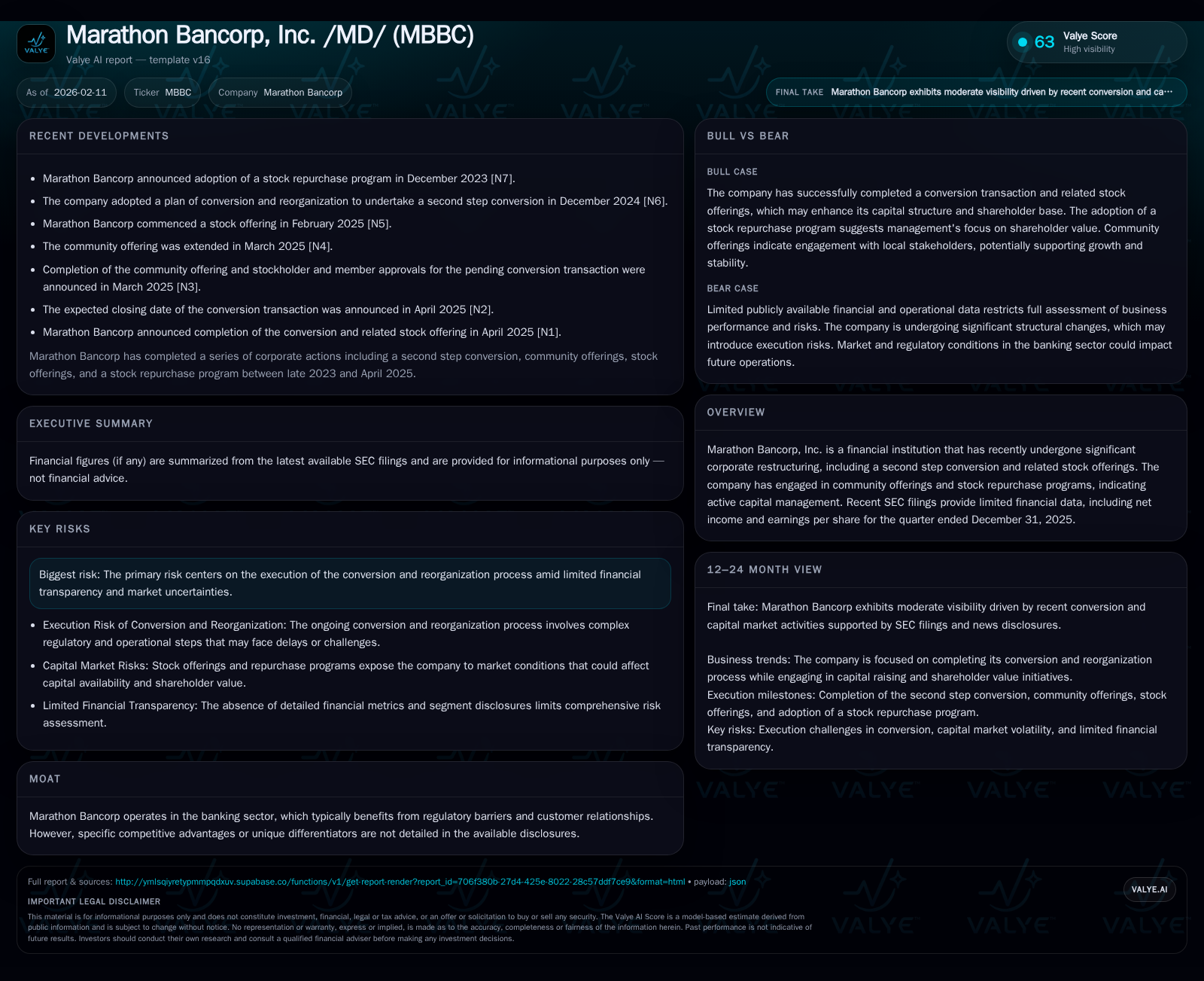
Marathon Bancorp, Inc. has embarked on a complex journey of corporate transformation involving a second step conversion paired with active capital management initiatives like stock offerings and repurchases. While the company’s recent quarterly financials reveal modest profitability, limited transparency around certain operational details frames an ongoing execution narrative. Amid an opaque banking environment defined by incremental shifts, Marathon’s regulatory moats and client ties remain standard industry features without standout advantages, underscoring the nuanced balance between unlocking shareholder value and confronting structural complexity.
The Conversion Journey: A Closer Look at Marathon’s Corporate Restructuring
Marathon Bancorp, Inc.’s recent developments are dominated by its second step conversion — a process that essentially advances the company’s transition from a mutual holding company structure to a fully public stock entity. According to the detailed references in their SEC filings [S1], this involved amending articles of incorporation and bylaws initially set out during their original registration on Form S-1. Such structural recalibration impacts governance rights, stock issuance protocols, and ultimately how shareholders engage with the bank.
This next phase is more than administrative; it suggests a strategic repositioning aimed at enhancing capital flexibility and market presence. While intricate legal documents primarily govern these changes, they signal Marathon’s intent to evolve operationally beyond traditional mutual frameworks into clearer public market accountability.
Capital Management Tactics: Stock Offerings and Repurchases in Focus
Marathon’s capital moves have drawn active attention with multiple stock offerings—some targeted as 'community offerings'—and concurrent share repurchase programs [valye_report_excerpt], [S2]. These maneuvers suggest a balancing act: raising equity capital to support growth or regulatory requirements while managing shareholder dilution.
Community offerings often help deepen local investor engagement and may facilitate broader ownership distribution. Meanwhile, repurchasing shares can be seen as signaling management's confidence in valuation or desire to optimize capital structure metrics.
However, given the limited explicit disclosures or market commentary, the full strategic calculus remains partly opaque. The interplay between funding needs post-conversion and shareholder value considerations embodies a calculated yet cautious capital stewardship approach.
Interpreting Recent Financial Performance: Signals within Limited Data
The latest quarterly filing ending December 31, 2025 [S2], [F1] shows Marathon generating net income of approximately $501,000 for Q2 fiscal 2026. Earnings per share data is less detailed publicly but implies modest profitability underpinning its post-conversion operations.
This result aligns with expectations for a regional bank stabilizing after corporate restructuring phases. Though not indicative of rapid growth spikes, the positive bottom line amidst ongoing transformation stresses an operational foothold.
Yet, significant financial transparency constraints limit in-depth trend analysis or benchmarking against peers. Investors must therefore interpret these signals as part of a broader narrative marked by gradual progress rather than definitive inflection points.
Governance and Leadership under Transition
SEC filings from Marathon include comprehensive governance components such as employment agreements for key executives (e.g., Nicholas W. Zillges), change in control contracts for senior officers, equity incentive plans articulated through several forms of awards, and insider trading policies [S1].
These documents establish a framework designed to ensure continuity and alignment between management interests and shareholder value during this sensitive conversion period. Change in control agreements notably offer protections aimed at reducing disruption risks tied to ownership transitions.
In tandem with revised corporate bylaws reflecting new ownership structures, these governance measures demonstrate thoughtful preparation for leadership stability amid corporate evolution — an essential consideration given the complexities involved.
Risk Factors: Market Uncertainties and Execution Challenges
Marathon’s primary risk landscape centers on successfully executing its second step conversion amidst inherently limited financial disclosure and wider economic uncertainties [valye_report_excerpt].
Conversion processes in banking often carry multifaceted challenges — from regulatory approvals to stakeholder communication difficulties — all compounded by marketplace volatility or shifts in interest rate environments common within mid-2020s banking sectors.
Moreover, sparse transparency constrains external assessment capabilities, adding layers of execution risk that stakeholders must carefully weigh. This risk profile underscores why detailed monitoring is warranted during such transformation timelines.
Marathon's Moat and Market Position: Contextualizing Competitive Strengths
Operating within banking secures some defensive advantages generally attributed to regulatory barriers protecting community banks from unfettered competition. Marathon benefits broadly from customer relationship durability typical in regional finance institutions [valye_report_excerpt].
However, unlike banks emphasizing technological innovation or niche market dominance, Marathon does not presently highlight uniquely differentiated product suites or exceptional scale economies in disclosures reviewed here.
Hence, while possessing standard moats against entrants based on compliance thresholds and localized trust networks, its competitive strength appears conventional rather than extraordinary — particularly relevant when assessing longer-term sustainability amid evolving banking trends.
Unlocking Value or Navigating Complexity? Investor Implications
The tapestry woven by Marathon Bancorp reveals both opportunity threads - driven by strategic restructuring and active capital management - as well as complexity strands linked to limited data visibility and fragmented narrative clarity.
From an analytical stance focused on buy-side approaches (without prescriptive recommendations), this duality requires balancing indications of foundational profitability with cautious acknowledgment of risks inherent to conversion execution uncertainty.
Potential upside emerges if the bank successfully leverages newfound capital flexibility post-conversion while maintaining operational discipline reflected modestly in recent earnings data. Conversely, residual opacity may keep valuation premium constrained until more consistent disclosure advances investor confidence.
Continued scrutiny of subsequent filings alongside evolving sector dynamics will be vital to contextualizing whether Marathon’s transformation journey translates into substantial shareholder value creation or primarily signals intricate navigational challenges for stakeholders.
This analysis is based on public filings as of February 11, 2026. It aims to provide an informative perspective on Marathon Bancorp’s current status without offering investment advice.
Disclaimer: This is research-only, informational analysis and not investment advice. It may include AI-generated interpretation and general industry context. Always verify important details using primary sources.

Comments