
Bristol Myers Squibb’s Strategic Evolution: Innovation, Acquisitions, and Operational Efficiency Amid Legacy Pressures
An in-depth analysis of BMY’s transformative growth tactics counterbalancing legacy portfolio challenges in the competitive pharmaceutical landscape.
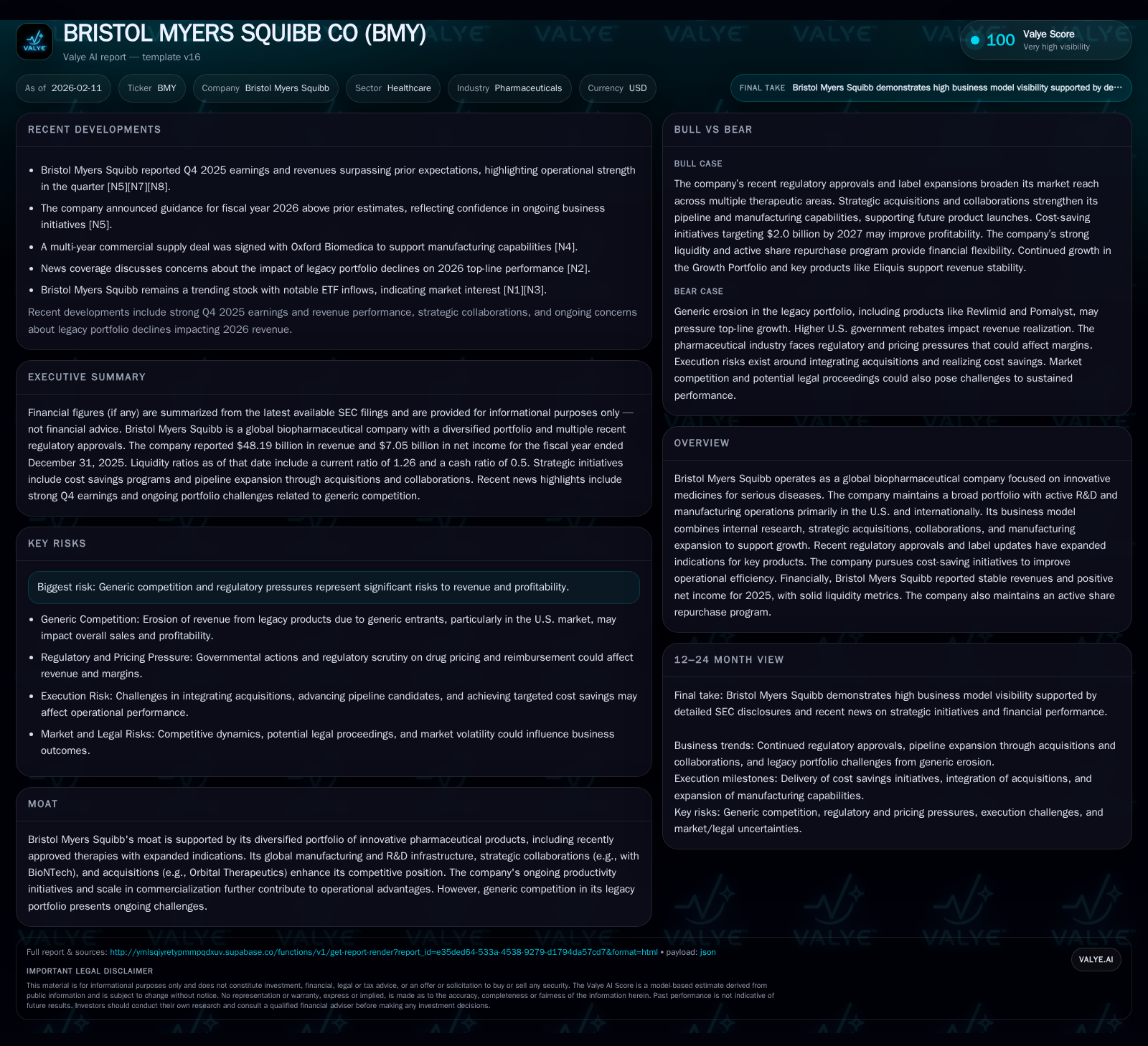
Bristol Myers Squibb (BMY) showcased resilience and strategic agility through innovation-led revenue growth, key acquisitions, and operational discipline in its 2025 performance. While gross revenues remained stable at $48.2 billion, positive earnings buoyed by new regulatory approvals spotlight the company's evolving pharmaceutical portfolio. Strategic collaborations with entities like BioNTech and the acquisition of Orbital Therapeutics reinforce pipeline strength against intensifying generic competition. Operational efficiency programs and a robust global manufacturing footprint underpin BMY's scalability, though legacy product erosion remains an imminent headwind. The leadership team’s focused execution and active capital return via share buybacks sustain market confidence amid regulatory and competitive risks.
From R&D to Revenues: Charting BMY’s Innovation-Driven Growth
Bristol Myers Squibb’s financial results for 2025 underscore a company firmly anchored in innovation at its core. Reporting revenues of $48.2 billion, nearly flat relative to prior year yet exceeding estimates, BMY benefitted from incremental gains tied to recent regulatory approvals broadening indications for flagship medicines [S1][F1][N2][N6]. These expanded labels not only prolong product lifecycles but also augment patient accessibility across diverse geographies.
The company’s R&D intensity is apparent in the breadth of its biopharmaceutical portfolio — spanning oncology, immunology, cardiovascular disease, and fibrosis indications — which collectively forms the backbone of year-over-year revenue resilience. This deliberate pivot away from commoditized legacy compounds towards differentiated therapeutic agents reflects a strategic endeavor to future-proof revenue streams against inevitable patent expirations.
Acquisitions and Collaborations: Strengthening the Pipeline and Market Presence
2025 saw Bristol Myers Squibb deepen its moat through select but impactful acquisitions such as Orbital Therapeutics and collaboration agreements exemplified by the global strategic partnership with BioNTech [S1][N9][N7]. These moves are more than mere portfolio fillers; they strategically address emerging modalities like cell therapies and RNA-based treatments where innovation cycles promise outsized returns versus traditional small molecules.
Such alliances also offer synergistic benefits ranging from shared technological platforms to expanded commercial reach — imperative in a landscape increasingly dominated by nimble biotech entrants with focused pipelines. The multi-year supply deal with Oxford Biomedica further illustrates BMY’s commitment to securing scalable manufacturing access for cutting-edge gene therapies [N9].
Manufacturing Muscle and Global Footprint: Operational Foundations for Scale
Integral to BMY’s commercial and clinical ambitions is its extensive manufacturing infrastructure spread across multiple locations including the U.S., Puerto Rico, Netherlands, Ireland, and Switzerland [S1]. The presence of eight manufacturing sites globally enables robust supply chain resiliency crucial for meeting escalating demand from both internal pipelines and partnered products.
This geographically diversified footprint underpins operational flexibility — mitigating risks associated with geopolitical uncertainties or localized disruptions — while supporting cost efficiencies through economies of scale. The alignment of manufacturing capabilities with expansive R&D centers ensures rapid translation from innovation to production.
Financial Health Check: Robust Liquidity Versus Cost and Competition Pressures
From a balance sheet perspective, Bristol Myers Squibb sustains considerable liquidity with over $10 billion in cash equivalents as of year-end 2025 [F1], providing ample runway to fund ongoing research investments and strategic business development initiatives. Its current ratio at 1.26 suggests healthy short-term financial stability despite sizeable current liabilities.
Yet beneath this solidity lies mounting pressure as generic competition exerts downward force on revenues derived from mature portfolio assets. Net income of $7.05 billion reflects strong operational profitability; however, margin preservation depends heavily on offsetting these losses with growth drivers emanating from novel assets [F1][S1][N11].
Cost Efficiency Initiatives: Navigating Increased Operational Demands
Recognizing the financial headwinds intrinsic to an evolving pharmaceutical ecosystem, BMY has launched comprehensive cost-saving initiatives targeting enhanced productivity across manufacturing operations and corporate functions [valye_report_excerpt]. These measures aim not only at trimming expenses but also streamlining workflows—fundamental given the rising complexity attendant to biologics manufacturing.
Sustaining profitability amid competitive pricing pressures necessitates disciplined management of overheads alongside prudent investment prioritization — an approach consistently articulated in recent management discussions.
Legacy Portfolio Headwinds and Their Strategic Mitigations
A notable drag on near-term growth persists via declines linked to aging blockbuster drugs subjected to generic entry [N11][valye_report_excerpt]. This attrition manifests as both top-line contraction risks and compressed margins due to intensified price competition.
To blunt this impact, Bristol Myers Squibb accelerates commercialization efforts around newly approved therapies while exploring label expansions that can extend exclusivity periods [S1][N6]. In tandem, broadening geographic penetration into emerging markets offers additional levers to counterbalance volume loss domestically.
Risk Terrain: Regulatory, Generic Competition, and Market Dynamics
The complex regulatory environment adds layers of uncertainty—ranging from approval delays, post-market surveillance obligations, to pricing scrutiny [S1][S2]. Foreign exchange volatility also figures prominently; substantial exposure primarily in euro and yen requires sophisticated hedging using forward contracts and swaps that materially reduce earnings variability risks.
Interest rate adjustments have minimal anticipated impact on financial instruments per sensitivity analyses documented [S1], reflecting prudent debt management policies. Credit risk exposure remains tightly controlled through diversification mandates applied across investment counterparties.
Leadership Insight: Guiding the Next Phase at BMY
At the helm is Dr. Christopher Boerner, Chair and CEO since 2024, whose ascension through commercial leadership roles underscores his adeptness in scaling operations internationally and integrating complex therapeutic portfolios [S1]. Alongside CFO David V. Elkins’ seasoned financial stewardship — including prior leadership at Johnson & Johnson and Celgene — management demonstrates depth needed for navigating pharma’s multifaceted challenges.
Legal matters remain contained without material disruption according to recent disclosures, further attesting to effective governance frameworks [S1].
Market Sentiment and Shareholder Returns: Earnings Impact and Buybacks
Following its Q4 earnings beat announcement in early February 2026, BMY shares surged approximately 7.6% reflecting investor optimism buoyed by solid fundamental performance [N1]. Concurrently active share repurchase programs totaling several billion dollars have been deployed strategically over recent years to return capital while signaling management confidence [F1][S2].
Such market responses align with broader ETF inflows into defensive healthcare sectors amidst macroeconomic uncertainties witnessed at year-end 2025 [N12].
Looking Ahead: What 2026’s Early Signals Suggest for Investors
Early momentum into 2026 suggests Bristol Myers Squibb will maintain its emphasis on advancing clinical pipelines alongside managing legacy product transitions carefully [N10][N11]. Continued investment in cell therapy platforms aligns with industry-wide shifts toward personalized medicine paradigms.
However, vigilance remains warranted around external factors such as regulatory reform debates or intensified generic encroachments that could constrain near-term pricing power. Ultimately, BMY’s composite strategy balancing scientific innovation with commercial rigor positions it well amidst pharma’s evolutionary cycle.
Disclaimer: This report is for informational purposes only reflecting an analytical perspective based on publicly available data up to February 11, 2026. It does not constitute investment advice or recommendations concerning Bristol Myers Squibb or any securities mentioned herein.
Disclaimer: This is research-only, informational analysis and not investment advice. It may include AI-generated interpretation and general industry context. Always verify important details using primary sources.

Comments