
Mastercard Accelerates Growth Through AI-Driven Payments and Strengthened Security Amid Regulatory Challenges
Mastercard leverages its vast payments network and AI innovations such as agentic commerce to expand its digital payment solutions while addressing increasing cybersecurity and regulatory risks.
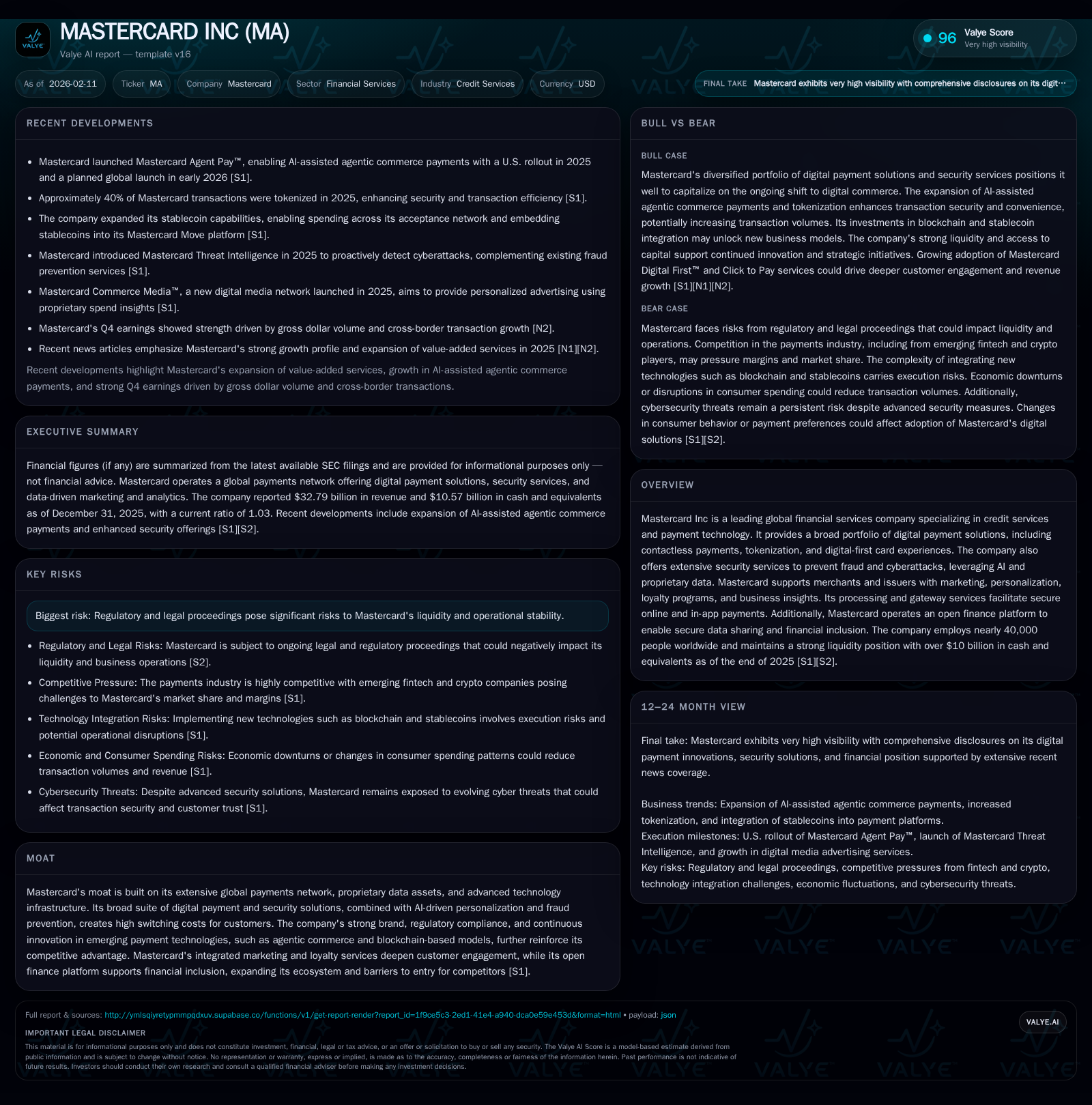
Mastercard continues to solidify its leadership in the global payments industry by advancing digital-first payment experiences, including contactless and tokenized transactions, supported by a strong security framework enhanced by AI. The company's pioneering agentic commerce initiative, launched in 2025, positions it at the forefront of scalable AI-powered payment automation. While maintaining robust financial health with over $10 billion in cash reserves, Mastercard navigates evolving regulatory and cybersecurity threats that could impact operations. Its competitive moat remains reinforced by proprietary data, brand strength, and integrated ecosystem services that collectively sustain high switching costs for customers.
Mastercard's Expanding Digital Payments Frontier
Mastercard has continuously evolved its product portfolio to meet shifting consumer expectations in an increasingly digital environment. Central to this evolution is its commitment to enabling seamless payment experiences through innovations like tokenization and contactless payments. Approximately 40% of Mastercard transactions are now tokenized—a critical security enhancement that replaces sensitive card numbers with secure tokens during transactions [S1]. This not only fortifies transaction safety but also streamlines user experience across online, in-store, and mobile touchpoints.
Further strengthening digital adoption is Mastercard's Digital First™ program. This initiative empowers issuing banks to offer cardholders fully digital payment solutions that span card application, instant access, authentication (including biometric options), and transaction management [S1]. Alongside Digital First™, the Click to Pay checkout feature enhances speed and security for online purchases while giving merchants a straightforward implementation path backed by improved fraud prevention.
Recent earnings underscored these solutions as core growth drivers; robust gross dollar volume (GDV) gains were propelled in part by cross-border transaction upticks contributing to fourth quarter earnings beats [N5]. These advancements reflect Mastercard's strategy to stay ahead of diverse payment trends by delivering inclusive digital experiences at scale.
Agentic Commerce: The Future of Automated Payment Experiences
Pioneering new frontiers in payment technology, Mastercard launched its Agentic Pay™ framework in 2025. This AI-empowered solution enables secure, scalable payments conducted through autonomous agents within Mastercard’s acceptance network [S1]. Unlike conventional manual or semi-automated processes common among competitors such as PayPal expanding agentic commerce offerings [N8], Mastercard’s approach integrates existing tokenization and dispute management capabilities, allowing merchants easy participation without heavy integration burdens.
The U.S. rollout now permits all Mastercard cardholders to leverage this agent-based payment service with a planned global launch slated for early 2026. As agentic commerce matures from niche curiosity into a growth vector for transaction automation, Mastercard’s early investments position it advantageously to capture new revenue streams while simplifying complex buyer-seller engagement scenarios.
Security as a Strategic Differentiator in the AI Era
Security remains a cornerstone of Mastercard’s value proposition amid an escalating threat landscape exacerbated by AI-enhanced criminal tactics [S1]. Fraudulent activity and cyberattacks have surged industry-wide as attackers exploit advanced technology to harvest consumer personal information or fabricate counterfeit credentials.
Mastercard addresses these challenges through a multilayered defense architecture. Tokenization continues replacing vulnerable card data during transactions; biometric authentication options such as fingerprints or facial recognition via Mastercard Payment Passkey Service advance identity security; fraud detection systems leverage proprietary data combined with AI analytics to flag suspicious activity swiftly [S1].
Yet risk disclosures highlight that despite rigorous safeguards there can be no certainty against material breaches. Potential service interruptions resulting from cyberattacks or external disruptions could erode confidence in Mastercard-branded products while increasing compliance burdens—a persistent operational risk requiring sustained capital allocation [S1]. Thus investments in enhancing controls remain both protective moat elements and necessary cost centers.
Financial Health and Capital Deployment Priorities
Financially, Mastercard exhibits robust liquidity with over $10.5 billion in cash and equivalents as of year-end 2025 [F1]. Operating cash flow showed significant growth—$12.6 billion generated over nine months ended September 2025 compared with $9.9 billion prior year—reflecting stronger net income performance after non-cash adjustments [S2]. This healthy cash generation underpins flexible capital deployment capabilities.
The company maintains a disciplined debt profile with $19 billion total debt outstanding at September 2025 including recent issuances of fixed-rate notes maturing between 2028 and 2032 [S2]. Committed revolving credit facilities totaling $8 billion reinforce liquidity reserves supporting general corporate needs including contingency settlements.
On returning capital to shareholders, Mastercard balances share repurchases—marked by increased buybacks in 2025—with consistent dividend distributions [N9][S2], underscoring financial stewardship amid funding ongoing innovation investments.
Navigating Regulatory Landscape and Legal Risks
Mastercard faces heightened regulatory controls spanning data privacy laws, evolving rules governing AI deployment in financial services, third-party vendor oversight requirements, and broader legislative actions related to payment networks [S1][S2]. Risk factors disclosed emphasize that legal proceedings or adverse regulatory findings could impose liquidity strains or operational restrictions adversely impacting growth initiatives.
Additionally, the inherent systemic importance of Mastercard's switching systems subjects it to scrutiny regarding resilience against disruptions caused by network failures or cybersecurity breaches [S1]. As regulators intensify focus on safeguarding consumer protection while fostering innovation balance remains challenging.
This dynamic compels continuous monitoring of compliance frameworks coupled with proactive dialogue engaging policymakers—vital for sustaining Mastercard’s license-to-operate globally amidst fast-changing regulatory regimes.
Competitive Moat Reinforced by Data and Brand Strength
At the core of Mastercard’s enduring competitive advantage lies its expansive global payments network interconnected with proprietary insights derived from massive transaction datasets [S1]. These network effects generate considerable switching costs as issuers and merchants rely on Mastercard’s integrated services spanning digital payments, fraud prevention, loyalty programs, personalization powered by AI.
The brand equity cultivated over decades further fortifies customer trust signals essential within an industry hinging on credibility amid security concerns. Unlike emerging fintech challengers facing scale constraints or trust gaps, Mastercard enjoys entrenched relationships entrenched through multi-layered solutions offering value beyond basic transaction processing.
Together these factors create formidable barriers limiting effective encroachments on market share even as competitors innovate aggressively within segments like peer-to-peer payments or cryptocurrency integrations.
Ecosystem Synergies: From Consumer Convenience to Merchant Enablement
Beyond primary payment functions, Mastercard’s portfolio fosters rich ecosystem synergies supporting both ends of the transaction chain. Marketing services help issuers drive customer acquisition while personalization tools enable bespoke loyalty programs that lock-in consumer engagement [S1].
Merchant enablement technologies such as SmartPOS / SoftPOS solutions lower barriers for small businesses accepting contactless payments directly through smartphones without expensive hardware investments—a compelling offering expanding acceptor footprints rapidly across geographies [S1].
Moreover, the open finance platform promotes secure financial data sharing boosting inclusion initiatives—bridging underserved populations with mainstream financial access [S1]. This multistakeholder approach creates virtuous cycles where enhanced consumer convenience fuels merchant benefit realization further embedding Mastercard into daily commerce fabric.
The Stablecoin Question: Innovation Meets Skepticism
Mastercard has taken stepwise measures incorporating stablecoin functionality into its network infrastructure, facilitating roughly 130 crypto co-brand card programs enabling spending of crypto assets seamlessly across its acceptance points [S1]. The Mastercard Move platform extends these capabilities allowing customers easy sending/receiving of stablecoins integrated within digital wallets.
However, public statements from senior executives reveal a measured skepticism regarding stablecoin utility long term—a perspective shared broadly across some traditional payment players cautious about volatility risks or regulatory clarity impeding mainstream acceptance [N14].
This delicate posture marks an attempt to balance enabling innovative fintech trends without prematurely embracing nascent asset classes still grappling with structural challenges—reflecting prudent risk management aligned with business realities.
Investor Sentiment and Market Reception to 2025 Results
Mastercard’s latest quarterly earnings release reporting robust gross dollar volume growth alongside cross-border transaction strength was well received by markets validating investor confidence in its structural growth narrative [N5][N6][N10]. Analysts highlighted value-added services expansion contributing positively alongside resilient core volumes fueling optimism on near-term revenue trajectories [N11].
Nonetheless short-term share price movements exhibited volatility influenced partly by ETF outflows impacting broader large-cap financial stocks as well as macro-level investor caution spurred by ongoing regulatory developments flagged recently by authorities [N12][N13].
In sum market reaction embodies recognition of solid fundamentals tempered prudently with sensitivity to external headwinds common within the global payments landscape today.
This analysis synthesizes publicly available information up to early 2026 without offering investment advice or price projections. Readers should consider the dynamic nature of regulatory environments and emerging technologies which may alter the competitive landscape beyond documented disclosures.
Disclaimer: This is research-only, informational analysis and not investment advice. It may include AI-generated interpretation and general industry context. Always verify important details using primary sources.

Comments